•
•
•
•
•
•
•
•
•
•
•
•
•
•
•
•
•
•
•
•
•
•
•
•
•
•
•
•
•
•
•
•
•
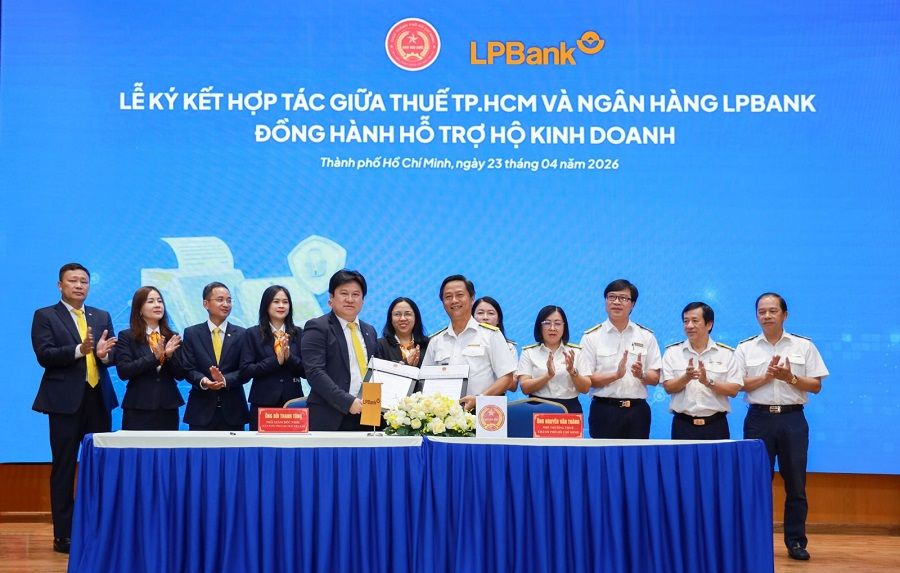
LPBank has signed a cooperation agreement with the Ho Chi Minh City Tax Department to support micro businesses (HKD) and individual business owners in promoting digital transformation, particularly as they transition from the flat tax regime to declared taxation.
To accompany HKD and individual business owners during this shift, LPBank collaborated with tax authorities and local agencies nationwide to organize a series of conferences titled “Transforming the model and methods of tax and cash flow management for micro businesses when eliminating the flat tax,” gradually bringing practical solutions into day-to-day business operations.
Following these activities, LPBank officially signed a Memorandum of Understanding with the Ho Chi Minh City Tax Department. The agreement aims to help HKD and individual business owners move from the flat tax method to declaration, accelerating large-scale transformation.
Under the terms of the cooperation, both sides will strengthen communication on new tax policies and support HKD and individual business owners to declare and pay taxes on a digital platform, while promoting cashless payments.
The initiative is designed to help taxpayers reduce compliance costs, simplify the declaration process, and gradually shift toward a more transparent and structured governance model.
At the event, Mr. Nguyen Van Thanh, Deputy Head of Ho Chi Minh City Tax Department, said that working with LPBank will bring tax policies closer to taxpayers through digital platforms, ensuring clear and timely guidance that aligns with real business activities.
As part of the collaboration, LPBank will roll out financial packages linked directly to the operations of HKD and individual business owners. Instead of standalone products, these utilities are intended to be integrated into a single system for transactions, revenue management, and tax obligations.
The bank said the tools are connected directly to the tax system, enabling transaction data, revenue, and tax obligations to be synchronized in real time.
Through a business account at LPBank, customers can connect to the eTax Mobile platform to declare and pay taxes quickly. The solution also includes QR payments, LPBank balance-notification announcements, and a sales management application to monitor cash flow in real time—reducing reliance on cash and minimizing errors from manual record-keeping.
LPBank also applies preferential policies on fees and interest rates to ease transition costs. It will provide production and business loan packages with simplified procedures to help customers reinforce resources, and includes the Sinh lời Lộc Phát product to optimize idle cash with a high rate of return.
In a statement, an LPBank representative said: “The banking industry is entering a new cycle of competition, where data, experience, and personalization capabilities become core. With a customer-centric approach, LPBank shifts from supplying products to designing integrated financial solutions tied to cash flow and customers’ financial obligations, accompanying HKD and individual businesses through the transformation. We hope to contribute to transparent financial operations in line with the Party and State's guidelines. LPBank not only provides capital but also supports customers to manage, optimize and grow sustainably in the digital era.”
LPBank said signing with the Ho Chi Minh City Tax Department is an important step toward its goal of becoming a leading bank that supports private sector development and aligns with the tax administration’s digital transformation roadmap.
In a context where millions of HKD and individual business owners are required to improve management and financial transparency, the participation of financial institutions like LPBank is expected to shorten the adaptation process and provide a foundation for the private sector to develop professionally and sustainably.

Premium gym chains are entering a “golden era” that is ending or already in decline, as rising operating costs collide with shifting consumer preferences toward more flexible, community-based ways to exercise. Long-term memberships are shrinking, margins are pressured by higher rents and facility expenses, and competition from smaller, more personalized…