•
•
•
•
•
•
•
•
•
•
•
•
•
•
•
•
•
•
•
•
•
•
•
•
•
•
•
•
•
•
•
•
•


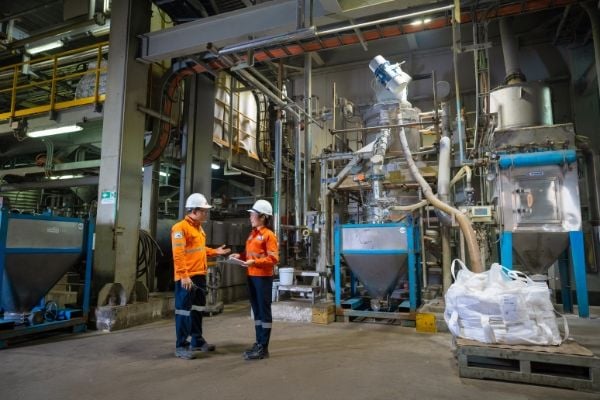
After more than ten years and USD 700 million invested, Masan High-Tech Materials (MSR) is looking to expand Nui Phao’s refining role beyond processing ore from its own tungsten mine in Thai Nguyen. The company aims to turn the site into a hub for refining ore sourced from outside as demand for materials used in chips and AI accelerates.
At Masan High-Tech Materials’ 2026 annual general meeting on April 16, Deputy CEO Phan Chiến Thắng presented a lump of ore mined directly from Nui Phao to illustrate the company’s mining technology. He said MSR must strip millions of tonnes of earth to obtain ore, but the value comes from the roughly 20% retained after beneficiation, before deep processing separates four minerals: copper, fluorite, bismuth and tungsten.
Tungsten is positioned as a key input for chips, high-power electronic devices and AI-serving servers and data centers. According to the 2025 annual report, over the past five years MSR has held about 21% of tungsten supply outside China.
Deputy CEO Phan Chiến Thắng said MSR’s advantage is a closed-loop chain from mining to refining, enabling tungsten output with 99% purity. Over the past decade, the company has invested more than USD 700 million to build and operate this system.
Thắng said the Nui Phao mine has operated continuously for ten years, with no interruptions. MSR mines about 3.5 million tonnes of ore annually, while the processing plant runs 24/7, stopping only for maintenance.
In Q1 2026, profits exceeded those of 2025, supported by a sharp rise in APT prices. In 2025, Masan High-Tech Materials reported revenue of VND 7,443 billion (USD 278 million), up 19% on a like-for-like basis.
In Q1 2026, the APT price surpassed USD 3,100 per mtu. This helped net revenue reach about VND 2,993 billion (USD 112 million) and net profit about VND 537 billion (USD 20 million), higher than the 2025 profit.
For 2026, the company targets revenue of VND 16,000–20,300 billion and net profit of VND 1,700–2,500 billion, and also plans to list on HOSE.
Leadership said current tungsten refining capacity is over 9,000 tonnes per year. After more than a decade, Nui Phao can process not only internal ore but also receive raw materials from other regions.
At the AGM, shareholders asked about license durations and reserves at Nui Phao. Leadership said Nui Phao is located in a broad mineral planning zone set by the government, covering the company’s existing mining area and allowing continued mining for decades. The company also cited new sustainable mining policies and amendments to the Minerals and Geology Law as a basis for exploration and expansion in neighboring areas.
According to leadership, the “four-metal recovery model” allocates costs to products produced earlier in the process, supporting tungsten margins improving to above 25%. A longer mine life is also expected to reduce mining costs as stripping decreases and ore recovery increases.
In the long term, MSR expects average tungsten production for 2026–2036 to reach about 8,000 tonnes per year, with half from Nui Phao and the remainder from external ore under off-take contracts. The mix of domestic ore and external sources is intended to increase tungsten output using refining infrastructure built over more than a decade at Nui Phao.
“Thanks to the four-metal recovery model, costs are allocated to products produced earlier, helping tungsten margins improve to above 25%. At the same time, a longer mine life reduces mining costs as stripping decreases and ore recovery increases.” — Phan Chiến Thắng, Deputy CEO of Masan High-Tech Materials.





Premium gym chains are entering a “golden era” that is ending or already in decline, as rising operating costs collide with shifting consumer preferences toward more flexible, community-based ways to exercise. Long-term memberships are shrinking, margins are pressured by higher rents and facility expenses, and competition from smaller, more personalized…