•
•
•
•
•
•
•
•
•
•
•
•
•
•
•
•
•
•
•
•
•
•
•
•
•
•
•
•
•
•
•
•
•
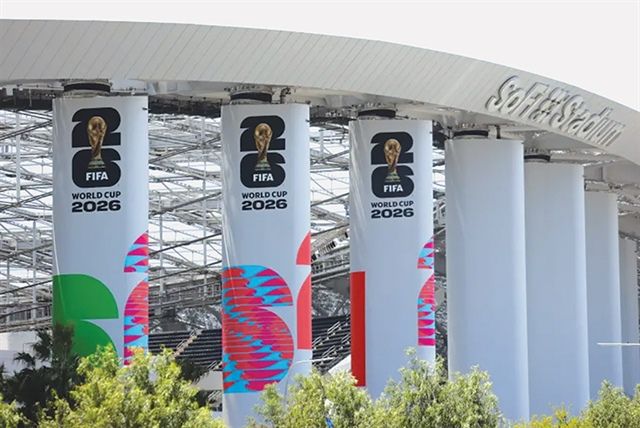
World Cup 2026 is expected to be both the biggest football tournament in history and a major economic test, with tens of billions of dollars in revenue and millions of visitors. A central question, however, is who benefits most from the event’s new scale and business model.
World Cup 2026 will be hosted across three countries—the United States, Canada and Mexico—for the first time. The number of teams will rise from 32 to 48, matches from 64 to 104, and direct attendance is expected to exceed 6 million.
Joint research by FIFA and the World Trade Organization (WTO) estimates the tournament could add about $40.9 billion to global GDP and about $17.2 billion to the U.S. economy. The event is therefore positioned not only as the world’s largest sporting tournament but also as one of the largest commercial events.
What differentiates this edition is less the scale than the economic model. Instead of relying heavily on new stadium and infrastructure projects, World Cup 2026 is expected to use existing facilities, particularly NFL stadiums. Deutsche Bank argues that this approach reduces the risk of “white elephant” stadiums seen after some past World Cups by shifting the focus toward extracting commercial value from assets that already exist.
With construction costs reduced, the tournament’s cash flows are expected to tilt more toward revenue streams such as tickets, sponsorship, broadcasting rights and premium services.
Many experts point to FIFA as the clearest beneficiary, arguing the organization is turning the World Cup into an even more efficient commercial engine. Industry estimates for FIFA’s revenue in the 2023–2026 commercial cycle range from $11 billion to $13 billion, compared with roughly $7.5 billion in the 2022 cycle in Qatar.
The increase is linked to having more than 60% more matches, creating additional opportunities to sell advertising, sponsorships, tickets and merchandise.
Richard Sheehan of Notre Dame University estimates that revenue from tickets and premium customer services for World Cup 2026 could exceed $7 billion—many times higher than the previous edition. He projects average revenue per match could rise from about $15 million in the 2022 Qatar tournament to over $70 million.
One driver is dynamic pricing, where ticket prices adjust to market demand rather than being fixed. FIFA President Gianni Infantino has argued that football needs to adopt market pricing in an entertainment industry that is increasingly competitive.
FIFA also controls more revenue nodes than in previous World Cups. Beyond selling tickets directly, it includes the secondary-ticket market in its official ecosystem and charges fees from both sellers and buyers, which is designed to help FIFA retain value that previously went to scalpers.
Tourism is expected to benefit most directly from the World Cup, though not uniformly across all host-city businesses. The U.S. Travel Association projects that international visitors to the U.S. will spend on average over $5,000 per person during the tournament. SoFi forecasts that each host city could generate an additional $160 million to $620 million in economic activity.
Sojern data shows air-ticket bookings to Houston and Dallas rose sharply year-on-year. Marriott International CEO Tony Capuano said hotel demand in host cities is tracking with company expectations and suggested the World Cup could lift Marriott’s revenue per available room (RevPAR) by about 0.4 percentage points in the U.S.
Restaurant chains, sports bars, delivery platforms and ridesharing services are expected to benefit from fan concentrations in host cities. Still, the positive impact is not expected to be even.
The American Hotel and Lodging Association (AHLA) estimates that about 80% of host-city hotels reported bookings below expectations before the event. Businesses cited higher travel costs and weaker-than-forecast international demand as factors affecting footfall.
Hospitality firms expect room demand to surge as the tournament reaches the knockout rounds, reflecting a pattern where some benefits may arrive later rather than evenly over the full schedule.
While FIFA is expected to capture most revenue, host cities face a different balance of costs and returns. Local authorities are expected to shoulder expenses related to security, traffic, crowd management and public services, while FIFA earns most revenue from tickets, sponsorship and broadcasting rights.
New Jersey, the site of the final, is cited as an example. Plans show the state will spend about $48 million on NJ Transit for crowd management around MetLife Stadium. Total World Cup-related costs in the state are about $120 million, including infrastructure, transport and security.
Danielle Zanzalari, an economics associate professor at Seton Hall University, said New Jersey’s investments are unlikely to yield net gains for taxpayers, noting that fan enjoyment does not necessarily translate into recouping public budgets.
Several studies suggest World Cup effects are typically short-term. Goldman Sachs estimates the tournament may generate a temporary growth spur in the year of the event, while Barclays estimates the World Cup can lift U.S. GDP by at most about 0.2% in the summer of that year.
One reason is the “substitution effect,” where higher prices and crowds discourage some ordinary and business travelers from visiting host cities. In that case, fan spending may offset or partially replace pre-existing tourism spending rather than add fully to it.
Beyond record revenues, World Cup 2026 is also described as reflecting a broader economic trend. The BBC characterizes it as a “K-shaped economy,” where higher-income consumers continue to increase spending while others face greater difficulty accessing premium products and services.
Rising ticket prices may make it harder for traditional fans to follow the tournament directly, while premium service packages become central to FIFA’s revenue-maximizing strategy. The article also notes that access to the tournament can vary sharply by income: the cost of attending the final is described as a small fraction of income in developed countries, but can be equivalent to several years’ income in poorer countries.
If the U.S. model proves successful, the article says global leagues and clubs could adopt similar strategies to maximize revenue. It also argues that the tournament’s economic transformation could have long-term implications for how sports events are priced, distributed and commercialized.
While World Cup 2026 is expected to set new revenue records for FIFA and the global sports industry, the article concludes that the most important legacy may be how cash is allocated among participants: FIFA is positioned to hold most of the commercial value, consumer-service beneficiaries may gain from short-term spending, and host cities must balance investment costs against economic benefits.
In that framework, the key question is not only how much money is generated, but who retains the majority of the cash.
Bitcoin (BTC) investors who use steady dollar-cost averaging (DCA) may be underperforming versus strategies that adjust exposure to the market’s cycle, according to new research arguing that Bitcoin’s behavior differs from traditional long-duration assets.
In a report cited by Markus Thielen of 10x Research, Bitcoin’s market…