•
•
•
•
•
•
•
•
•
•
•
•
•
•
•
•
•
•
•
•
•
•
•
•
•
•
•
•
•
•
•
•
•


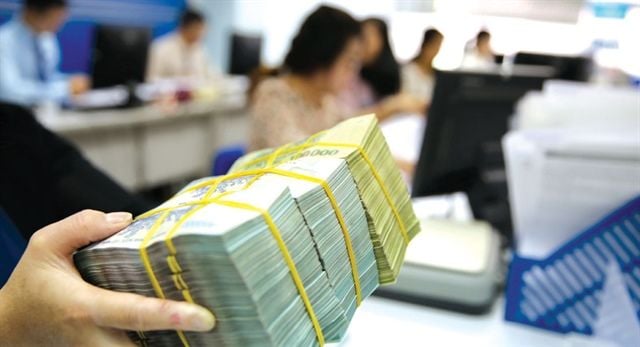
Reducing interest rates is not only a question of whether banks agree to lower published rates; it is also shaped by the internal liquidity structure of the banking system. When credit expands faster than deposits, liquidity pressure spreads from the primary funding market to the interbank market and then to the Open Market Operations (OMO) channel, making rate cuts a more complex and uneven process across banks.
By the end of Q1-2026, credit across the system rose 3.18%, while deposits increased only about 0.55%, leaving credit growth running at nearly six times the pace of deposit growth. This imbalance has required the State Bank of Vietnam (SBV) to repeatedly inject liquidity through OMO.
The current liquidity pressure is not new. It reflects a prolonged period in which credit grew faster than deposits. SBV data released at the end of 2025 showed total deposits rising by more than 14%, while credit growth had already surpassed 19% at that time.
The gap has persisted from 2023 to the present. In 2026, institutions are expecting credit growth of 18.1%, higher than projected deposit growth of 16.3%, indicating the problem is likely to remain rather than fade as a short-term fluctuation.
When market 1 does not supply enough funds, pressure shifts to market 2—the interbank market—where banks borrow from each other to cover shortfalls for settlement, reserve requirements, and end-of-day balancing. Interbank rates are often treated as a gauge of system liquidity.
When a group of banks faces funding shortages, demand for interbank borrowing rises and overnight, one-week, and two-week rates increase. A clear example occurred at the end of March 2026, when the overnight rate briefly surged to 12%. SBV then continued to inject net liquidity via OMO to support system liquidity.
However, the interbank market mainly addresses short-term liquidity needs and cannot provide the longer-term funding required to sustain credit growth. If a bank must repeatedly borrow on the interbank market to cover deposit shortfalls, its cost of funds can become volatile and harder to manage.
In a scenario where interbank rates rise, banks may still have to reduce lending rates in line with policy, but their actual cost of funds may not fall. This can compress net interest margin (NIM), creating profitability pressure.
For banks with thin capital, low-liquidity assets, and weaker credit quality, NIM compression may limit loan-loss provisioning capacity and introduce additional balance-sheet risks.
In the first week of April 2026, SBV injected more than 286,000 trillion dong via OMO and net injected nearly 96,000 trillion dong after netting maturities. In parallel, the total amount outstanding on the pledged collateral channel reached 354,825 trillion dong, after SBV placed large bids on the OMO channel.
These actions helped bring interbank rates down following a sharp rise, but they also highlight the system’s growing reliance on short-term liquidity support.
As of Q1 2026, the loan-to-deposit ratio (LDR) across the banking sector continued to rise, while the system’s cost of funds (COF) increased notably. From Q4 2025 to Q1 2026, average COF rose from 3.81% to 4.11%.
As LDR approaches a safety limit, banks have less liquidity headroom. They may need to raise deposit rates to attract new deposits while moderating loan growth.
When LDR is high, cutting lending rates in real terms becomes difficult because banks must balance liquidity and profitability. The small private banks face the strongest pressure, which can lead to underground competition for deposits or increased interbank borrowing—both of which can raise COF and squeeze NIM.
In a forced rate-cut scenario, three options are described for small banks: (1) accept slower credit growth; (2) sustain credit growth by borrowing more in the interbank market or participating in OMO if collateral is available, noting that this is short-term funding; or (3) compete for deposits using non-interest costs such as gifts, fee discounts, preferential customers, or bundled deposit products.
As a result, even if published rates fall, funding costs may not. The practical consequence of liquidity pressure is that NIM can be squeezed if banks cut lending rates but funding costs do not decline proportionately.
For large banks, the gap can be offset by non-interest-bearing CASA deposits, fees, large corporate clients, and lower operating costs. For smaller banks, a decline in NIM can more directly affect profits, provisioning capacity, and resilience to bad debts.
When liquidity is tight, SBV can support the system through open market operations, refinancing operations, or currency swaps. OMO injects short-term funds by lending against collateralized securities, helping ease liquidity shocks in the interbank market. However, OMO is described as a relief valve and cannot replace stable deposits from market 1. If credit continues to grow faster than deposits for a prolonged period, SBV can help prevent short-term disruptions but cannot convert short-term funds into long-term capital for the entire system.
Lê Hoài Ân (CFA)
Premium gym chains are entering a “golden era” that is ending or already in decline, as rising operating costs collide with shifting consumer preferences toward more flexible, community-based ways to exercise. Long-term memberships are shrinking, margins are pressured by higher rents and facility expenses, and competition from smaller, more personalized…