•
•
•
•
•
•
•
•
•
•
•
•
•
•
•
•
•
•
•
•
•
•
•
•
•
•
•
•
•
•
•
•
•


This year’s bank shareholders’ meeting season has highlighted caution in growth targets. The shift reflects limits in available credit capacity and signals that banks are moving into a phase where growth must be more selective. As capital is directed more toward the real economy, the challenge is no longer simply to lend more, but to preserve net interest margin (NIM), control risk, and maintain profit quality.
Commercial banks operate on the spread between the cost of funds and the yield on earning assets. Banks mobilize deposits from residents, businesses, and other sources, then allocate funds to lending, bonds, and other earning assets to generate interest income. The spread between the yield on earning assets and the cost of funds underpins net interest income, and NIM measures how efficiently capital is converted into profit.
When NIM is high, banks can generate solid profits even with moderate credit growth. When NIM declines, banks often need to expand loan volumes more aggressively to sustain profit growth. For this reason, credit growth targets discussed at shareholder meetings should be assessed alongside indicators such as NIM, CASA (current account and savings account deposits), funding costs, and bad debts.
Recent developments suggest that banks’ NIM is no longer in the favorable zone seen during periods of low interest rates and strong retail lending. In 2020–2021, funding costs fell sharply as deposit rates declined, helping many banks improve funding costs, while retail and consumer lending continued to grow.
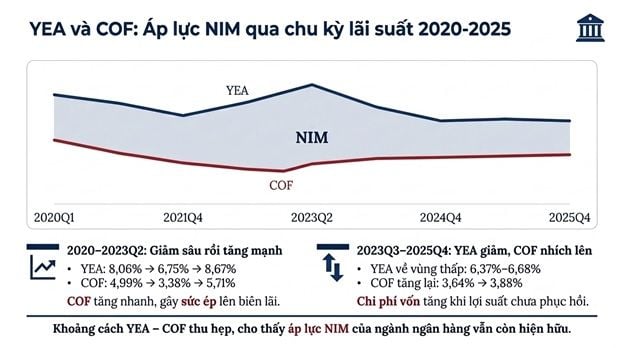
Based on the figures cited in the article, the net interest income margin (NII margin) fell from 8.06% to 6.75% in 2020–2021. Over the same period, the cost of funds (COF) dropped more sharply from 4.99% to 3.38%, helping keep the gap between the yield on earning assets (YEA) and funding costs.
By Q2 2023, however, the improvement in NIM became less favorable: YEA recovered to 8.67% while COF rose sharply to 5.71%. From Q3 2023 to the end of 2025, pressure intensified as YEA declined into the 6.37%–6.68% range while COF increased from 3.64% to 3.88%. The article links this to upward pressure on funding costs despite central bank interventions through policy direction and open market operations, resulting in a narrower YEA–COF gap that directly weighs on NIM.
In the article’s framing, NIM does not necessarily fall because banks lend less. Instead, each unit of earning assets produces a smaller “wedge” than before. When COF rises, banks pay higher costs for deposits, securities, and other funding sources. At the same time, YEA is constrained by policies to reduce lending rates, competition among corporate clients, and the shift of credit toward production sectors that typically carry lower profit margins. As a result, YEA tends to plateau or slightly fall while COF edges up, compressing NIM.
The article also emphasizes that banks need to pay closer attention to CASA, the structure of funding maturities, and the selection of lending portfolios to defend NIM going forward.
With NIM under pressure from both rising input funding costs and limitations on lending yields, banks cannot rely on defending the current margin alone. The larger issue is redesigning growth strategy—choosing customer segments and allocating capital in line with policy directions without eroding profitability.
The article highlights a clear split in 2026 credit growth targets across banks. The highest targets are for HDBank, VPBank, and MBBank, at around 37%, 34%, and 30%, respectively. By contrast, a more cautious group includes ACB at about 16%, VIB at 15%, SHB at 13%, TCB at 12%, and VCB at 11%.
This divergence reflects two strategies: one group uses growth headroom to scale quickly, while the other prioritizes balancing credit growth with risk control. However, higher growth does not automatically translate into higher profitability if banks must pay higher funding costs to mobilize the additional funds. In 2026, NIM remains central, but the pressure on each bank will differ depending on the pace of credit expansion and the ability to mobilize low-cost funding.
The article notes that 2026 credit growth will not only be shaped by growth caps, but also by the quality of capital allocation. As policymakers encourage lending to manufacturing, trading, exporting, agriculture, and SMEs, banks are expected to adjust lending appetite toward a more prudent and substantive stance. The article describes this as positive for the economy because lending to sectors that produce goods, services, and employment can support more sustainable growth than lending that primarily channels funds into asset trading.
However, loans for production and business are typically associated with lower interest margins because corporate clients can negotiate better terms and competition among banks is intense. Banks seeking growth in these segments may need to accept thinner margins or compensate through larger volumes—creating a trade-off between macro objectives and individual bank profitability.
Banks with higher growth headroom may expand credit faster than the market, but the article cautions that this is not an automatic advantage. For banks such as HDBank, VPBank, and MBBank, targeted growth rates of 37%, 34%, and 30% create opportunities to gain market share while also increasing pressure on funding mobilization. As loan books expand, banks must attract more deposits or other funding sources to support liquidity, capitalization, and disbursement capacity.
In an environment where deposit rates are rising, mobilizing new funds can raise costs, pushing COF upward and pressuring NIM downward. If funding-cost growth outpaces improvements in lending yields, high credit growth may scale the balance sheet without delivering proportional profit growth. For high-growth banks, the challenge is therefore to expand lending without eroding margins.
The article argues that the biggest challenge in 2026 is not pursuing a single objective. If a bank focuses only on credit growth, it may relax lending standards or accept thinner margins. If it focuses only on preserving NIM, it may slow growth and lose market share to more aggressive competitors.
To manage NIM in 2026, the article calls for a holistic approach: increasing CASA, optimizing funding term structure, controlling funding costs, expanding customers with solid cash flows, and increasing non-interest income. It also suggests that banks with strong non-term deposit bases, broad client ecosystems, and robust risk-pricing capabilities will have an advantage. In a context where sector-wide NIM is compressed, the article concludes that differences between banks may come less from which bank grows faster and more from which bank can grow with fewer trade-offs.
Overall, managing NIM in 2026 is presented as a crucial test of commercial banks’ management capabilities: lending still needs to support the economy, but banks cannot rely too heavily on high-yield segments. The “winner,” in the article’s view, will be the institution that maintains stable margins, manages risk, and sustains asset quality.

Premium gym chains are entering a “golden era” that is ending or already in decline, as rising operating costs collide with shifting consumer preferences toward more flexible, community-based ways to exercise. Long-term memberships are shrinking, margins are pressured by higher rents and facility expenses, and competition from smaller, more personalized…