News that Iran reopened the Hormuz Strait during the Israel–Lebanon ceasefire helped push oil below $90 a barrel, while
gold rose by as much as $70. At the close on April 17,
Brent crude fell 9% to $90 a barrel, and WTI dropped 11% to $83.
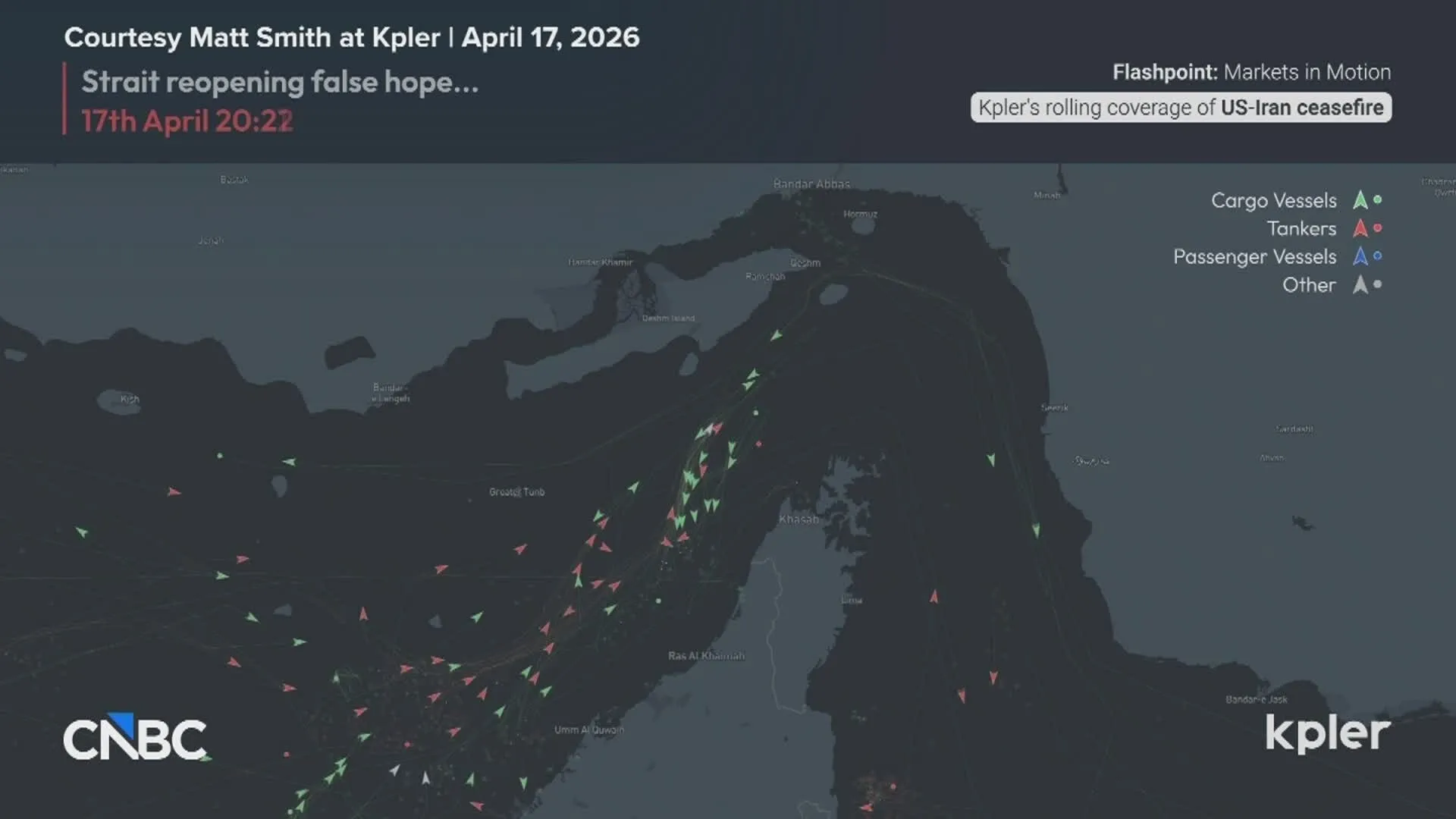
Oil prices eased after Iran announced the Hormuz Strait was fully opened for commercial shipping during the ceasefire between Israel and Lebanon.
Video shows ships turning back at the Hormuz Strait, despite Iran’s reopening claim, on April 17, 2026. Source: CNBC.
“All commercial traffic through the Hormuz Strait is fully open for the remainder of the ceasefire,” Iranian Foreign Minister Seyed Abbas Araghchi wrote on social media on April 17. However, ships must move along the “coordinated route” announced by Iran’s maritime authority, he said.
Israel and Lebanon had previously agreed to a 10-day ceasefire starting at 5:00 a.m. on April 17. The Israeli military operation in Lebanon targeting Hezbollah has been a sticking point in talks between the United States and Iran.
Oil-price charts show WTI down more than 11% for the session on April 17. The Hormuz Strait carries about 20% of global crude oil and LNG; however the waterway has been nearly blocked since late February, contributing to a global energy squeeze.
World gold prices also rose on the Hormuz development, with a move up as much as $70 to $4,860 per ounce on April 17, before settling at $4,829.
Gold prices rose in late trading on April 17. The chart is from Kitco.
Easing Middle East tensions has supported precious metals. In recent weeks, gold faced pressure as higher energy costs pushed inflation higher and delayed rate cuts by central banks. Since the start of the conflict, gold has fallen about 10%.
Positive headlines from the Middle East have also helped lift U.S. equities, with the Dow Jones Industrial Average closing about 1.8% higher at the open. The S&P 500 and Nasdaq Composite were up about 1.2–1.5%.
Wall Street has recently hit fresh records as investors remained optimistic about an end to the Middle East conflict. Since the start of the conflict, the S&P 500 and Nasdaq Composite have risen more than 10% overall.
— Ha Thu (via CNBC, Reuters).