•
•
•
•
•
•
•
•
•
•
•
•
•
•
•
•
•
•
•
•
•
•
•
•
•
•
•
•
•
•
•
•
•


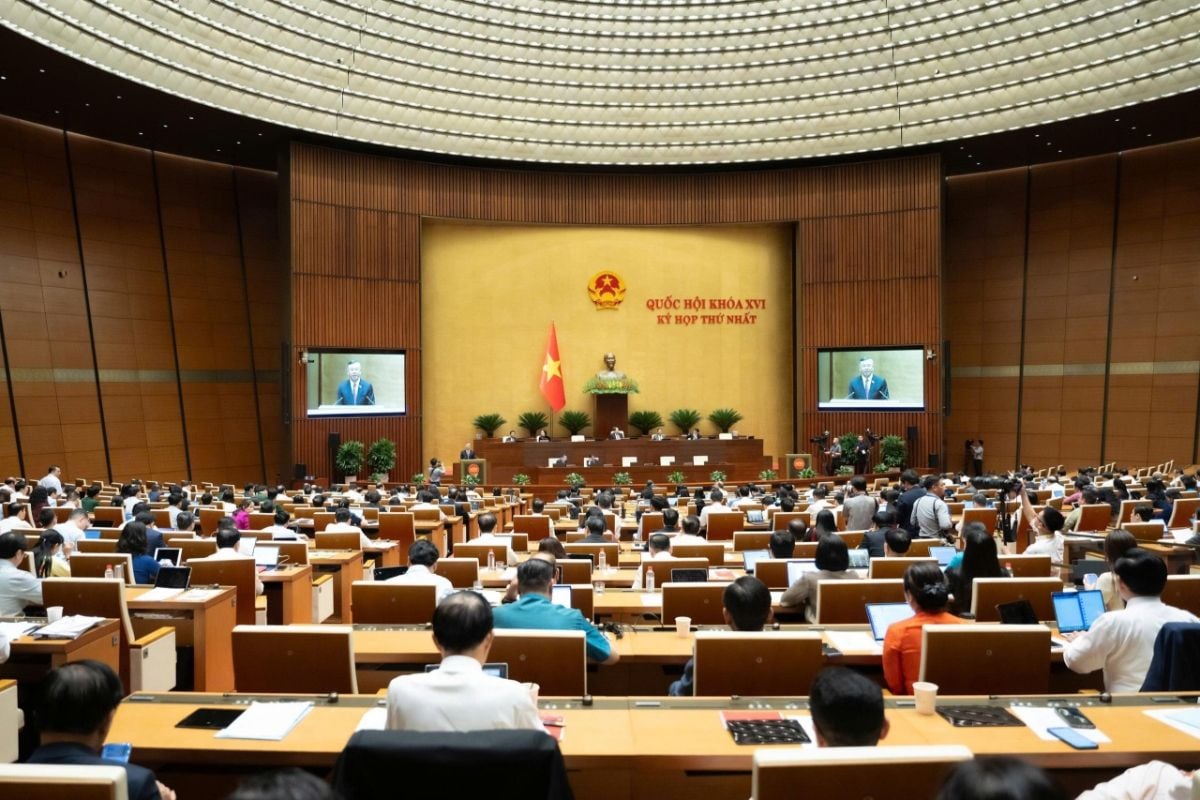
On the morning of April 21, the National Assembly held a plenary session under the leadership of Vice Chairwoman of the National Assembly Nguyen Thi Hong to debate the assessment of the results of implementing the socio-economic development plan and the state budget for 2025, the current status of implementation in the first months of 2026, and the five-year socio-economic development plan for 2026-2030.
Deputy Phan Duy Anh (Da Nang National Assembly District) said the Government’s proposed growth targets for the next period show strong determination, but face major feasibility challenges. He highlighted that the target of average GDP growth of 10% per year over the next five years, together with a substantial reduction in ICOR to 4.5–4.8, is unprecedented in decades.
The deputy noted that in the two previous periods, ICOR declined very slowly, indicating limited improvement in capital-use efficiency. Specifically, ICOR was 6.77 in 2016–2020 and 6.43 in 2021–2025. Over five years, ICOR fell by only 0.34 points.
He said the 2026–2030 target of 4.5–4.8 would require a reduction of 1.6–1.9 points within five years, meaning the required pace of improvement must be much larger than in the past. He attributed the difficulty to persistent bottlenecks, including dispersed capital allocation, limited project preparation, slow land clearance, and unstable supply of materials.
Deputy Phan Duy Anh urged the Government to publish a concrete roadmap to improve investment efficiency and to clarify the contributions of labor productivity, the application of science and technology, and the restructuring of public investment toward greater concentration.
On revenue collection and budget forecasting, the deputy cited that state budget revenue in 2025 reached 2,681,000 billion dong, exceeding the estimate by 36.3%. Despite the overshoot, he argued that revenue forecasting and budgeting are not yet fully aligned with reality, a problem that has persisted for many years and affects fiscal policy design, resource allocation, and debt management.
He proposed improving the quality of assessment, forecasting, and budgeting, and studying modern budgeting methods that treat revenue targets not only as statutory targets and adjust spending according to actual receipts.
In the public investment domain, the deputy said the disbursement rate reached 98% of the Prime Minister’s plan, but disparities among funding sources remain evident. Local budget capital disbursement reached 117.8%, while central budget disbursement stood at 76.1%. Disbursement of non-state capital was only 44.5%.
He said the situation has persisted for years. In Q1 2026, disbursement progress was only 10.4% of the plan, with 48.3 trillion dong in planned capital not yet allocated across 15 ministries and central agencies and 24 localities.
Accordingly, he urged clarifying responsibilities of each agency and locality and applying sufficiently strong sanctions for delays caused by subjective reasons.
Nguyen Nhu So from the Bắc Ninh delegation warned about misalignments in the economy’s capital structure. He said short-term funding used to cover long-term needs creates liquidity pressure and diverts capital away from higher value-added activities, contributing to an ICOR that remains in the 6–7 range and requiring more capital to achieve the same growth.
He also pointed to a paradox in the financial system: credit-to-GDP is about 146%, while there is a shortage of medium- and long-term funding. He described this as reflecting an imbalance in the financial system.
To address it, he proposed restructuring capital allocation to advance development of a robust stock and corporate bond market, reducing reliance on bank credit. He also suggested linking credit policy to efficiency and sustainability while using public investment to lead funding toward social resources.
In response, Finance Minister Ngo Van Tuan said the Government would consider a range of measures, including reviewing growth scenarios, strengthening coordination between fiscal and monetary policy, and finalizing tax policy to ensure revenue while supporting businesses.
On public investment disbursement, he said the Ministry of Finance is coordinating with ministries, sectors, and localities to remove obstacles and is preparing for a national conference chaired by the Prime Minister to accelerate disbursement in 2026. The ministry is also focusing on resolving land-related project backlogs and other projects, mobilizing capital to meet development needs, and developing the capital market through institutional reform and infrastructure development for market participants.







Premium gym chains are entering a “golden era” that is ending or already in decline, as rising operating costs collide with shifting consumer preferences toward more flexible, community-based ways to exercise. Long-term memberships are shrinking, margins are pressured by higher rents and facility expenses, and competition from smaller, more personalized…