•
•
•
•
•
•
•
•
•
•
•
•
•
•
•
•
•
•
•
•
•
•
•
•
•
•
•
•
•
•
•
•
•


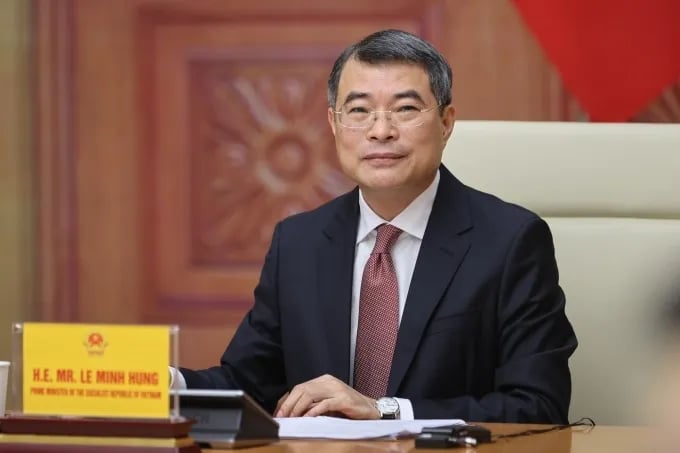
Prime Minister Le Minh Hung called on leading U.S. energy and technology firms to invest in Vietnam during a meeting on 16 April with 52 companies led by the U.S.-ASEAN Business Council (USABC). He said the Vietnamese government is ready to offer the most favorable conditions for foreign investors, including U.S. businesses, to expand operations and investment in the country.
The Prime Minister said Vietnam will support leading U.S. energy corporations to invest in the country, aiming to strengthen national energy security and help develop an energy market that is fair, transparent, and efficient.
He noted that Vietnam’s energy demand has risen rapidly in recent years due to industrialization and urbanization, creating pressure on the power supply system. Under the VIII Electricity Plan, Vietnam aims to ensure electricity supply for growth while transitioning to a more sustainable energy model. The government’s commitment to net-zero emissions by 2050 further increases the urgency of the energy transition, which requires large capital, advanced technology, and international management experience.
Vietnam also views science and technology cooperation as a pillar of bilateral relations. The Prime Minister said the government is ready to enable capable U.S. telecom firms to access the market to study investment opportunities, transfer technology, and develop telecom infrastructure, including 5G and submarine fiber networks, while ensuring national security and regulatory compliance.
He referenced that in February, the Ministry of Science and Technology licensed satellite Internet service (Starlink) in Vietnam.
The Prime Minister urged U.S. firms to intensify cooperation with domestic companies, implement technology transfer—especially core technologies—to help Vietnam connect more deeply with regional and global value chains.
He also proposed that USABC and U.S. companies work toward reaching an equitable and balanced counterpart trade agreement as soon as possible.
In addition, the Prime Minister said the U.S. should consider recognizing Vietnam as a market economy and removing Vietnam from the export-restricted list (D1-D3).
At the meeting, leaders of relevant ministries listened to proposals from U.S. companies regarding administrative procedures. The Prime Minister said he would address procedural obstacles immediately, and that both sides would continue discussions to resolve outstanding issues.
He said Vietnam is accelerating reforms by improving the legal framework, institutions, and the business environment, with cutting administrative procedures and business conditions identified as a priority. For Q2, ministries are required to reduce compliance costs by 50% and reduce the time needed to complete procedures by 50%, with no ministry implementing more than 30% of the total procedures in its area.
The Prime Minister said economic, trade, and investment relations between Vietnam and the U.S. have continued to develop positively. The U.S. remains Vietnam’s largest export market. Two-way trade reached $209.5 billion in 2025, while U.S. exports to Vietnam exceeded $19 billion, up 28% from 2024.
He added that Vietnamese firms have signed contracts to purchase aircraft and U.S. equipment valued at more than $37 billion.




Premium gym chains are entering a “golden era” that is ending or already in decline, as rising operating costs collide with shifting consumer preferences toward more flexible, community-based ways to exercise. Long-term memberships are shrinking, margins are pressured by higher rents and facility expenses, and competition from smaller, more personalized…