•
•
•
•
•
•
•
•
•
•
•
•
•
•
•
•
•
•
•
•
•
•
•
•
•
•
•
•
•
•
•
•
•


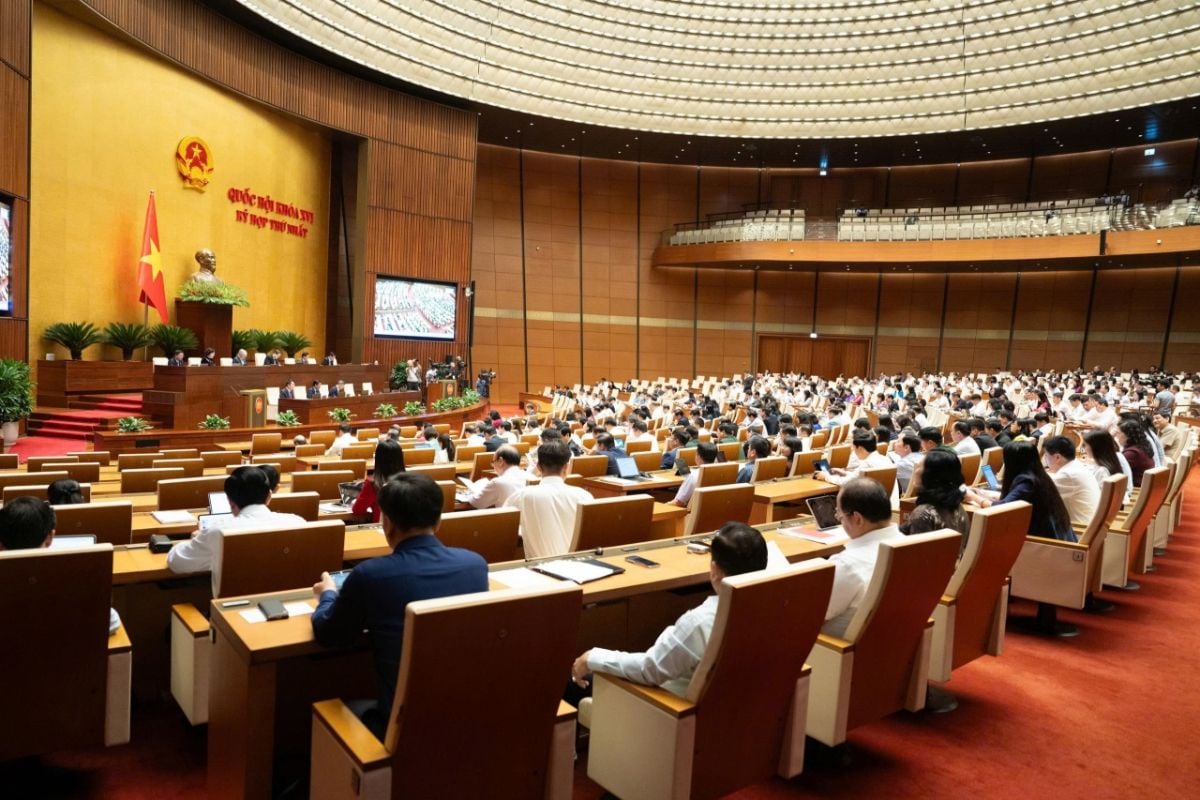
Continuation of the First Session on the morning of 21 April, lawmakers discussed the assessment of additional results in implementing the socio-economic development plan and the state budget for 2025, as well as progress in the plan in the early months of 2026. The reform of administrative units and the reorganization of local governments at two levels is moving into a substantive implementation phase. After merger, the rural-urban administrative apparatus is expected to operate more leanly, efficiently, and closer to the people. However, discussions in the National Assembly indicated that the key challenge is not only organizational structure or function allocation, but also human policy—especially wages.
Many deputies argued that wage reform is no longer a purely technical, arithmetic adjustment. Instead, it is a prerequisite for retaining staff, motivating civil servants, and improving the quality of the workforce that implements decisions after reorganizations. Deputy Nguyen Dang An (Lạng Sơn) said the policy to reorganize the local government apparatus at commune level is correct, noting that commune-level units have begun operating more stably and effectively, providing better services to people and enterprises.
After consolidation, the locality’s scale, population, and commune-level workload have increased significantly. At the same time, the number of professional units has been reduced, and many functional offices must oversee multiple fields under the guidance of different ministries. As a result, workloads have risen, particularly in mountainous, border, and ethnic minority areas. Deputies noted that commune-level cadres and civil servants do not only perform administrative tasks; they also directly handle residents’ life issues and support business operations. Requirements for professional skills and IT capability are increasing, while the grassroots workforce remains short of deeply specialized staff.
Staff reductions under relevant decrees have created gaps that cannot be filled immediately. Deputies said this requires a planned, phased approach to training and retraining, and earlier staffing assignments aligned with local realities. However, they emphasized that regardless of how flexibly the machinery is reorganized, if wage policies do not keep pace, pressure for public-sector workers to exit and re-enter will continue.
In reforming wage policy, the state has taken steps to raise the base salary in stages. From 1 July 2026, the base salary is scheduled to increase to 2.53 million VND per month. Deputies said the issue is not whether wages increase, but whether the increase is sufficient for public-sector earners to cover living costs.
Representative Thach Phuoc Binh (Vinh Long) said 2.53 million VND per month is only about 8.12% above the current level, exceeding inflation and creating a nominal increase. However, he argued the rise is not strong enough to address living costs for most civil servants—especially new entrants, those without additional income, and those working in large urban areas.
With the standard starting wage, the actual income of a new civil servant is around 4.7 million VND per month before social insurance. Meanwhile, minimum living costs in major urban areas commonly range from 6–7 million VND per month, excluding housing, healthcare, and education. Deputies said the gap between income and basic living needs prevents many public-sector workers from living independently on salary alone, forcing reliance on other income sources and reducing motivation and public service quality.
Deputies compared public-sector wages with the labor market. Since early 2026, regional minimum wage levels in the private sector have been adjusted. The highest level in Region I exceeds 5.3 million VND per month, while the average across four regions is about 4.47 million VND per month. With a base salary of 2.53 million VND and a coefficient of 2.1, many civil servants’ income would approach or reach the highest regional minimum wage. Deputies said this would be enough to “keep pace,” but not to provide long-term security given rising urban living costs.
They also cited cost pressures in 2025: expenses for essential items rose faster than the CPI. Housing, electricity, water, and construction materials increased by over 8%, while medicines and health services rose nearly 13%. Deputies said these are difficult-to-cut household expenditures for civil servants, so even nominal wage increases are perceived as insufficient relative to spending pressures.
Based on these analyses, many deputies argued that the base salary in the next period should be raised to about 2.65–2.7 million VND per month, equivalent to a 13–15% increase over the current level. They said this would balance budget capacity with the need to secure living standards and provide genuine motivation for the public sector.
Deputies said such an increase would help narrow the gap between income and basic living costs, improve the appeal of public employment amid growing competition for talent from the private sector, and support deeper reform outcomes. They emphasized it is a necessary condition for policies to reorganize the apparatus, streamline personnel, and raise workforce quality—avoiding a situation described as “lean machinery but thin motivation.”
Deputies emphasized that wage reform should be treated as an investment in the quality of national governance, not merely a budget expense. They argued that when policy implementers can live on their salaries, work with confidence, and receive proper training, public administration efficiency can improve sustainably. In a context where the system is pushing to streamline, modernize, and raise governance effectiveness, deputies warned that delaying or partially adjusting wage policy could undermine the impact of other reforms. Conversely, a stronger wage move could provide momentum to implement reforms in practice.







Premium gym chains are entering a “golden era” that is ending or already in decline, as rising operating costs collide with shifting consumer preferences toward more flexible, community-based ways to exercise. Long-term memberships are shrinking, margins are pressured by higher rents and facility expenses, and competition from smaller, more personalized…