•
•
•
•
•
•
•
•
•
•
•
•
•
•
•
•
•
•
•
•
•
•
•
•
•
•
•
•
•
•
•
•
•


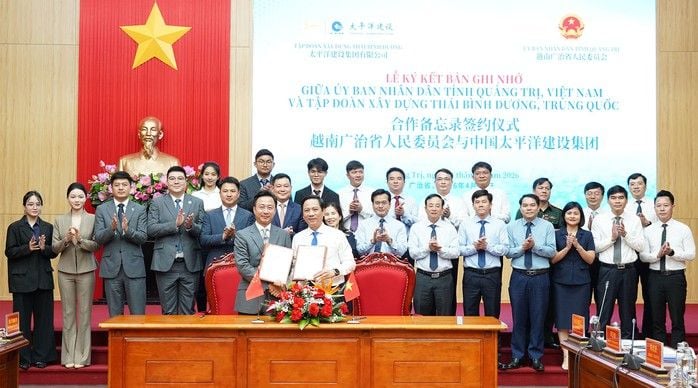
On April 25, the People’s Committee of Quang Tri Province announced that it had signed a memorandum of understanding with Pacific Construction Group (China) to promote investment in infrastructure, energy, industry, and tourism. The agreement was signed the day before in Dong Ha with the attendance of Hoang Nam, the standing vice chairman of the provincial People’s Committee, and the leadership of Pacific Construction Group led by Chairman Nghiêm Hao. Speaking at the event, Mr. Hoang Nam said that in the context of deep integration, cooperation with international groups is an opportunity for the locality to better harness its potential and create new growth momentum. After the administrative boundary adjustment from mid-2025, Quang Tri enters a development phase with expanded space and greater room to attract investment. The province sits on the North-South transport axis and is the starting point of the East-West Economic Corridor, directly connecting Laos, Thailand and the Mekong subregion. The system of international border gates, deep-water ports, and cross-regional transport infrastructure is being completed, enabling logistics development and cargo transshipment. In addition to location advantages, Quang Tri has a long coastline, a large industrial land bank, and potential for renewable energy such as wind, solar, and natural gas. The province intends to develop along four pillars: energy, logistics, green agriculture, and tourism. The Pacific Construction Group (China) delegation attended the signing ceremony. Under the terms of the memorandum, the two sides will focus on researching and implementing cooperation in urban infrastructure and transportation, energy, industrial zones, tourism, and other potential fields. Investment promotion activities and business networking will be launched in parallel to gradually materialize the agreed contents. The memorandum is viewed as a starting point for the two sides to advance toward concrete projects, on the principles of equality, mutual benefit, and compliance with the laws of each country.


Premium gym chains are entering a “golden era” that is ending or already in decline, as rising operating costs collide with shifting consumer preferences toward more flexible, community-based ways to exercise. Long-term memberships are shrinking, margins are pressured by higher rents and facility expenses, and competition from smaller, more personalized…




