•
•
•
•
•
•
•
•
•
•
•
•
•
•
•
•
•
•
•
•
•
•
•
•
•
•
•
•
•
•
•
•
•


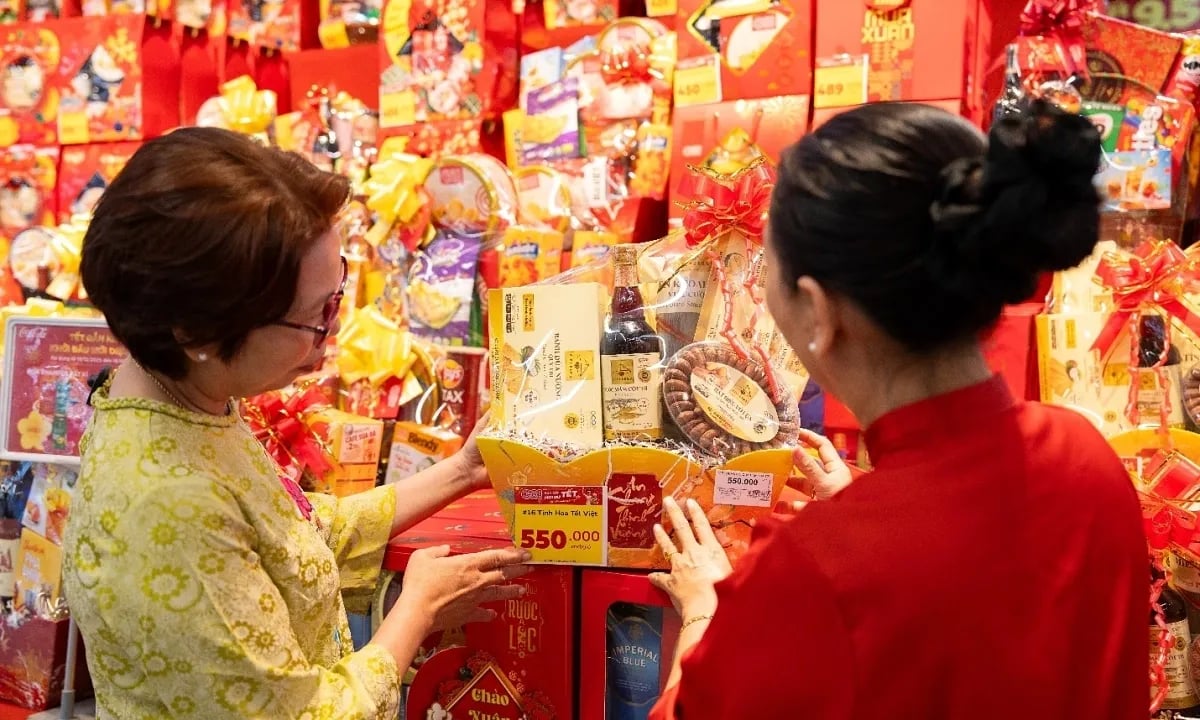
In the days leading up to Tet, production and packaging facilities across traditional craft villages and regional agricultural hubs are operating at full capacity to ensure timely supply of goods for the market. This period is widely regarded as the “golden season” for local specialty products.
Demand for regional specialties during Tet is rising not only in volume, but also in quality and presentation. Consumers are increasingly prioritizing products with clear origins, food safety assurances, strong local identity, and more elegant, gift-ready packaging.
At Hai Dang Pure Anchovy Fish Sauce Cooperative in Phuoc Thang ward (Ho Chi Minh City), members are continuously bottling traditional fish sauce to fulfill Tet orders. The cooperative’s product is a 3-star OCOP item produced using traditional methods. According to Mr. Le Viet Hung, Chairman of the cooperative’s board, the peak Tet season this year is expected to supply over 5,000 liters of pure fish sauce in multiple bottle formats.
In Ho Chi Minh City, Song Xoai Green Grapefruit Cooperative in Tan Thanh ward is also entering its peak period. According to Mr. Hoang Kha, the cooperative’s director, grapefruit output for Tet this year is about 200 tons. Beyond fresh grapefruits, the cooperative has expanded into fermented grapefruit products, dried grapefruit peels, grapefruit flower tea, and packaged Tet gift baskets, broadening consumer choice.
Survey observations across major retail chains indicate that Vietnamese goods remain highly represented during Tet. In the Go! system, Vietnamese goods account for over 90% with more than 40,000 SKUs. Meanwhile, WinMart and WinMart+ maintain 80–90% Vietnamese goods. In the agricultural and processed foods segment—where many OCOP products are included—Vietnamese items contribute over 30% of revenue.
Alongside shifting consumer preferences, Tet 2026 (Binh Ngo year) is seeing a more polished presentation of Vietnamese goods and OCOP products, from product quality to how items are brought to market. Tet packaging has received more investment, with neater designs and clearer labeling. Many OCOP products have also been standardized to meet supermarket criteria, helping them secure shelf presence in modern retail channels.
A representative from Central Retail Vietnam said that during Tet Binh Ngo 2026, the GO!, Tops Market, and Mini Go! networks nationwide supplied more than 3,000 Tet gift baskets with private labels. The majority of these baskets are Vietnamese specialties. Gift baskets are priced from 300,000 to 500,000 VND, and the Viet Gems gift-basket line is designed to introduce regional specialties and OCOP products to consumers.
In Hanoi, the Spring Fair has become a familiar shopping destination in the run-up to Tet, featuring hundreds of items including highland produce, island seafood, and notable OCOP products to meet rising end-year demand.
At the Son La province booth, representatives said products such as dried meat, dried fruit, tea, and coffee—core local items—have clear origins and are OCOP certified or are representative agricultural products. Moc Chau mandarins, Muong La apples, and Moc Chau strawberries are replenished daily to ensure freshness upon arrival.
The Phu Quoc specialties pavilion is also drawing attention with traditional fish sauce, dried shrimp, pepper, and other dried fish products. Products from the Cau Ke coconut candy line (Tra Vinh) are noted for distinctive quality, including thick, chewy coconut flesh and natural fat. Using local materials, VICOSAP has invested in deep processing and diversified product lines into jarred candied coconut, dried candied coconut, and flavored candied coconut.
The fair highlights not only food but also medicinal products. Participating this year, An Binh Cooperative (Cho Don district, Thai Nguyen) offers 13 local products, including a 3-star OCOP yellow tea set. Quy Hoa yellow tea is a national 5-star OCOP product, nicknamed the “green gold” of the Northeast, attracting visitors with its story of product preservation and livelihoods.
As observed at the fair, many customers prefer genuine regional specialties even when prices are higher, citing quality and provenance. The Tet consumption trend is shifting from “buy more” to “buy carefully,” with greater emphasis on clean, safe, and branded products.
To serve Tet shopping needs, Hanoi’s Department of Industry and Trade organized a program chain titled “Promoting representative products, specialties, OCOP serving Tet Binh Ngo – Spring Unity” from 09/02 to 13/02/2026.
With nearly 300 stalls and thousands of quality products, the event is expected to become a shopping and experiential destination that supports domestic consumption and spreads the value of Vietnamese goods. The program is held at three venues—Quang Minh commune, Phuc Loc commune, and Thach That commune—and runs daily from 08:30 to 22:00.
A key focus is promoting OCOP products, regional specialties, and handicrafts. For businesses and producers, the program is positioned as an opportunity to introduce brands, promote products, and seek partners. Through direct trade promotion activities, many OCOP products and regional specialties are expected to reach consumers, expanding markets, increasing value, and improving competitiveness.
OCOP Thanh Hoa is aligning with modern Tet gifting trends. Instead of selling individual products, many OCOP operators in Thanh Hoa are collaborating to build Tet gift baskets rich in local flavors. This approach is intended to expand distribution during peak season and raise the market standing of OCOP products.
Thanh Hoa is also working to maintain market stability ahead of Tet Binh Ngo 2026 to ensure sufficient goods and stable prices for people to enjoy the Spring and Tet holiday.
In Hanoi, Tet shopping on online markets is described as busy. Retail research indicates that Tet spending typically accounts for about 25–30% of total annual retail revenue, while the Fast-Moving Consumer Goods sector alone contributes around 20% of annual revenue during Tet.







Premium gym chains are entering a “golden era” that is ending or already in decline, as rising operating costs collide with shifting consumer preferences toward more flexible, community-based ways to exercise. Long-term memberships are shrinking, margins are pressured by higher rents and facility expenses, and competition from smaller, more personalized…