•
•
•
•
•
•
•
•
•
•
•
•
•
•
•
•
•
•
•
•
•
•
•
•
•
•
•
•
•
•
•
•
•


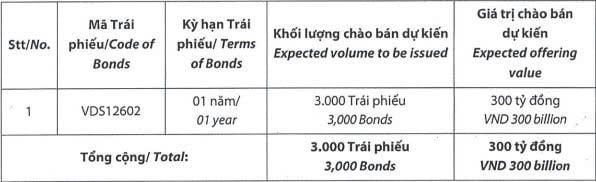
Dragon Viet Securities (VDSC) plans to issue 3,000 non-convertible bonds under code VDS12602, aiming to raise up to 300 billion dong. Each bond has a par value of 100 million dong. The bonds will be issued on May 12, 2026, via private placement through an agent.
The VDS12602 bonds are unsecured and come with no warrants. They have a 1-year maturity and pay a fixed interest rate of 9% per year, with monthly coupon payments.
The bond structure also includes a call option allowing the issuer to repurchase 50% of the bonds after six months from issuance. The maximum repurchase rate is set at 7.6% per year.
With proceeds of up to 300 billion dong, VDSC plans to use the funds to restructure debt. The stated purposes include repayment of maturing bonds and/or prepayment of bank borrowings at maturity or earlier.
Earlier, between March 4 and April 1, 2026, Dragon Viet Securities issued 700 bonds under code VDS12601. Each bond had a par value of 100 million dong, for a total of 70 billion dong.
In its Q1 2026 consolidated financial statements, VDSC reported revenue of about 202.8 billion dong, up 20% year-on-year.
Operating expenses were over 190.5 billion dong, up 69%. The company also set aside 33.1 billion dong for impairment of investment portfolios, up 8.9 times year-on-year.
As a result, after taxes and fees, VDSC posted a net loss of about 29.5 billion dong, compared with net profit of over 19 billion dong in the same period last year.
As of March 31, 2026, total assets fell 3.1% year-to-date to about 7,868.5 billion dong. Loans stood at about 3,842.3 billion dong, representing 48.8% of assets. Investments maturing by headline date totaled 1,100 billion dong, or 28.6% of assets.
On the liabilities side, total liabilities were over 4,839.4 billion dong, down 3.6%. Short-term borrowings and finance lease liabilities were about 2,232 billion dong. Short-term bonds issued were 2,529.1 billion dong, accounting for 52.3% of liabilities.
Source: VDS.
Premium gym chains are entering a “golden era” that is ending or already in decline, as rising operating costs collide with shifting consumer preferences toward more flexible, community-based ways to exercise. Long-term memberships are shrinking, margins are pressured by higher rents and facility expenses, and competition from smaller, more personalized…