•
•
•
•
•
•
•
•
•
•
•
•
•
•
•
•
•
•
•
•
•
•
•
•
•
•
•
•
•
•
•
•
•


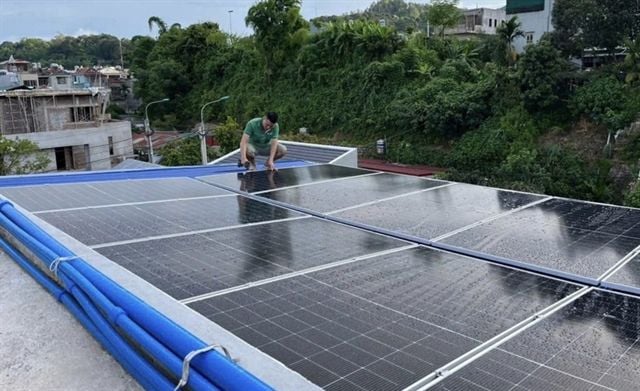
Rooftop solar systems can supply electricity for production while helping households and businesses reduce electricity costs. In some cases, users report savings of up to 20 million đồng per month, even as electricity demand rises during summer peak periods.
In Sơn La, Ms. Đàm Thị Liên’s family in Chiềng Lề Ward saw electricity bills fall sharply despite higher summer electricity demand. The household previously used about 600 kWh per month. After installing a rooftop solar system, electricity costs declined by an average of 30–40%.
At Hoàng Phúc Ice and Water Shop in Chiềng Sinh, Sơn La, Ms. Đinh Thị Liệu invested in a rooftop solar system with a capacity of 54 kWp. Monthly electricity costs at the business dropped from 40 million đồng to 20 million đồng, representing savings of about 50%.
Beyond direct bill reductions, rooftop solar can also help production facilities maintain electricity supply during peak hours, reducing the risk of outages.
Many households are investing in rooftop solar for self-consumption. In Hanoi, Ms. Nguyễn Thị Hải Yến installed a system with 8.61 kWp (14 panels). Since August 2025, her household’s grid consumption from the network decreased from 812 kWh to 444 kWh per month, about a 45% reduction. She expects to save 18–20 million đồng per year.
According to Yến, in autumn and winter, electricity bills can fall to only a few thousand đồng. During hot seasons, solar output peaks and offsets most electricity costs. She also said the solar array provides roof insulation, reducing solar radiation and lowering indoor temperatures by 3–5 degrees Celsius on hot days.
Mr. Nguyễn Thượng Quân, CEO of Sao Nam Technology Integration JSC, said rooftop solar with storage is a “top-notch” solution for households. He noted that for households with electricity bills in the range of 2.4–4 million đồng, a hybrid rooftop solar system (grid-tied with storage) is suitable.
He cited investment costs of around 50–100 million đồng, with electricity bills reduced by 50% to nearly 100%. The reported payback period is under 3.5 years.
At a seminar on electricity savings and new rooftop solar, Mr. Trịnh Quốc Vũ, Deputy Director of the Electricity Department (MoIT), said Vietnam’s total solar capacity—including rooftop solar and large-scale solar—has reached over 19,000 MW. With this scale, Vietnam is among Southeast Asia’s leading countries in solar power development.
Under the revised Plan VIII direction, among total capacity of about 46,000 MW, the target is to develop about 26,000 MW of rooftop solar. To support this, the Ministry of Industry and Trade has been tasked by the Government to draft incentive mechanisms to promote rooftop solar development for households, and to submit them for the Prime Minister’s issuance as a decision.
Vũ said the draft decision is under review by the Prime Minister for consideration and approval. “We expect that when the supportive mechanisms for rooftop solar development for households are approved by the Prime Minister, it will be a major boost to momentum and address barriers, pushing this model forward in the coming period,” he said.







Premium gym chains are entering a “golden era” that is ending or already in decline, as rising operating costs collide with shifting consumer preferences toward more flexible, community-based ways to exercise. Long-term memberships are shrinking, margins are pressured by higher rents and facility expenses, and competition from smaller, more personalized…