•
•
•
•
•
•
•
•
•
•
•
•
•
•
•
•
•
•
•
•
•
•
•
•
•
•
•
•
•
•
•
•
•
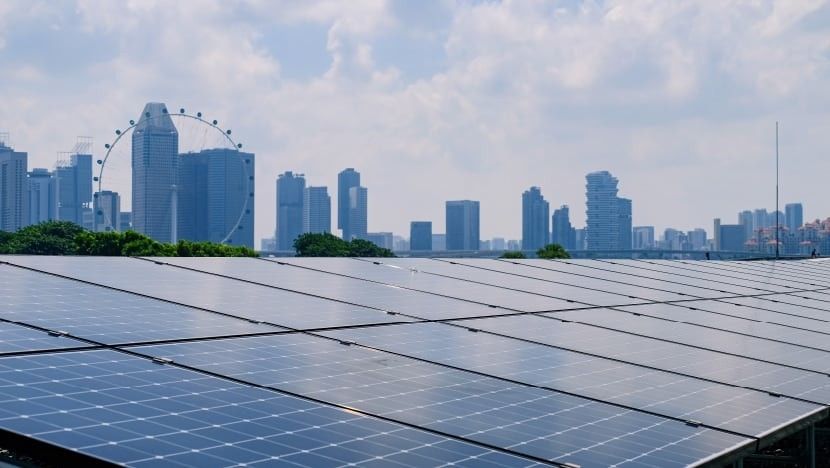
Against the backdrop of climate change increasingly affecting economic growth and energy security, Singapore is pursuing a pragmatic transition strategy: expanding solar power, researching new energy sources, promoting carbon markets, and investing heavily in long-term climate resilience. Climate change is no longer a risk confined to the future; it is gradually reshaping the operating conditions of economies. For Singapore, an island city-state with limited land, high population density, and low-lying topography, the pressure is particularly acute. Maximizing space for solar power Unlike many other countries, Singapore has little scope for large-scale hydropower or wind power. In a context of scarce land, solar power has become the most feasible renewable energy option for the city-state. However, instead of large solar farms, Singapore optimizes every available space—from rooftops of residences, industrial estates to reservoirs. One notable project is the floating solar system at the Tengeh reservoir. The system spans about 45 hectares, nearly one-third of the reservoir surface, with more than 120,000 solar panels. The electricity generated supports PUB’s water treatment operations and helps reduce about 32 kilotons of carbon emissions per year, equivalent to removing about 7,000 cars from the roads. Singapore initially set a target of 2 gigawatt-peak (GWp) for solar capacity but achieved it ahead of schedule. The city-state has since raised the target to 3 GWp by 2030, enough to power about 500,000 homes per year. Finding new energy sources and supporting businesses to transition Nevertheless, solar power alone cannot meet the nation’s total electricity demand. That necessitates expanding other low-carbon options to ensure long-term energy security. Among the options under study are low-carbon hydrogen, including imports, storage, and use in power generation as well as industry. Singapore is also looking at carbon capture, utilization and storage (CCUS) technologies. Biomethane is being piloted to assess its use in the electricity sector. In parallel, advanced nuclear technologies are being studied in the long term to assess safety, feasibility, and suitability for Singapore’s conditions. The transition to a low-emission economy entails significant costs for businesses, especially energy-intensive sectors. Firms must invest in upgrading equipment, changing operating processes, and meeting increasingly stringent climate disclosure requirements, while maintaining competitiveness. To support the private sector, Singapore has rolled out several programs, including the Energy Efficiency Grant to defray costs of upgrading energy-saving equipment, and the Enterprise Financing Scheme – Green to help businesses access loans for sustainable investments. The Sustainability Reporting Grant helps firms meet climate-related reporting requirements and build capabilities in related areas. The Enterprise Sustainability Programme for SMEs helps raise skills in energy management and sustainability reporting for the workforce. Carbon markets as a supporting role Beyond domestic solutions, Singapore views international carbon markets as an important supplementary tool for reducing emissions. Under the existing carbon tax regime, businesses may use high-quality carbon credits to offset up to 5% of taxed emissions after internal reductions. To ensure transparency and credibility, Singapore is cooperating with international partners through the Coalition to Grow Carbon Markets and has signed bilateral agreements with many countries to align carbon-market standards. Singapore believes that emission reductions are necessary but not sufficient, as some climate impacts have already materialized and will persist for decades. In this context, 2026 is identified as the “Year of Climate Adaptation.” The city-state is building its first National Adaptation Plan, focusing on heat resilience, flood protection, coastal defense, water and food security. Singapore’s pragmatic, long-term approach to climate change seeks to push energy transition while preparing for climate risks that are forecast to grow more severe in the future. Singapore to deploy floating solar farms covering more than one-third of Lower Seletar reservoir by 2029 09:21, 03/01/2026 The floating solar project at Lower Seletar Reservoir illustrates Singapore’s push to maximize available space for solar energy and reduce emissions while supporting water security. Climate strategy: Building “green bridges” to mobilize capital and decarbonization initiatives 14:07, 28/01/2026 Turbines ready for hydrogen: A strategic step in Singapore’s decarbonization journey 16:46, 27/10/2025 Key terms and further reading on Singapore’s climate and energy policy including disaster resilience, carbon markets, and green financing.
Bitcoin (BTC) investors who use steady dollar-cost averaging (DCA) may be underperforming versus strategies that adjust exposure to the market’s cycle, according to new research arguing that Bitcoin’s behavior differs from traditional long-duration assets.
In a report cited by Markus Thielen of 10x Research, Bitcoin’s market…