•
•
•
•
•
•
•
•
•
•
•
•
•
•
•
•
•
•
•
•
•
•
•
•
•
•
•
•
•
•
•
•
•

Solana’s consistently low transaction fees are intensifying competition among other major blockchain networks, including Base, BNB Chain, and Polygon, by making user costs a decisive factor for activity and liquidity.
Recent on-chain data indicates Solana’s average transaction fee remains consistently below $0.001, often hovering near $0.00025 for non-priority transactions. The resulting cost advantage is creating pressure on competing ecosystems to improve fee efficiency.
Base, a Coinbase Layer-2, saw fees drop after the Ethereum Dencun upgrade. However, costs can still rise to $0.05 or higher during periods of peak retail activity.
BNB Chain and Polygon are also described as cheaper than Ethereum mainnet, but they are characterized as struggling to match Solana’s sub-cent consistency. The article links this to how retail liquidity tends to move toward venues with the lowest friction, where token swaps can be executed for fractions of a penny on Solana rather than paying five to ten cents elsewhere.
The push for lower costs is not limited to token swaps. The article says capital is rotating toward platforms that address “fee fatigue,” particularly in the digital content economy, where Web2 services can charge high commission rates.
It also points to growing interest in decentralized applications that combine AI utility with improved monetization, citing this as a tailwind for new entrants such as SUBBD Token ($SUBBD).
The article argues that creators often face a large disconnect between output and retained income, noting that legacy Web2 platforms may deduct between 20% and 70% of earnings.
SUBBD Token ($SUBBD) is presented as aiming to disrupt what the article describes as a $191B industry by applying crypto’s low-friction approach to content monetization.
According to the article, SUBBD operates as an ERC-20 token on Ethereum and uses EVM-compatible smart contracts to reduce reliance on intermediaries. It also claims the platform integrates proprietary AI models, including automated personal assistants, voice cloning, and object recognition, to streamline creator workflows.
The article further states that the platform enables influencers to create “AI versions” of themselves to interact with fans 24/7, positioning this as a way to address scalability constraints for human creators.
On tokenomics, the article says AI integration supports token-gated exclusive content and uses AI tools for optimization, with the goal of lowering barriers for creators while increasing potential revenue. It also notes that execution risk remains, particularly around whether the AI tools are intuitive for non-crypto users.
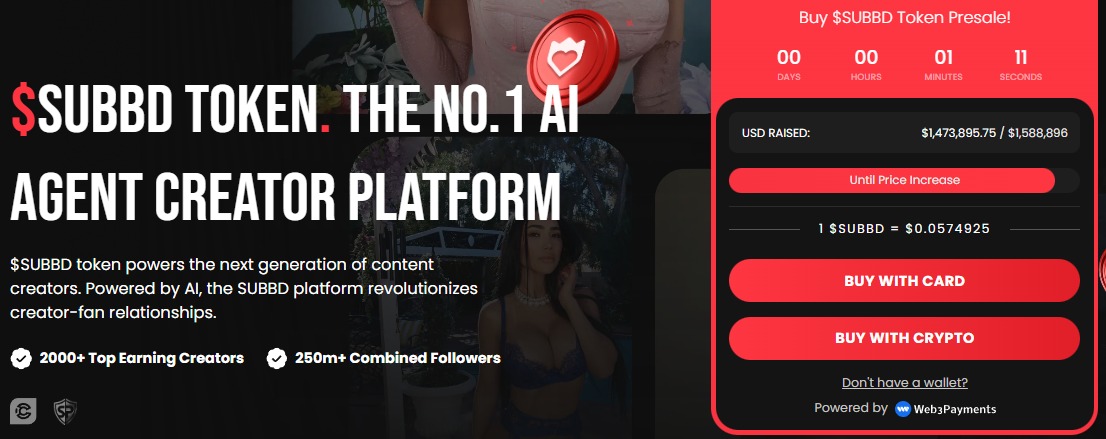
The article describes the SUBBD Token presale as a sentiment indicator for the AI-Web3 convergence. It reports that the project has raised exactly $1.47M, with tokens priced at $0.057495.
Staking is described as designed to encourage longer-term holding. The article states SUBBD offers a fixed 20% APY for the first year for users who lock their tokens.
It also says staking provides access to exclusive livestreams, “behind the scenes” (BTS) drops, and XP multipliers intended to enhance platform standing, framing the approach as focused on community stability rather than short-term trading.
As the presale progresses, the article says attention shifts to the rollout of “HoneyHive” governance features and the onboarding of the first cohort of AI-driven influencers.
For investors seeking alternatives to high-fee structures in both DeFi and Web2, the article presents SUBBD as a “logic-driven” option centered on lower-friction participation.
This article is for informational purposes only and does not constitute financial advice. Cryptocurrencies are high-risk assets. Always perform your own due diligence before investing. The views expressed here are those of the author and do not necessarily reflect the official policy of any financial institution.
Editorial Process for bitcoinist is centered on delivering thoroughly researched, accurate, and unbiased content. We uphold strict sourcing standards, and each page undergoes diligent review by our team of top technology experts and seasoned editors. This process ensures the integrity, relevance, and value of our content for our readers.