•
•
•
•
•
•
•
•
•
•
•
•
•
•
•
•
•
•
•
•
•
•
•
•
•
•
•
•
•
•
•
•
•
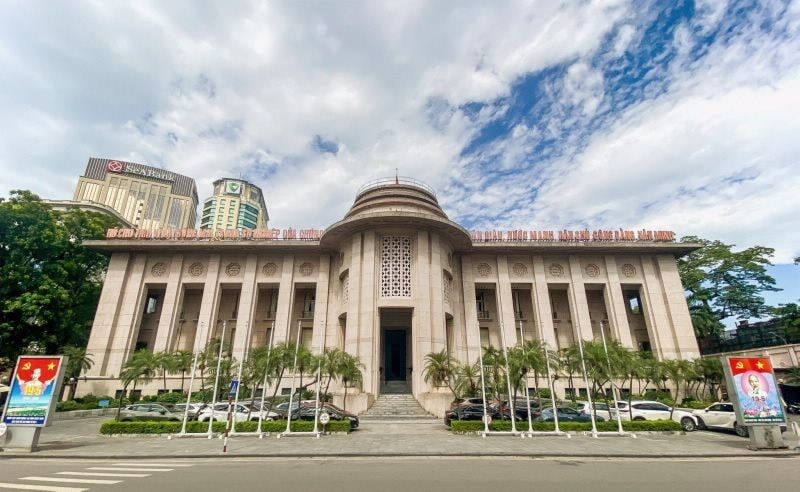
VNĐ interbank rates stayed in the lower range in the June 15 session, with movements differing by tenor. The overnight rate, which makes up most of market transactions, held at 3.50% per year. The 1-week and 1-month tenors rose by 0.20 and 0.15 percentage points to 5.00% and 7.50% per year, respectively. The 2-week tenor edged down by 0.05 percentage points to 5.65% per year.
Liquidity in the banking system remained stable after interbank rates cooled sharply last week. At the close of June 12, VNĐ interbank rates fell across most tenors versus the previous weekend: the overnight rate dropped by 2.7 percentage points to 3.50% per year; the 1-week tenor fell by 1.8 percentage points to 4.80% per year; the 2-week tenor declined by 1.3 percentage points to 5.70% per year; and the 1-month tenor decreased by 0.1 percentage point to 7.35% per year.
In this context, the State Bank of Vietnam continued to intensify liquidity absorption. In the June 15 session, it offered 2,000 billion VND via the pledge channel, including 1,000 billion VND with a 35-day tenor and 1,000 billion VND with a 56-day tenor, with interest rates maintained at 4.50% per year. The full tendered volume was absorbed by credit institutions.
Meanwhile, maturities on the day totaled 24,122 billion VND. Because the State Bank did not issue new bills, it absorbed net 22,122 billion VND from the banking system in the session. The outstanding volume on the pledge channel fell to 258,084 billion VND.
Previously, the State Bank also absorbed net 25,733 billion VND through open market operations during the week of 8–12 June.
Rong Viet Securities (VDSC) said that in 2026 the State Bank fundamentally changed how liquidity is supported through the open market channel compared with 2025. Instead of heavy long-tenor injections seen in 2025, from the end of Q1 2026 the central bank has provided “drip-like” support via the pledge channel with short tenors of 7–14 days. As a result, the outstanding OMO balance is now around nearly 300,000 billion VND, down sharply from the near 500,000 billion VND peak in late February 2026.
VDSC attributed the shift to the State Bank’s deliberate choice, citing a thin foreign exchange reserve buffer. It said large-scale VNĐ liquidity injections could put depreciation pressure on the dong and complicate exchange-rate management. The broker also pointed to inflation risks linked to geopolitical tensions in the Middle East as an additional constraint when deciding whether to loosen liquidity.
Bitcoin (BTC) investors who use steady dollar-cost averaging (DCA) may be underperforming versus strategies that adjust exposure to the market’s cycle, according to new research arguing that Bitcoin’s behavior differs from traditional long-duration assets.
In a report cited by Markus Thielen of 10x Research, Bitcoin’s market…