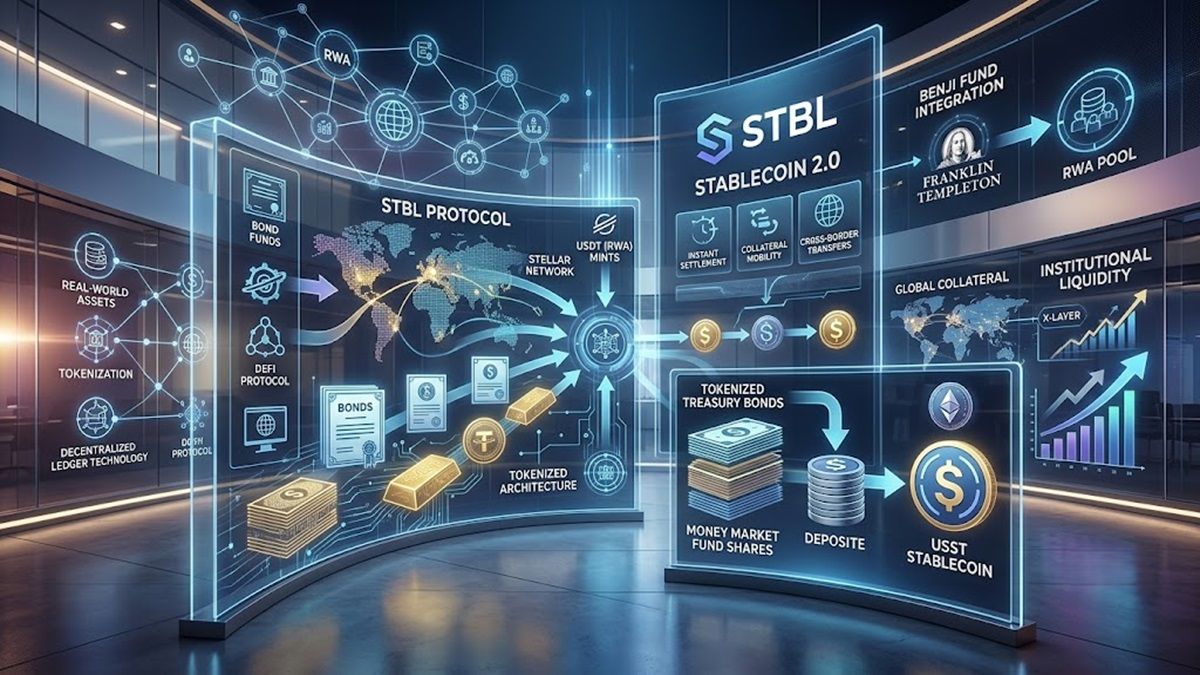
On July 1, 2026, STBL officially launched the institutional stablecoin USST on the Stellar blockchain, backed by tokenized real-world assets (RWA). Initial minting uses tokenized treasury collateral USDY, with plans to add Franklin Templeton’s BENJI fund as a secondary backing option at a later stage.
The development reflects increasing institutional interest in real-world asset liquidity and the use of open blockchain infrastructure to support asset workflows. The launch demonstrates how open networks can support institutional asset workflows and expand utility within the tokenized asset ecosystem.
Asset issuance occurs by depositing tokenized treasury bonds or shares in money market funds. The initial minting process is conducted from eligible treasury collateral USDY. The token employs a Stablecoin 2.0 architecture, enabling immediate settlement, mobility of operational collateral, and automated cross-border transfers. STBL was co-founded by technology specialist Avtar Sehra and entrepreneur Reeve Collins, who previously co-founded the issuing firm Tether.
The technical infrastructure includes use on the X-Layer scalability platform, where USST acts as a reserve asset. Stellar Development Foundation representatives note that financial institutions require networks capable of supporting settlement processes with high practical utility and fluidity, and the new instrument aligns with this objective.
The launch represents a step forward in Stellar's strategy to serve institutional fixed-income markets and real-world asset workflows. By enabling tokenized real-world assets to function as liquidity and settlement collateral, the network aims to optimize value transfer for bondholders and support settlement processes with increased utility.
Officials from the Stellar Development Foundation indicate that financial corporations demand networks capable of supporting settlement processes with high practical utility and fluidity. The USST launch illustrates how open blockchain infrastructure can support institutional asset workflows and broaden the utility of tokenized assets. The project has not disclosed a date for BENJI integration or the total minting volume in the initial issuance.