•
•
•
•
•
•
•
•
•
•
•
•
•
•
•
•
•
•
•
•
•
•
•
•
•
•
•
•
•
•
•
•
•


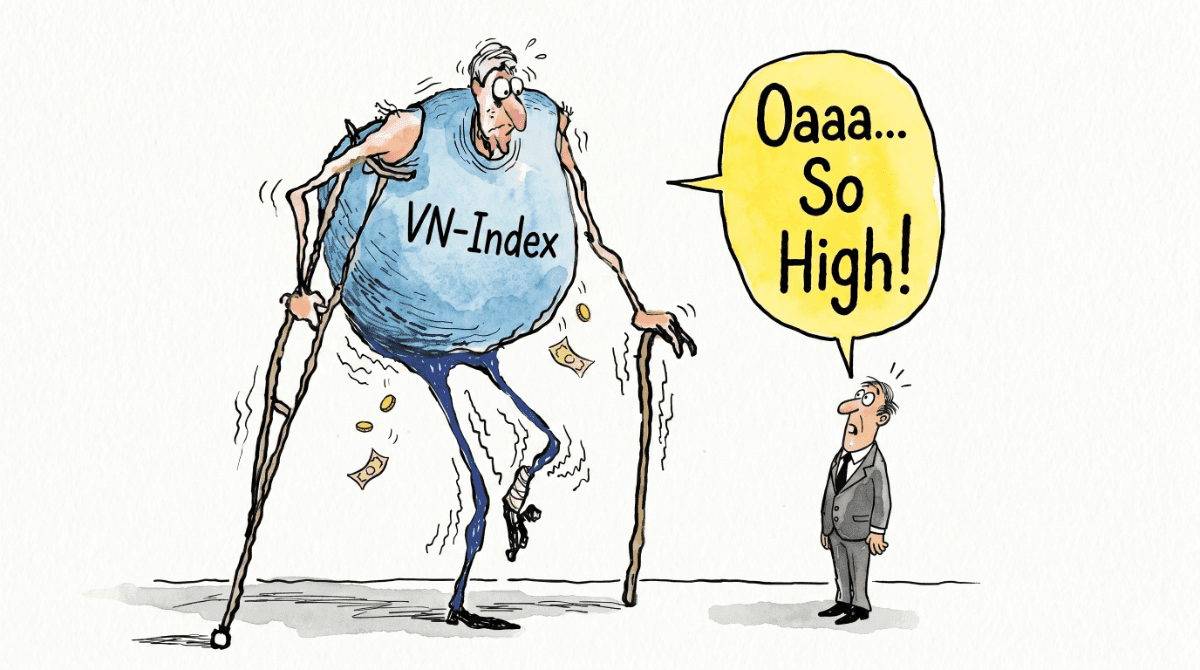
Even leading stocks such as VIC and VHM were sold off heavily, STB was pushed to the ceiling, and the rest were mostly in the red. If negotiations can proceed and a cease-fire extension is reached, there will still be opportunities. Otherwise, the market remains uncertain, and safety comes first.
VNIndex closed the session down slightly by 0.2%, helped by VIC up 1.41%, STB up 5.45%, LPB up 2.28%, and VHM up 0.48%. However, breadth was negative, with decliners outnumbering gainers by 2.3 to 1, and 125 stocks falling by more than 1%.
The session showed a stronger round of profit-taking than the previous day, and the market failed to maintain differentiation. Liquidity on the two exchanges rose nearly 23% versus yesterday, exceeding 23 trillion dong excluding negotiated deals, indicating selling pressure below the reference price.
While VNIndex advanced over the last three sessions, many individual stocks have stalled for four sessions. The caution also appears to have increased toward the ceasefire deadline after a relatively solid short-term uptrend following the ceasefire agreement.
The likelihood of a meeting between the two negotiating teams remains unclear. At minimum, credible signals are needed before an extension can be expected. If negotiations proceed, the market would then face the risk that talks do not produce any outcome, potentially triggering renewed pressure and a hotter conflict.
The article outlines three scenarios: an interim “pause” agreement that could extend the détente and allow time for a third round of negotiations (which could lead to a positive market reaction); or a best-case outcome where the conflict ends entirely at the negotiating table, which would likely drive a sharp market rally. However, the piece emphasizes that outcomes are unpredictable and investors should wait for confirmation signals rather than act early.
At the start of the session, the futures market reflected a cautious mindset. VN30 rose in the first half, but the basis was sometimes more than -20 points. When VN30 moved up from around 2027.xx, the basis was about -13 points, which was described as large; when the index reached 2040.xx for the first time, the basis widened to -21 points. As VN30 reversed from 2040.xx, the basis was around -17 points, and going Short was not advised.
Only after VN30 retraced and failed to retest the 2027.xx level in the afternoon did the basis ease to around -8 points, making a Short position possible.
VN30 closed at 2007.08. The nearest resistance levels for tomorrow are 2014, 2027, 2040, 2049, 2062, 2072, and 2079. Support levels are 1997, 1982, 1973, 1960, 1950, and 1935.
The article characterizes the market as approaching a point of uncertainty where both unfavorable and favorable scenarios can occur. Broad profit-taking today is presented as consistent with risk-off sentiment. It also stresses that real money matters most, and in a bad scenario a single session could erase prior gains. In speculation, it advises guarding against the worst-case outcome rather than hoping for the best.
“Blog chứng khoán” is a personal blog and does not represent VnEconomy’s views. The opinions and assessments are those of the individual investor, and VnEconomy respects the author’s views and style. VnEconomy and the author are not responsible for issues arising from the assessments and investment opinions published.







Premium gym chains are entering a “golden era” that is ending or already in decline, as rising operating costs collide with shifting consumer preferences toward more flexible, community-based ways to exercise. Long-term memberships are shrinking, margins are pressured by higher rents and facility expenses, and competition from smaller, more personalized…