•
•
•
•
•
•
•
•
•
•
•
•
•
•
•
•
•
•
•
•
•
•
•
•
•
•
•
•
•
•
•
•
•

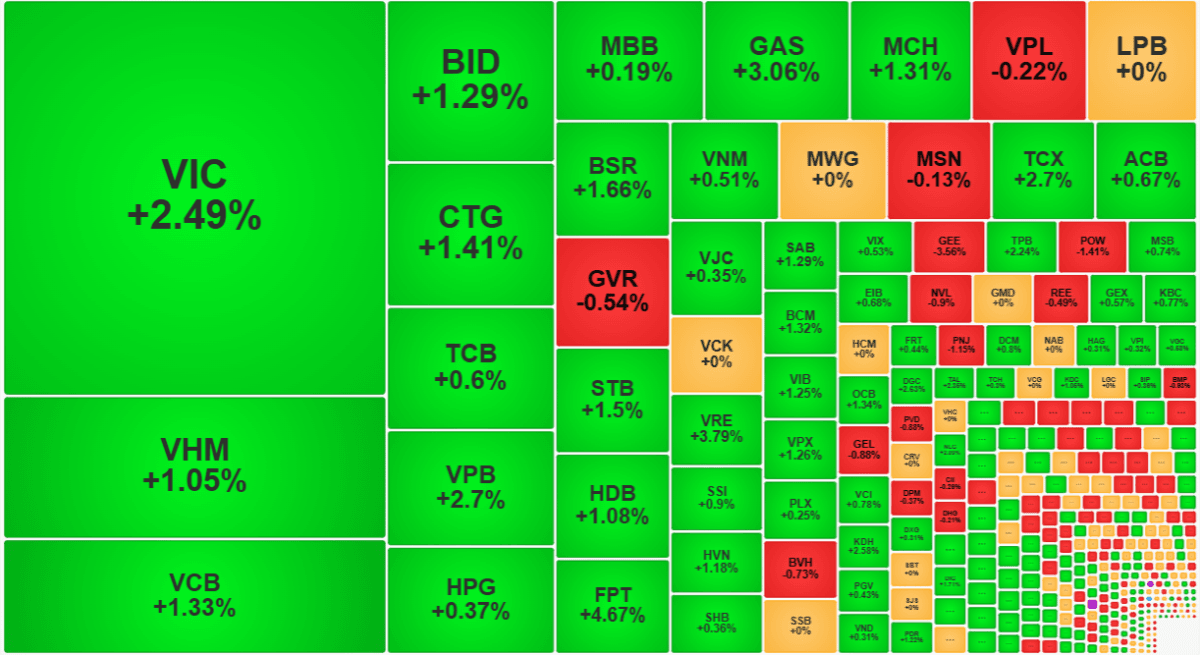
The VN Index (VNI) rose strongly today and surpassed the 1,900-point mark, but the overall market remained weak as most stocks declined. The securities sector briefly surged before losing momentum. With the index pushed higher by a limited set of stocks, the reliability of breakout signals beyond the resistance level was reduced.
Looking back to late December last year, VNI was driven to a historic high by VIC and VHM (around 1,800 points), but the move ultimately stalled. When the leading stocks turned lower, the downside impact was larger than a typical correction.
The divergence between market breadth and the index is also a warning sign. Today, the advance/decline ratio was about 0.62 to 1, and over the last four weeks only six sessions saw the ratio balanced or leaning toward gains. While the strong index rise supported sentiment and helped prevent widespread intraday selloffs, a higher-quality breakout is still needed—one that benefits the broader market rather than only a group of stocks.
Intraday dynamics showed that many stocks moved higher early and then weakened later, or rose initially and fell afterward. This is not the trading pattern typically associated with a durable VNI breakout beyond a key psychological level.
More than 54% of stocks traded saw their prices fall back by over 1% from intraday highs, and 70% of those were pushed below the reference level. This points to active selling, though it was not a severe rout: roughly 22% of VNI’s liquidity was concentrated in the weakest group (down more than 1% from the reference), which was not overwhelming.
Despite the index’s strong performance, the day did not deliver the kind of broad-based rally that could have been supported by improving external conditions such as global equity strength, sharply lower oil prices, and easing tensions. The assessment remains that momentum to launch a new upcycle is still insufficient, even though trading “hotspots” appear intermittently.
The current market view is unchanged: even if VNI reaches a new high, opportunities are expected to remain limited and selective. Participation is possible but should be modest and focused on short-term trading.
The derivatives market was relatively favorable for trading, with a narrow basis. Except for the first 30 minutes—when the F1 basis was relatively wide—VN30 tested 2061.xx with a basis under 2 points, which is considered good for a long position using an index-based stop-loss if VN30 falls below 2061.
Although the intraday range was narrow, the second move from 2073.xx to 2086.xx occurred rapidly once the afternoon session began, and the basis widened quickly as well. VN30 did not have enough momentum to extend meaningfully beyond 2086.xx toward the 2100.xx area. As a result, the risk of holding a long position was assessed as fairly high, requiring a fast exit to avoid losses.
With VIC and VHM at new highs, VNI could potentially break the 1918–1920 point threshold, signaling a new high, assuming other leading stocks do not deteriorate too much. However, such a move is considered unlikely to trigger a broad rally. The strategy remains to trade conservatively and focus on derivatives.
VN30 closed today at 2079.1. Nearest resistance levels for tomorrow are 2087; 2100; 2117; 2130; 2140; 2149. Support levels include 2073; 2061; 2049; 2040; 2028; 2015.
Note: “The Stock Blog” is personal in nature and does not reflect the views of VnEconomy. The opinions and assessments are those of individual investors, and VnEconomy respects the author’s views and writing style. VnEconomy and the author are not responsible for issues arising from the evaluations and investment opinions posted.

Bitcoin (BTC) investors who use steady dollar-cost averaging (DCA) may be underperforming versus strategies that adjust exposure to the market’s cycle, according to new research arguing that Bitcoin’s behavior differs from traditional long-duration assets.
In a report cited by Markus Thielen of 10x Research, Bitcoin’s market…