•
•
•
•
•
•
•
•
•
•
•
•
•
•
•
•
•
•
•
•
•
•
•
•
•
•
•
•
•
•
•
•
•


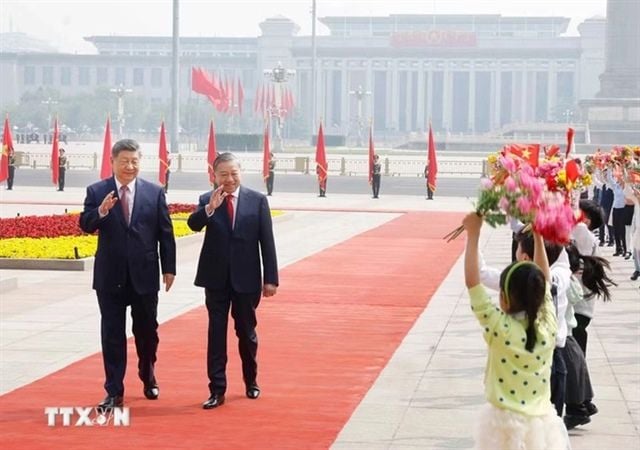
In high-level diplomacy, there are visits that carry meanings beyond the scope of a single event. They are moments when every step is not only about strengthening bilateral relations but also about shaping how a country chooses its position in a world that is changing.
Today’s world no longer operates on the inertia of the post–Cold War period, where economic integration was the principal driving force. Instead, a new era is emerging in which strategic competition becomes the central axis governing international relations.
Competition now extends beyond geopolitics into new spaces such as technology, data, supply chains, and global standards. Sectors once seen as neutral—semiconductors, artificial intelligence, and energy—have become hot spots of power competition.
Alongside this, global supply chains are being redesigned under a new logic. Where efficiency and cost used to be the criteria, reliability and security are now decisive. Countries no longer seek the cheapest partners but the most trustworthy ones.
A notable feature is the interweaving of cooperation and competition. Nations collaborate deeply in some areas while competing intensely in others. This makes the international environment more complex, requiring not only a clear strategy but also flexible adaptive capacity.
Tied to this, restructuring is not merely a shift in the world but a process of redesigning power structures and interests. In a world being redesigned, a country’s position is not something granted; it is the result of calculated strategic choices.
Vietnam does not stand in the middle and wait passively; it actively positions itself within the stream of global restructuring. An independent, self-reliant foreign policy, multi-polarization, and diversification carry not only principled significance but have become concrete capabilities for action.
Independence is not about keeping distance; it is the ability to decide one’s development path. Multi-polarization is not only about broadening relations; it is about optimizing the country’s position in an increasingly complex network of relations.
In that logic, strengthening ties with major partners, including China, is not a contingent choice but part of a comprehensive strategy to preserve a peaceful and stable environment and maximize development opportunities.
More importantly, these layers of meaning are integrated into a single logic. The visit is not just about achieving a specific objective; it serves multiple goals: maintaining stability, expanding cooperation, and reinforcing the political trust that underpins complex relationships.
This integration reflects a shift in foreign policy thinking—from handling issues one by one to designing moves with high systemic linkage.
Diplomacy can open opportunities, but development only comes when those opportunities are realized, which depends on domestic capacity. The directions of cooperation stemming from the visit—from infrastructure and trade to technology—only matter if they are implemented as concrete projects that create real value for the economy.
This requires foreign policy thinking to be linked with domestic execution capacity. A correct strategy cannot realize its potential without a flexible institutional system, a capable machinery, and a transparent policy environment.
In a world where capital and technology are moving rapidly, opportunities do not wait. The country that acts faster and more effectively will seize the advantage.
For Vietnam, this means continuing to reform institutional frameworks, raising the capacity of the machinery, and building a seamless execution chain from policy design to implementation and supervision.
Viewed this way, foreign policy not only opens opportunities but also creates positive reform pressure on the domestic system.
A key feature running through the visit is the shift from foreign policy thinking as event-focused to structural thinking.
In a stable world, countries can exploit short-term opportunities. But in a restructuring world, the advantage belongs to those who understand the structures being formed and know how to position themselves within them.
Structural thinking allows looking at the world as a connected system, where every move has not only immediate effects but long-term ripple effects. In this view, a visit is not merely an event but a node in a strategic network.
For Vietnam, this has special meaning. As an open economy and a country occupying an important geopolitical position, Vietnam cannot simply follow existing structures; it must actively participate in shaping them.
When foreign policy, economy, institutions, and execution are connected within a coherent whole, every diplomatic step becomes part of a strategy to elevate national status.
In the stream of diplomacy, there are visits that allow a clearer identification of how a country thinks about its future. Vietnam’s visit to China by the General Secretary and President is presented as such a case.
The deeper meaning of the visit lies not only in what happened but also in what it hints at: a new approach in which foreign policy becomes a tool to shape the development environment, structural thinking becomes the strategic foundation, and execution capacity becomes the ultimate measure.
In a world where the rules of the game are being rewritten, the advantage belongs to those who actively participate in shaping those rules.
Perhaps this is the greatest message of the visit.
TS. Nguyễn Sĩ Dũng
Governmental Newspaper





Premium gym chains are entering a “golden era” that is ending or already in decline, as rising operating costs collide with shifting consumer preferences toward more flexible, community-based ways to exercise. Long-term memberships are shrinking, margins are pressured by higher rents and facility expenses, and competition from smaller, more personalized…