•
•
•
•
•
•
•
•
•
•
•
•
•
•
•
•
•
•
•
•
•
•
•
•
•
•
•
•
•
•
•
•
•
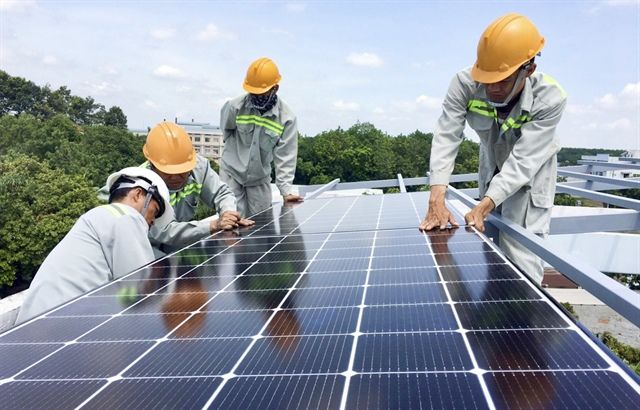
Residential electricity prices in Vietnam are calculated using six progressive tiers, so summer bills often rise sharply when household consumption crosses the tier thresholds. Under the current tariff structure, installing rooftop solar can help households reduce monthly electricity payments—especially in peak hot months when air conditioning and other high-power appliances drive usage higher.
Under Decision No. 1279/QĐ-BCT dated May 9, 2025, the residential electricity price is set across six progressive levels:
The gap between tiers is significant. Tier 6 is 1,520 dong/kWh higher than Tier 1, 1,410 dong/kWh higher than Tier 2, 1,080 dong/kWh higher than Tier 3, 460 dong/kWh higher than Tier 4, and 110 dong/kWh higher than Tier 5.
In peak summer months, households can be surprised by steep electricity bills because once consumption exceeds the defined thresholds, additional electricity is charged at higher rates. As a result, even a relatively small increase of “a few dozen kWh” in a hot month can materially raise the total bill compared with the previous month.
Prolonged hot weather, long hours of air conditioning, and high-power appliances such as cooling devices, induction stoves, and electric water heaters can push consumption upward quickly, accelerating the move into higher price tiers.
Rooftop solar can reduce household electricity bills by generating electricity on-site. North Region Power Corporation (EVNNPC) has issued recommendations based on monthly consumption levels.
For monthly consumption below 300 kWh, EVNNPC states it is not yet necessary to invest in rooftop solar.
For monthly consumption from 300–500 kWh, rooftop solar capacity of 2–3 kWp can be considered. The expected monthly production is about 250–350 kWh, with a payback period of 5–6 years.
With solar generation, household electricity purchases can drop to below 200 kWh/month. Previously, with consumption of 300–500 kWh/month, bills would have already shifted to Tier 4, 5, or 6.
For households consuming 500–800 kWh/month, EVNNPC recommends installing rooftop solar with 3–5 kWp. Monthly yield is estimated at 400–650 kWh, with payback of 4–5 years. After installation, these households can avoid Tier 5 and Tier 6.
For consumption around 800–1,200 kWh, rooftop solar of 5–7 kWp is described as highly recommended. The monthly yield would range from 650–900 kWh, with payback of 3.5–4.5 years.
Notably, with rooftop solar output, these households would not have to use electricity priced at Tier 6 (3,460 dong/kWh), resulting in substantial monthly savings.
As energy demand grows, investment efficiency across different power generation options becomes a key factor in energy policy. Based on average capital costs, rooftop solar is currently priced at 13–16 million dong per kWp. The payback period is estimated at 3.5–6 years, while solar battery storage lifetime can reach 15–20 years, supporting long-term returns.
According to Mr. Nguyen Thuong Quan, General Director of Sao Nam Integrated Technology, rooftop solar system design should start by determining the household’s load to calculate a suitable investment cost.
He recommended that households do not necessarily need to install a large system. Instead, they should install enough capacity to keep electricity bills from reaching Tier 5 and Tier 6, achieving significant savings with a lower upfront cost.
Premium gym chains are entering a “golden era” that is ending or already in decline, as rising operating costs collide with shifting consumer preferences toward more flexible, community-based ways to exercise. Long-term memberships are shrinking, margins are pressured by higher rents and facility expenses, and competition from smaller, more personalized…