•
•
•
•
•
•
•
•
•
•
•
•
•
•
•
•
•
•
•
•
•
•
•
•
•
•
•
•
•
•
•
•
•


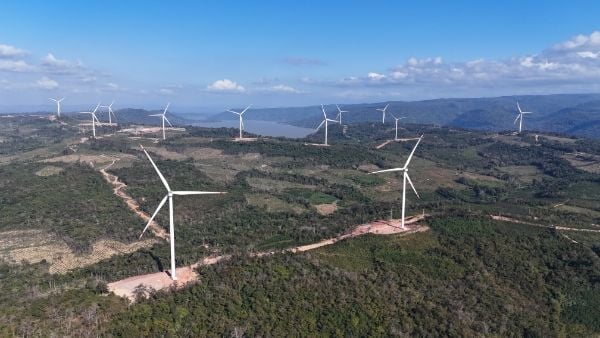
The cross-border wind-power project led by T&T Group, spearheaded by Bai Bâu Hiên, has been completed in 16 months, delivering 0.9 billion kWh per year. This pace is not only a record in project delivery but also raises questions about a fundamentally different approach to energy development. T&T Group, Savan 1, and the Fast-Track Journey Across the Land of the Million Elephants By December 2025, shortly after receiving the concession contract from the Lao government in January 2025, T&T Group advanced the main components of the project in parallel, including generation and transmission infrastructure, within a single integrated package, thereby gaining proactive control over schedule and grid integration. The project faced challenging terrain spanning mountainous areas, with requirements to transport equipment across the border and withstand harsh weather conditions. Notably, the result of this approach was milestones achieved rapidly. On August 31, just over six months later, the 220 kV transmission line, nearly 70 km from the plant to the connection point in Vietnam, was completed. Choosing to invest in dedicated transmission infrastructure upfront, even at higher costs, helped the project avoid the scenario of finishing generation but waiting for the grid. In the power sector, the gap between a project and an actual power source often lies in transmission. Soon after, at the end of 2025, the Savan 1 wind plant officially achieved commercial operation (COD). From the Savannakhet wind plateau, power is transmitted along a dedicated 220 kV line, crossing the border and integrating into Vietnam’s grid at Lao Bao. Importantly, the entire sequence—from legal finalization, contracting, construction, to transmission-infrastructure investment and grid connection—was completed within about 16 months, a pace rarely seen for large-scale onshore wind projects in the region. This reflects not only construction speed but also the ability to coordinate all project stages, addressing procedural hurdles and transmission bottlenecks, thereby creating a distinctive approach to developing cross-border energy projects. As of now, Savan 1 operates steadily, delivering 0.9 billion kWh per year to the national grid. The grid-connection rate exceeds 90%. Experts say Savan 1’s story clearly demonstrates the measurable results of Vietnam–Laos energy cooperation and highlights the growing role of the private sector in turning energy-security ambitions into tangible execution, beyond planning or pledges. Vietnam–Laos Energy Cooperation in the National Energy Security Equation A notable point from Savan 1 is the increasing role of the private sector in turning energy policy into real outcomes. Historically, energy infrastructure—especially transmission—was viewed as a state-led domain. Given growing capital needs, tight schedules, and the energy-transition pressures, deeper private-sector participation is becoming essential to push projects into operation. Against this backdrop, T&T Group approaches energy not as a sole investor but as part of a long-term portfolio aligned with national priorities. The group aims, step by step, to participate in supplying around 10% of Vietnam’s total installed capacity in the medium to long term—a sign of a methodical approach that ties corporate growth to energy-security requirements. Founder and Executive Chairman Do Quang Hien of T&T Group has stressed that a company can sustain a long-term path in energy only when investment is balanced with national interests, system sustainability, and real value creation for the economy. This view helps explain T&T’s pursuit of large, high-capital projects and rigorous execution, rather than short-term investments. The completion, interconnection to Vietnam’s grid, and stable operation of Savan 1 thus represent more than a single wind project; they illustrate the policy-direction realization through private-sector resources and signal that Vietnam–Laos energy cooperation is moving to a phase measured by operational effectiveness and tangible contributions to national energy security.






Premium gym chains are entering a “golden era” that is ending or already in decline, as rising operating costs collide with shifting consumer preferences toward more flexible, community-based ways to exercise. Long-term memberships are shrinking, margins are pressured by higher rents and facility expenses, and competition from smaller, more personalized…