•
•
•
•
•
•
•
•
•
•
•
•
•
•
•
•
•
•
•
•
•
•
•
•
•
•
•
•
•
•
•
•
•


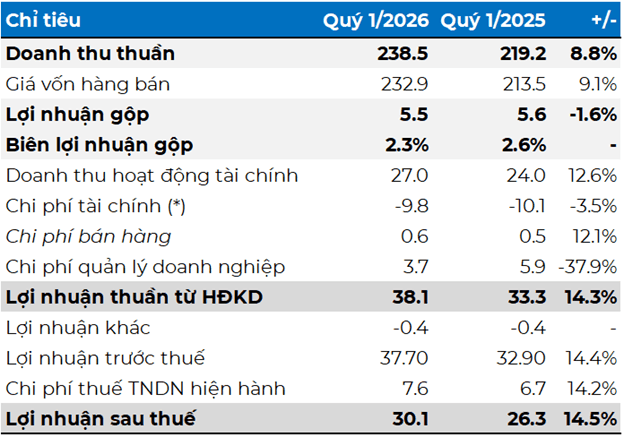
Thaiholdings Joint Stock Company (HNX: THD) reported Q1 2026 net profit after tax of 30.1 billion dong, completing more than 33% of its full-year profit target within the first three months.
In Q1, THD’s net revenue reached 238.5 billion dong, up 8.8% year-on-year. Net profit after tax rose 14.5% to 30.1 billion dong, supported largely by financial revenue of 27 billion dong, which increased by nearly 13%, alongside cost reductions.
During the quarter, Thaiholdings allocated nearly 1,647 billion dong (up more than 83 billion dong from the start of the year) to secured short-term lending for 11 months to four companies:
Thaiholdings also made long-term investments with a gross value of more than 2,613 billion dong. The largest allocation was 1,800 billion dong into Thaigroup, which holds 48% of Thaiholdings. The remaining investments were directed to Kim Lien Travel JSC (17.2% holding), Hanoi Ton Đan JSC (19.52%), and LPB Fund Management Co., Ltd (15%), which were major THD shareholders in the past.
In February 2026, the company spent 7.5 billion dong to purchase an additional 750 thousand shares to increase its stake in LPB Fund Management.
Other receivables currently amount to more than 97 billion dong. Long-term other receivables account for nearly 93 billion dong, including office lease deposits of nearly 87 billion dong for Ton Đản Hanoi JSC. The remainder of over 6 billion dong relates to a business cooperation contract with Kim Lien Travel. The cooperation funds are used to implement a mixed-use complex project at 5-7 Đào Duy Anh, Hanoi, including commercial and service facilities, a hotel, an office building, and rental apartments.
For 2026, Thaiholdings targets net revenue of 967 billion dong, with pretax profit and net profit targets of 114 billion dong and 91 billion dong, respectively—each lower than the 2025 results.
Based on the Q1 performance, after the first three months of 2026, the company has achieved nearly 25% of the revenue target and 33% of both the pretax and after-tax profit targets.






Premium gym chains are entering a “golden era” that is ending or already in decline, as rising operating costs collide with shifting consumer preferences toward more flexible, community-based ways to exercise. Long-term memberships are shrinking, margins are pressured by higher rents and facility expenses, and competition from smaller, more personalized…