•
•
•
•
•
•
•
•
•
•
•
•
•
•
•
•
•
•
•
•
•
•
•
•
•
•
•
•
•
•
•
•
•


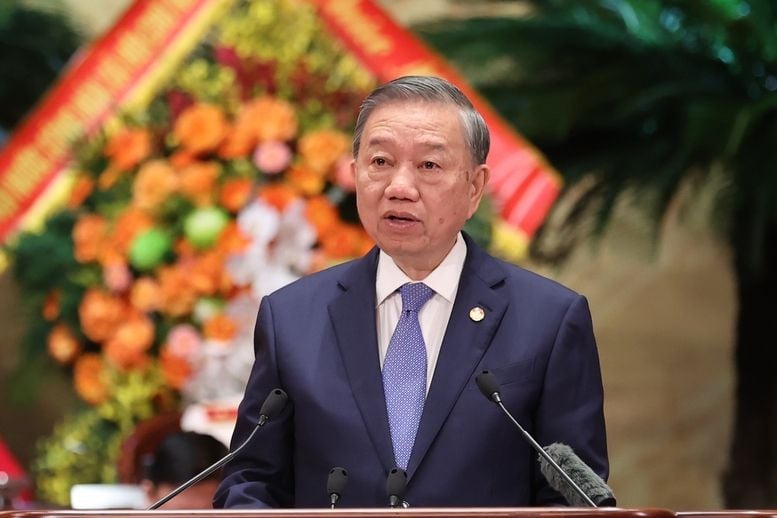
The Fatherland Front must be the place to protect the legitimate interests of the people.
On May 12, the 11th National Congress of the Vietnam Fatherland Front for the 2026–2031 term was formally opened at the National Convention Center in Hanoi. The congress was attended by General Secretary and State President To Lâm, other leaders, former leaders of the Party and State, and 1,136 delegates representing the Fatherland Front, member organizations, and the bloc of great national unity.
In his directive to the Congress, To Lâm said the 11th Congress marks a milestone at the start of a new development phase for the Vietnam Fatherland Front, as the country enters a period requiring new tasks and a new organizational model. He said the Front must clarify its role and operating methods to continue serving as a forum that gathers the people, reflects public opinion, defends the people’s legitimate interests, and connects and mobilizes the strength of the entire nation toward national development goals to 2030 with a vision to 2045.
To Lâm said history has shown that when the people’s will is united, the entire nation can overcome challenges and achieve sustainable achievements. He described great national unity as both a precious tradition and a strategic line, a source of strength for the Vietnamese revolution—from the August Revolution, through wars of national liberation and defense of the Fatherland, to renovation, integration, and development.
In the new era, he said great national unity has become not only a spiritual value but also a development capability of the country—an important resource to unleash creativity, build social consensus, and safeguard the nation.
He said unity today requires respecting lawful differences, balancing interests, and aligning with the country’s common goal of a peaceful, independent, democratic, prosperous, and civilized Vietnam.
During the past term, To Lâm noted that Front systems at all levels and member organizations, despite a shortened period, proactively carried out important tasks, reorganized and prepared the apparatus according to Party directives, prepared the Congress carefully, and gradually operated under the new model to ensure stable and smooth functioning.
He also acknowledged results achieved while requesting that limitations and shortcomings be addressed candidly to formulate solutions for the next term.
Emphasizing the principle “the people are the foundation,” To Lâm said the people are the center of renewal and development and the guiding principle throughout all Front activities. He said all Party lines, State policies, and Front programs, movements, and campaigns must originate from the needs, aspirations, rights, and legitimate interests of the people, aiming to improve their material and spiritual life and happiness.
To Lâm said the Front must both bring Party and State policies to the people and serve as a channel to faithfully reflect the people’s voices, aspirations, initiatives, and legitimate concerns to the Party and State.
He called for renewing the method of mobilizing and engaging the people in a rapidly changing society, saying mobilization cannot rely only on conferences, documents, or slogans. Instead, it should be conducted through dialogue, persuasion, tangible benefits, exemplary conduct, and concrete results.
He said each program, movement, and campaign should move from broad mobilization to concrete implementation, from form to substance, and be easy to understand and implement, with measurable results and real impact on people’s lives.
To Lâm said the Front should not replace the State or member organizations and should not be bureaucratic. Under the new organizational model, he said the apparatus can be leaner, but operations must be closer to the people. He said the Front may have fewer levels while expanding its capacity to gather people, and must play the role of political core in gathering, mediation, coordination, supervision, criticism, and mobilizing the strength of the people.
To Lâm highlighted the need to enhance the quality of social supervision and criticism and participation in building the Party and the State. He said supervision should focus on issues of public concern, social grievances, and policies with a large impact on people’s lives.
He said social criticism should be conducted early, from a distance, even during policy formation, and should go beyond wording to examine goals, feasibility, resources for implementation, and people’s benefits.
Front cadres, he said, must have political backbone, credibility in the community, and skills in mobilization, dialogue, criticism, and problem-solving. He said they must not be distant from the people, should go to the base, listen to the end, and follow through on addressing petitions.
He also called for systematic application of digital platforms to receive and process people’s feedback, enabling people to contribute suggestions anytime and anywhere.
To enable the Front to fulfill its tasks, To Lâm urged all levels to recognize more fully the Front’s position and role; respect, listen, coordinate, and create conditions for the Front to carry out its assigned functions. He said supervision comments and criticisms of the Front should be treated as important channels to improve leadership, governance, and operations.
Immediately after the Congress, he asked Front levels to promptly translate the Congress resolution into programs and action plans with clear people, clear tasks, clear responsibilities, clear deadlines, and clear results, ensuring the Congress’ spirit is brought into the life of the people.
With almost a century of companionship with the nation, To Lâm said he is confident the Vietnam Fatherland Front for the 2026–2031 term will continue to develop strongly, substantively, and more effectively—worthy of being the central hub of national unity and a reliable bridge between the Party, the State, and the people—contributing to sustainable national development in the new era.

Premium gym chains are entering a “golden era” that is ending or already in decline, as rising operating costs collide with shifting consumer preferences toward more flexible, community-based ways to exercise. Long-term memberships are shrinking, margins are pressured by higher rents and facility expenses, and competition from smaller, more personalized…