•
•
•
•
•
•
•
•
•
•
•
•
•
•
•
•
•
•
•
•
•
•
•
•
•
•
•
•
•
•
•
•
•


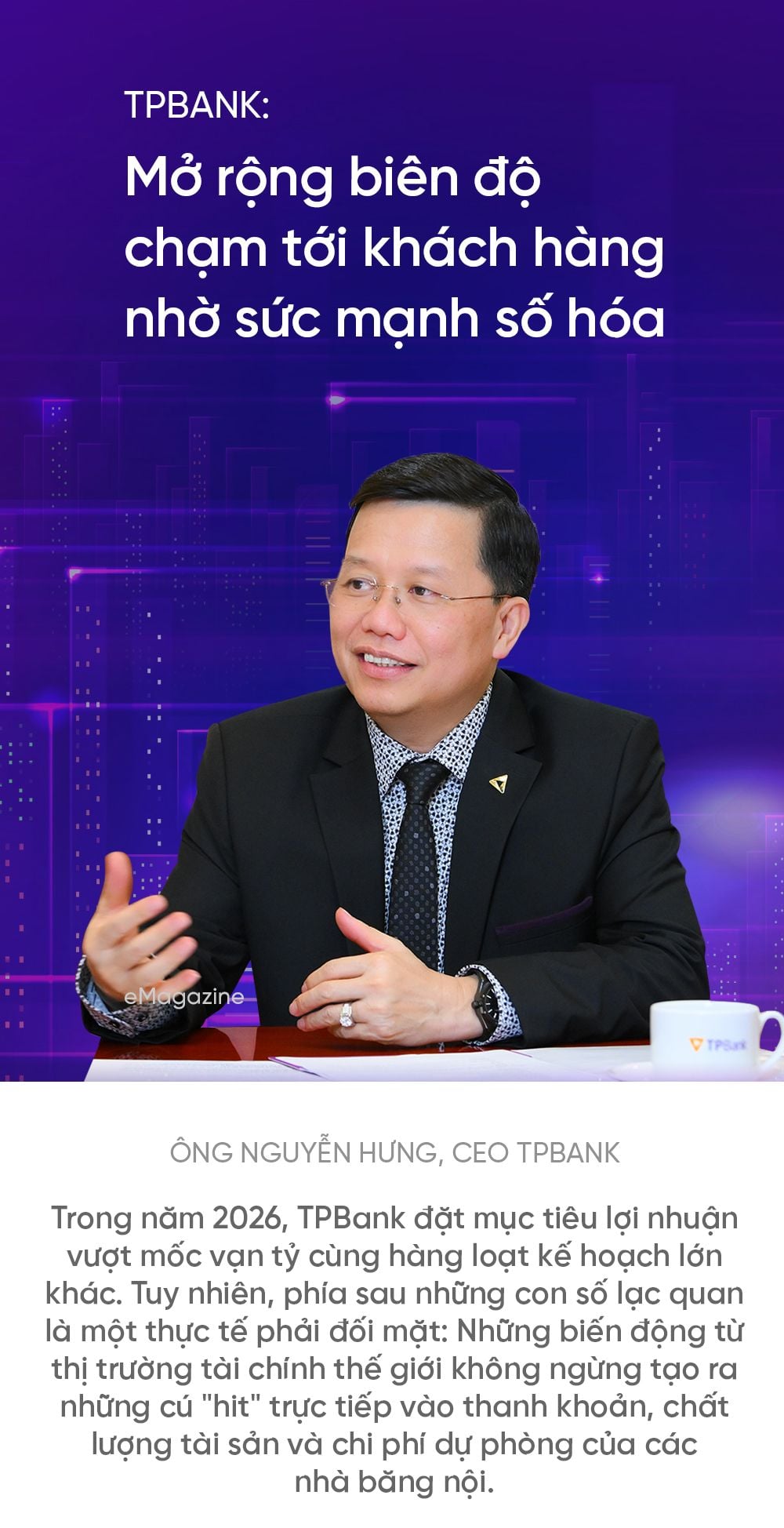
With CEO Nguyen Hung leading TPBank for more than a decade through the bank’s restructuring, governance in this phase resembles “laying a narrow blanket”: the bank must balance rigorous safety indicators with the ambition to scale in a volatile economy.
In its latest shareholder plan, TPBank sets a cautious growth target of 12% for this year, based on last year’s profit of VND 9,205 billion, implying profit of about VND 10,300 billion. Nguyen Hung said the bank is capable of achieving growth of 20% or more, but the main constraint is not lending capacity; it is strict regulations from the State Bank.
He cited two key limitations: a maximum of 25% of short-term capital may be used for medium- and long-term lending, and the risk weight for real estate has been raised by 2.5 times, narrowing operating space. The bank also needs to actively manage asset quality as the health of the business community has not fully recovered.
TPBank argues that viewing banks only through “lending and credit growth” keeps the discussion within a familiar constraint. By shifting the reference frame to a multi-dimensional financial services platform, the bank says growth can come from building revenues and profits across a service ecosystem, where each customer touchpoint can become a new revenue stream.
Nguyen Hung described governance and leadership as managing many interconnected financial indicators regulated by supervisors, international bodies, financial institutions, and rating agencies. He said TPBank’s approach is not simply to meet short-term targets, but to ensure sustainable development while keeping the “blanket” warm.
Indicators such as LDR, CAR, non-performing loans, and liquidity are framed as variables in a multi-dimensional optimization problem, where technology, data, and operating capabilities help the bank allocate resources more flexibly and accurately.
While many banks derive 70%–80% of income from net interest income (NII), TPBank highlights that it has one of the highest non-interest income shares in the system. It points to service lines including guarantees, trade finance (LC), and digital payments as ways to “thicken” the income base and provide a safety shield when credit markets tighten.
Nguyen Hung said TPBank does not want to be “merely lenders,” arguing that excelling in services helps the bank avoid being constrained by the “iron ring” of credit growth. He described the service push as shifting from a capital-intensive model to a capital-efficient model powered by technology and intelligence, supporting confidence in targeting a trillion-scale outcome without excessive strain if credit room tightens.
TPBank positions itself among industry leaders in digitization, arguing that a true digital bank requires a fundamental overhaul of the core, not just branding in annual reports. Nguyen Hung cited the lending process: previously, staff and credit analysts had to scan PDFs, retype long memos, and conduct laborious “four-eyes, four-hands” checks. He said AI and OCR now extract financial statement data, robots verify company data at the gate, and AI can act as a senior credit analyst with “15 years of experience” to support lending decisions.
He emphasized that “true digitization must be End-to-End (from start to finish).” If customers use the app but back-office staff still scan PDFs to push files for approval, he said that is “digital theater.”
To implement a “no touch” philosophy, TPBank has built an ecosystem of deep automation, with Process Digitization and Artificial Intelligence (AI) described as a breakthrough in recent years. In 2025 alone, the bank said it liberated about 500 back-office personnel.
TPBank also described AI adoption as “digital literacy for all,” building a “Prompt Bank” so that teams across legal compliance and credit can learn how to “write prompts” for AI. The bank said AI now automatically filters data, computes financial indices, and flags risks, leaving humans with strategic thinking steps rather than manual processing.
Nguyen Hung said an “ultimate weapon” enabling TPBank to run the system smoothly is the autonomy to own the source code. He said the decision was driven by a lesson from when TPBank relied on foreign partners and spent thousands of USD daily.
He explained that depending on external partners means waiting for their experts to modify even small features. TPBank chose to acquire the source code so it can change “overnight,” with the system operating with new features by the next morning. He added that the bank does not want to depend entirely on external partners to innovate on its own system.
He said this autonomy has shifted TPBank from a buyer of solutions to a true architect, controlling the pace and “soul” of the bank, and supports top productivity per employee even without large headcount increases—driven by algorithms rather than manpower alone.
TPBank said the banking race is increasingly about capturing the “wallet” and the frequency of customer use, not just expanding branch networks. It frames loyalty in the digital era as coming from helping customers save time.
Nguyen Hung described this as creating “addiction” through seamless convenience. He cited Gen Z’s routine transfers: instead of typing long account numbers and verifying recipient names multiple times, users can copy payment details sent via chat and paste them into TPBank’s ChatPay, where TPBank’s AI identifies and fills in the transfer instruction instantly.
For small businesses, he said cash flow and day-end reconciliation are often the biggest challenges. TPBank said it addresses this with a QR code system that varies with balance updates and includes detailed notes, helping shop owners manage hundreds of transactions without manual ledgers.
One of TPBank’s important plans for 2026 is to establish a dedicated subsidiary bank operating within the International Financial Center in Da Nang. The bank likens the initiative to building a “financial processing zone,” where it can test new financial products and services outside the domestic framework, connected directly to international capital flows.
Nguyen Hung said TPBank has prepared resources of VND 3,000 billion for the subsidiary and expressed hope that, leveraging its optimized technology strengths, TPBank will become an indispensable entity in the new financial ecosystem—where profits will flow to shareholders and also fund further investment in new entities and platforms.
TPBank said targeting a trillion-scale is only a milestone. Its broader ambition is to create an environment where customers are served with the speed of autonomous code, and the bank operates with the precision of AI algorithms refined through practical experience. The bank frames its goal as establishing a position as a technology owner—described as an antidote to navigating constraints while maintaining confidence in execution.







Premium gym chains are entering a “golden era” that is ending or already in decline, as rising operating costs collide with shifting consumer preferences toward more flexible, community-based ways to exercise. Long-term memberships are shrinking, margins are pressured by higher rents and facility expenses, and competition from smaller, more personalized…