•
•
•
•
•
•
•
•
•
•
•
•
•
•
•
•
•
•
•
•
•
•
•
•
•
•
•
•
•
•
•
•
•


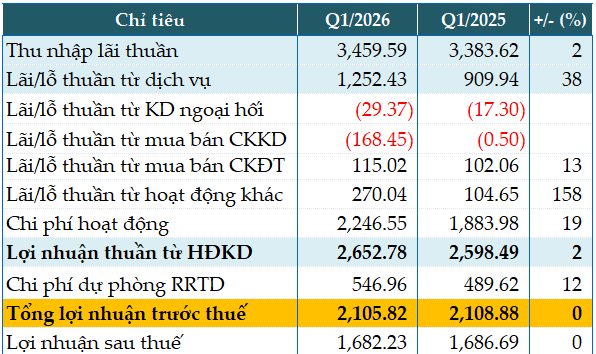
TPBank (Tien Phong Bank, HOSE: TPB) reported first-quarter 2026 pre-tax profit of nearly 2,106 billion dong, according to its consolidated financial statements. The figure was roughly in line with the same period last year.
During the quarter, TPBank’s net interest income increased 2% year over year to nearly 3,460 billion dong.
The services segment rose 38% year over year to more than 1,252 billion dong, supported by strong growth in fees from other services.
Gains from investment securities trading increased 13% to 115 billion dong as the bank optimized capital deployment in the market.
Other income grew 2.6 times to 270 billion dong, mainly driven by income on loans cleaned up through provisions, reflecting improved loan-collection efficiency.
Operating costs rose 19% to 2,246 billion dong, reflecting investments to expand the system and upgrade technology. After deducting costs, pre-provision operating profit increased 2% to 2,653 billion dong.
To strengthen its financial capacity and prepare for potential risks, TPBank increased loan-loss provisions by 12% to 547 billion dong.
As a result, Q1 pre-tax profit remained roughly unchanged versus the same period last year at about 2,106 billion dong.
Compared with TPBank’s full-year target of 10,300 billion dong in pre-tax profit, the bank had achieved 20% of the target by the end of Q1.
TPBank’s asset base continued to expand, up 4% from the start of the year to 527,169 billion dong at the end of Q1. Customer lending rose 3% to 316,042 billion dong.
Customer deposits declined 4% to 267,038 billion dong, reflecting balance-sheet restructuring to optimize funding costs.
Total non-performing loans (NPLs) as of 31/03/2026 increased 48% year to date to nearly 5,846 billion dong. The NPL ratio rose from 1.29% at the start of the year to 1.85%.
The increase was attributed to broader market dynamics, but the ratio remained within regulatory safety margins, indicating asset quality is still under tight control.






Premium gym chains are entering a “golden era” that is ending or already in decline, as rising operating costs collide with shifting consumer preferences toward more flexible, community-based ways to exercise. Long-term memberships are shrinking, margins are pressured by higher rents and facility expenses, and competition from smaller, more personalized…