•
•
•
•
•
•
•
•
•
•
•
•
•
•
•
•
•
•
•
•
•
•
•
•
•
•
•
•
•
•
•
•
•


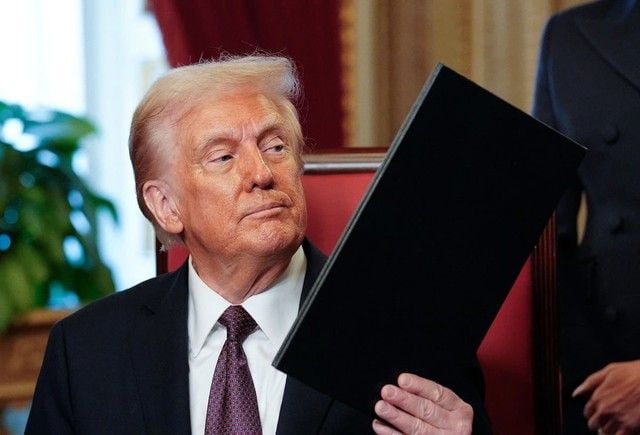
President Donald Trump announced on February 21 that he would raise global tariffs to 15% from 10%, effective immediately, according to a Truth Social post. The announcement came one day after the US Supreme Court rejected reciprocal tariffs.
On February 20, Trump signed an executive order imposing an additional 10% import tax. That tariff was scheduled to take effect at 0:01 on February 24 (US time) for 150 days.
The latest move is intended to respond to the Supreme Court ruling issued the same day, which rejected the tariff policy under the International Emergency Economic Powers Act (IEEPA).
Nguyen Trong Dinh Tam, Investment Advisory Director at TVS, said a 15% global tariff scenario would be positive for Vietnam’s export sectors. He noted that many goods could be adjusted from a 20% tariff level down to 15%.
Tam added that applying the 15% rate evenly across markets exporting to the US is expected to benefit Vietnam due to its geographic advantage, political stability, and a business environment that continues to improve. He also said tariff uniformity could support foreign direct investment (FDI) inflows into Vietnam.
“This would be the most positive scenario for Vietnam’s export groups into the US as well as the outlook for FDI into Vietnam,” the expert emphasized.
Tam cautioned that Trump’s new tariff policy still carries risks of not being implemented, particularly amid evolving legal developments at the US Supreme Court.
In the stock market, tariff-related news could have a near-term positive effect on the industrial park sector, which benefits from FDI, and support exporters such as textiles, seafood, and wood—especially firms with major US market exposure.
The expert also said Vietnam’s stock market has a high probability of rising after the Lunar New Year. If tariffs remain uncertain, VN-Index historical patterns suggest a cycle-dependent source of support for near-term gains after Tet. Data cited by TVS shows that during 2016–2025, the probability of a higher VN-Index in the first week after Tet was 80%, with average returns of about 1.4%.
TVS expects the market to extend an uptrend after Tet this year, supported by:
From a technical perspective, the expert said that if the VN-Index decisively breaks above the MA20 with expanding liquidity, it would re-establish a short-term uptrend.
In the medium term, the VN-Index is still in an uptrend formed since 2025, with the next target around 1,900.
Tam added that risk factors remain, including a rising interest rate environment. He noted that capital inflows often favor large-cap stocks with domestic growth narratives and state-led development themes, which could materially influence the index level.
Ngoc Ly. Source: Nhịp sống thị trường.





Premium gym chains are entering a “golden era” that is ending or already in decline, as rising operating costs collide with shifting consumer preferences toward more flexible, community-based ways to exercise. Long-term memberships are shrinking, margins are pressured by higher rents and facility expenses, and competition from smaller, more personalized…