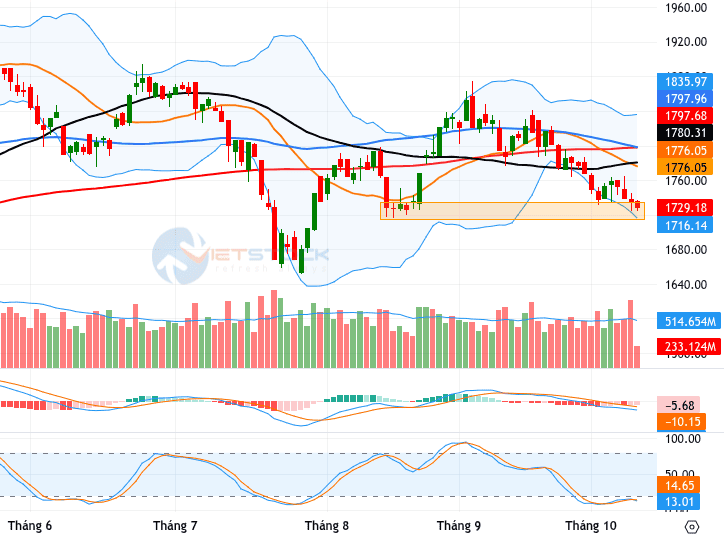
World gold prices are stabilizing around $4,800 per ounce, according to data cited by Kitco, with the latest settlement recorded on April 20. The move comes as investor positioning in major gold and silver exchange-traded funds turned more cautious, while broader market signals—such as the U.S. dollar—showed mild support.
Data from Muavangbac.vn shows that SPDR Gold Trust, the world’s largest gold fund, switched to net selling of 8.6 tonnes of gold on April 20, ending a four-session buying run. Total gold holdings in the trust fell to just under 1,060 tonnes.
In the same session, iShares Silver Trust (SLV), the world’s largest silver fund, recorded a net sale of nearly 31 tonnes of silver on April 20. Its silver holdings were reduced to 15,280 tonnes.
Kitco data indicates gold is hovering around $4,800 per ounce, down 0.24% on April 20. On the COMEX, silver fell about 1.3% to $79.70 per ounce.
Crude oil rose earlier in the week, which weighed on sentiment for gold and silver. However, precious metals regained balance on April 20 as the dollar index (DXY) weakened, closing at 98.05, down 0.04%.
CME’s FedWatch Tool shows futures markets assign a 100% probability that the Federal Reserve will keep rates unchanged at the upcoming meeting scheduled for April 28–29.
For the remaining meetings in 2026, the most likely scenario highlighted by the tool is a 0.25 percentage point rate cut at the December meeting, though that outcome carries a 37% probability.
In the latest gold report, Suki Cooper, Head of Global Commodities Research at Standard Chartered Bank, said gold appears to be forming a temporary bottom. She also pointed to uncertainties tied to the Iran conflict and inflation concerns that could keep downward pressure on prices in the coming months.
Standard Chartered’s official forecast projects an average gold price of about $4,605/oz in Q2 and $4,850/oz on average in Q3.
Cooper added that the near-term price path depends on a temporary ceasefire agreement and Middle East peace talks. She noted that, despite ongoing negotiations, traffic through the Hormuz Strait remains closed, adding strain to the global supply chain.
“With a fragile ceasefire and a shift in focus to real yields, gold has not yet escaped difficulty, and liquidity demand could continue to pressure prices. However, structural drivers remain intact, and we expect gold to resume an uptrend to retest its highs in the coming months,” Cooper said.
While acknowledging short-term volatility, Cooper said there are positive signs in the gold market. She cited cooling speculative activity, which has reduced “market froth,” and noted improving investor demand, with preliminary ETF data backed by gold indicating capital inflows returning.