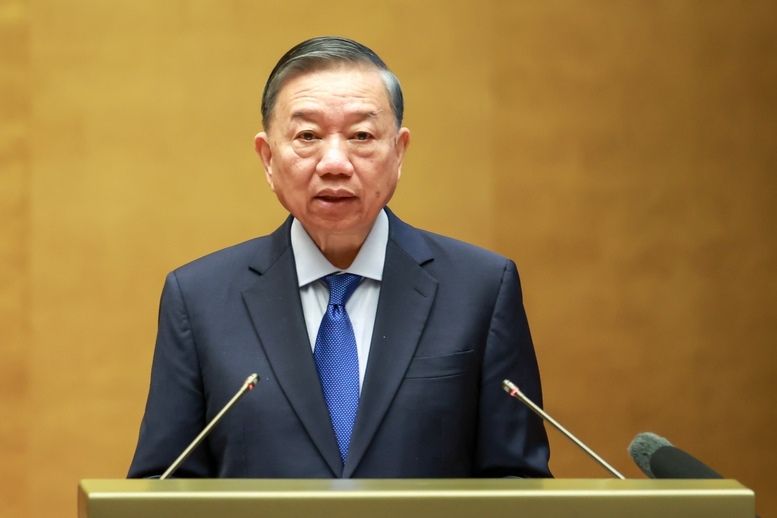
Vietnam is not only a place to locate factories but must become a hub for mobilizing and allocating capital for the region. General Secretary and President To Lam stressed that Resolution 10, issued on June 8, 2026, on developing foreign-invested economy (FDI) is not only about FDI but also calls for developing the capital market, upgrading the stock market, investment funds, international financial centers, and free trade zones. Vietnam must not only host factories but also become a hub for mobilizing and allocating capital and providing financial services, technology, and innovation for the region.
The Politburo issued Resolution 10 of June 8, 2026, on developing the economy with foreign-invested capital, reflecting nearly 40 years of implementing the Party’s openness policy. The resolution signals a shift from simply opening the door to welcoming capital to actively selecting and using international resources to build national competitiveness.
To Lam noted that Vietnam has progressively completed the framework of a market-oriented economy, expanded integration, and created an investment environment that is increasingly open, transparent, and stable. The country has transitioned from a closed, capital-poor economy heavily dependent on international aid to an open, deeply integrated economy with the region and the world. He stated that the question today is not how to obtain more foreign capital, but how to use foreign resources effectively to strengthen internal capacity, technological capability, competitiveness, and macroeconomic self-reliance.
He also stressed that the limitations in attracting FDI must be recognized, and that Resolution 10 sets higher goals and requirements. The aim is to develop a foreign-invested economy linked to stronger strategic autonomy, production capacity, technology, and competitiveness of the economy. Action must be intensified and guided by a clear understanding of the resolution, with consideration of the following approaches:
Resolution 10 can only come alive through decisive, substantive implementation with results as the measure. Each ministry should have a concrete action plan with clear tasks, timelines, and responsibilities. Localities must craft investment-attraction strategies aligned with planning, advantages, conditions, and regional links, ensuring no locality chases the same project type or attempts to build every port, airport, data center, or high-tech park without grounding in planning, resources, and comparative advantage. A holistic plan with clear delegation and cross-regional coordination is essential.
The central government should set strategic direction, refine the framework, coordinate regionally, screen large projects, and monitor implementation. Localities must be proactive and innovative but should not undermine planning, lower standards, or undermine long-term benefits. There should be criteria to evaluate offshore investment by sector and locality, including technology level, value-added, domestic supplier links, land use, budget contributions, human resource development, and environmental impact. Personnel assessments should be based on these criteria as well.
To Lam stressed that Vietnam does not attract investment at any price but as a country with strategy, selectivity, and the ability to screen and accompany good investors to create new value. The aim is to welcome foreign investors who operate long-term, comply with the law, respect workers’ and community rights, share technology, train local human resources, develop domestic enterprises, and elevate Vietnam’s position in the global value chain. The spirit of Resolution 10 is to have foreign investment strengthen, not replace, domestic capacity, contributing to sustainable, inclusive, high-quality growth.
The top official urged the entire political system, the business community, and both domestic and international investors to maximize responsibility, innovation, and determination to implement Resolution 10 in practice, turning sound policy into good projects, strong enterprises, new value chains, high-quality jobs, and enhanced national capabilities. This approach is presented as the practical path to advancing reform, integration, and development and to accelerating Vietnam’s growth toward a high-income economy by 2045.