•
•
•
•
•
•
•
•
•
•
•
•
•
•
•
•
•
•
•
•
•
•
•
•
•
•
•
•
•
•
•
•
•
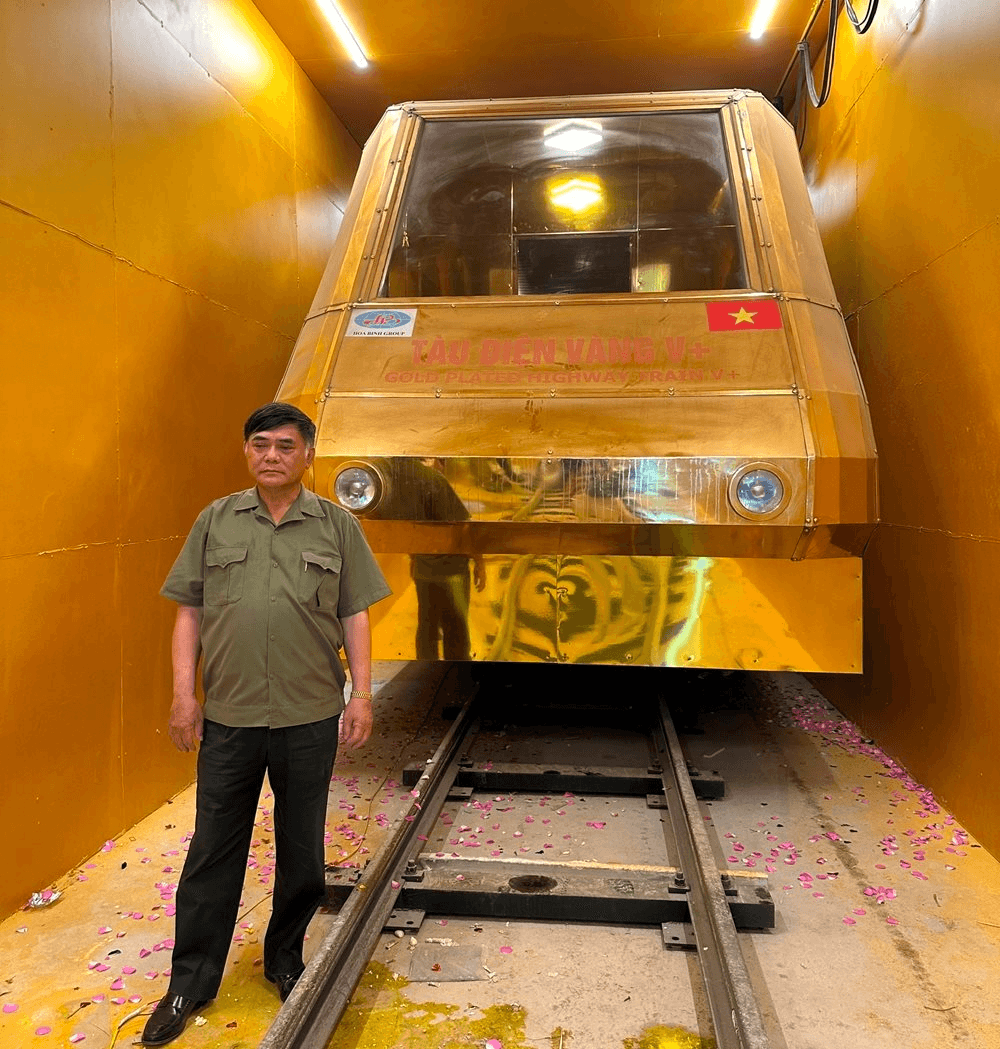
Vietnam has sparked public discussion after entrepreneur Nguyễn Hữu Đường, chairman of Hoa Binh Group, proposed a gold-plated underground metro train for Hanoi’s new metro lines. The idea was presented as a fast-to-build, low-cost, autonomous and driverless solution. However, the proposal has also triggered debate about feasibility and whether the technical standards behind the concept are sufficient.
Critics point to the reported manufacturing cost of about 1.5 billion VND and the additional gilding cost of up to 7.5 billion VND, arguing the project may be more focused on appearances than on intrinsic engineering quality.
Despite the attention given to the proposal, there is likely no real-world metro train worldwide that is “golden” in the literal sense. The discussion instead highlights that large-scale, high-profile metro plans exist globally—most notably Dubai’s Gold Line project.
Dubai’s Gold Line is a major multi-billion-dollar metro undertaking. The project—approved in April—covers a 42-kilometer fully underground route with an investment of about 9.26 billion USD. It is planned to include 18 stations and connect 15 strategic areas, while linking with more than 55 major real estate projects under development.
By 2040, the network is expected to serve about 1.5 million people daily, with passenger volumes reaching around 465,000 per day after 2040.
Environmentally, the tunnel is expected to eliminate more than 40 million car trips annually, reducing emissions. The project is also positioned as a “living lab” for advanced underground construction and automation technologies.
Construction will use an Earth Pressure Balance Tunnel Boring Machine (EPB-TBM) designed to minimize subsidence. The excavation process uses a mixing mud made from excavated soil and polymer foam to balance pressure at the tunnel face. As the TBM advances, robotic systems assemble high-strength concrete segments to form the tunnel lining, enabling 100% underground construction and helping protect surface life and business activity during the six-year build.
The Gold Line’s interior design emphasizes luxury and public-oriented spaces. Stations are planned as public art areas, combining natural Jura limestone panels that transmit light with copper detailing to create a classical yet modern atmosphere.
Island stations will feature dome ceilings inspired by pearl-shell forms, paired with natural ventilation supported by solar energy. Lighting is designed to change throughout the day to reduce the sense of confinement. Wall surfaces include glass panels intended to reflect UAE history from the 1960s onward, reinforcing cultural connections.
At the ends of each train, “Gold Class” luxury cabins are designed for quiet and privacy, with wide leather seats in a 2+1 layout. Climate-control panels in each cabin allow independent temperature adjustments for premium passengers.
Because the system operates autonomously, the leading Gold Class car is described as offering panoramic views of Dubai’s architecture when above ground, and tunnel lighting effects when underground.
Smart operations are central to the system. The line is planned to run unmanned from a Tier III-compliant Operations Center, coordinating with real-time passenger demand models based on Nol Card data. Machine learning models are used to simulate passenger flows at major transfer hubs and automatically adjust train frequency to reduce congestion.
During real-world tests, the project reports reductions in platform crowding by 40–60% and wait times dropping to under 30 minutes during large events. The top design speed is 110 km/h, supported by third-rail power supply and platform screen doors for safety.
The project’s “Gold Line” branding is linked to urban development goals and national image-building, alongside expected economic upside. Analyses cited in the article suggest cumulative economic benefits of up to 430% over 20 years, driven by reduced fuel costs, time savings, and lower emissions. The presence of stations is also expected to increase surrounding real estate values.
By burying the entire line underground at a depth of 40 meters, the project aims to protect urban aesthetics and surface land use, allowing green spaces, squares and pedestrian zones to expand while maintaining a high-value, image-driven transport system.
Overall, Dubai’s Gold Line combines advanced TBM excavation, AI-driven operations, and distinctive architectural design, positioning the project as more than a transport system—an effort to deliver a “gold-standard” urban infrastructure model.
Source: Quốc Vinh, Nhịp sống thị trường (06/09/2026)