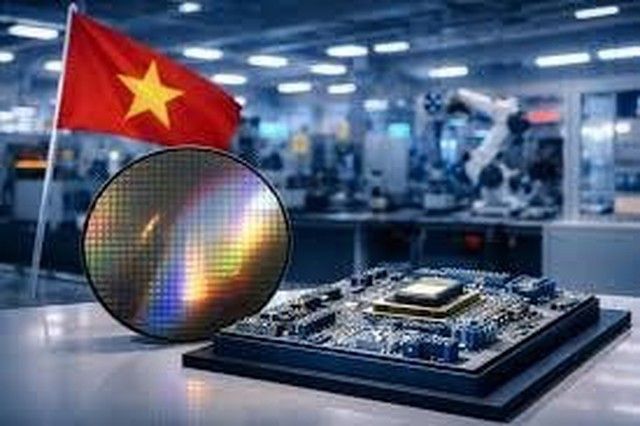
Vietnam’s semiconductor ecosystem is being shaped by an international division of labor between multinational corporations and domestic players, spanning design software, chip development, packaging and testing, and integration into end-user devices.
International groups help maintain the flow of goods across the sector. In design and wafer prototyping, software and tools are led by Siemens, Synopsys, Dassault Systèmes, Autodesk, and Cadence. Chip design and artificial intelligence (AI) solutions are led by Qualcomm, Marvell, Renesas, Microchip, Savarti, Ampere, and Infineon. Packaging and testing capabilities at home are performed by Intel, Amkor Technology, and Hana Micron, while finished semiconductors are integrated into end-user devices through manufacturing ecosystems powered by Samsung, LG, and Bosch.
Domestic enterprises are pushing into higher-value parts of the ecosystem. FPT’s technology core model includes a 2026 pretax profit plan for the tech group that is up 24.9% year over year. FPT Semiconductor has secured orders for 70 million chips through 2025 and announced the establishment of an advanced test and packaging plant in 2026 to serve Korea, Taiwan, and Japan.
Viettel, meanwhile, has broken ground on Vietnam’s first silicon manufacturing plant in 2026. The project is aimed at enabling self-reliant microchip and chip production for 5G base stations. Viettel also targets reaching the group of the world’s 60 top defence companies by 2030, with more than 10% of revenue from high-tech products.
Vietnam’s national strategy, per Decision 1018/QD-TTg, sets a three-phase roadmap to build a self-reliant semiconductor ecosystem by 2050, with emphasis not only on assembly but increasingly on design and manufacturing.
Human resource development targets include training 50,000 engineers by 2030, with private sector participation. The content highlights FPT’s pledge to provide 10,000 high-quality personnel.
On scale, the 2050 vision envisages more than $100 billion in annual revenue, including 300 design firms, 3 fabs, and 20 packaging and testing facilities.
Autonomy is supported by domestic resources and energy. Vietnam leverages about 22 million tons of rare earth reserves, described as the second-largest globally. Energy planning also includes the Ninh Thuan 1 and 2 nuclear power plants with a total capacity of 6,400 MW, intended to provide clean, stable electricity for semiconductor plants.
The legal framework also supports research and development, including a 10% corporate income tax rate and personal income tax exemptions for experts. The Sandbox mechanism under the Law on Science and Technology is presented as a key milestone, allowing trials of new materials for 3–6 years and offering protection for investors from certain administrative and criminal liabilities related to research risks.
Overall, the combination of domestic industrial movement, long-term national targets, and policy measures is positioned as a catalyst for both domestic and foreign-invested firms to invest in core technology activities in Vietnam.