•
•
•
•
•
•
•
•
•
•
•
•
•
•
•
•
•
•
•
•
•
•
•
•
•
•
•
•
•
•
•
•
•


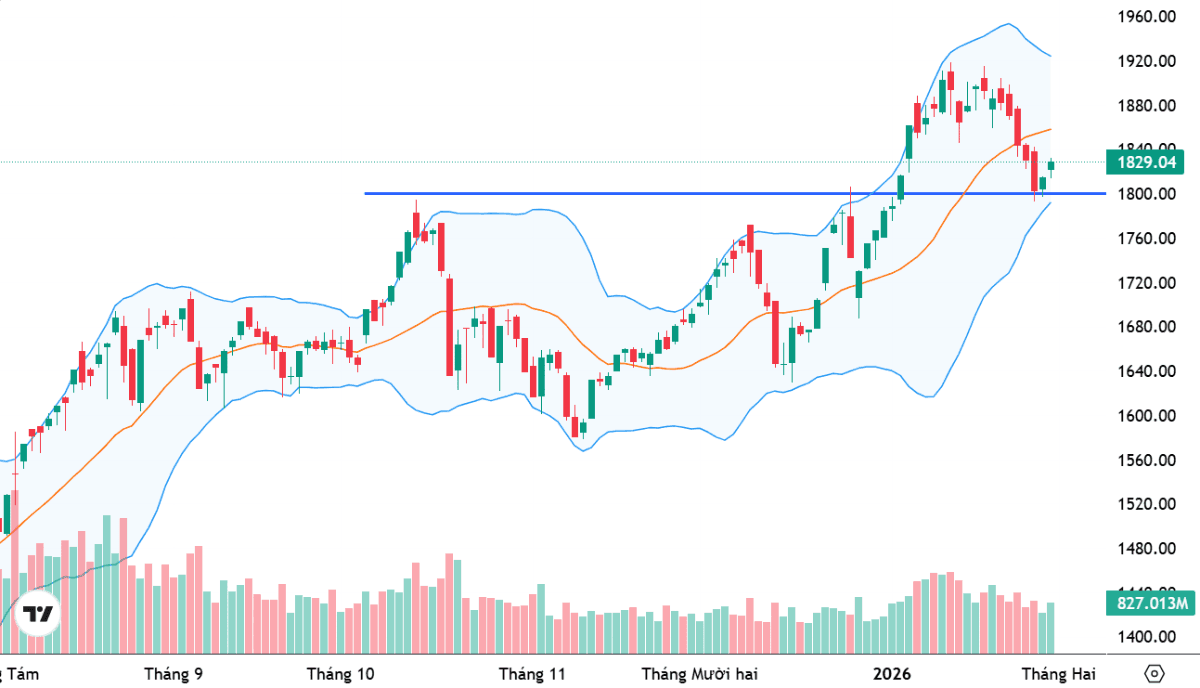
Vietnam’s stock market closed 2025 with the VN-Index up 40.87%, marking the strongest annual growth pace in eight years. The headline figure, however, does not fully capture the market’s swings—ranging from relief after the tariff shock to a pullback in the final three months as the index reached new historical highs, while many investors still recorded losses.
Over the long term, Vietnam’s stock market remains on a growth trajectory, and 2025 was described as “decent” for investors who held stocks prudently and managed risk effectively. Data from HoSE show that 54.4% of stocks were profitable, and 42% of stocks achieved at least 10% growth. Even so, these outcomes still lagged the VN-Index’s overall growth rate.
The VN-Index also ranked among the world’s five strongest-performing markets in 2025. It outperformed developed markets such as Japan’s Nikkei 225 (up 26%) and the US S&P 500 (up 16%), and it exceeded the performance of emerging markets, where the MSCI Emerging Markets index rose 28%.
In April 2025, a sudden shift in trade policy under US President Donald Trump triggered a major shock to global equity markets. The article notes that commodity-exporting countries faced counter-tariffs ranging from 20% to over 70%, with Vietnam cited at 46%.
Uncertainty around global trade drove broad market declines. On April 4, 2025, major indices fell: the S&P 500 (-4.12%), Dow Jones (-2.85%), Nikkei (-4.95%), FTSE 100 (-4.95%), DAX (-4.12%), Hang Seng (-4.11%), and KOSPI (-2.98%). The VN-Index also dropped on April 3, 2025 by 6.68%, and over four consecutive sessions recorded a maximum drawdown of 18.5%, compared with a 15% decline at the end of 2024.
The shock pushed Vietnam’s market valuations to the lowest level since late 2022, when the corporate bond crisis widened. The VN-Index P/E ratio on April 9, 2025 was 10.86x, close to the end-2022 level of about 10.53x. Despite the “very cheap” valuations, the key question at the time was whether the tariff war would have lasting negative effects or would function mainly as negotiating leverage.
After the tariff shock was initially described as “unintelligible,” the article says President Trump signaled opening negotiations and applied only a temporary additional 10% tariff. The market responded quickly, with a rare and sharp rally forming. The VN-Index rose by more than 67% from its April 2025 trough to mid-October. During the same period, 52.2% of VN-Index stocks posted gains of 30% or more, reflecting strong investment performance for those who captured the “golden opportunity” created by the shock.
The rally was supported by earnings results in Q3 2025, when market-wide net profit after tax increased 41.8% year on year. The non-financial sector rose 50.4%.
Following the sharp rebound from the tariff shock, the market entered a correction phase. The article argues that this correction was not reflected “reasonably” in the VN-Index, leaving investors frustrated in the last three months of 2025 as index gains outpaced declines in many portfolios.
The piece attributes the distortion to the VN-Index’s structure: it is capitalization-weighted, so it can be heavily influenced by a small number of large-cap stocks. It notes that when assessing the broader market trend, investors may need to look beyond the VN-Index alone.
By weight, four “Vingroup” stocks—VIC, VHM, VPL, and VRE—account for about 26% of the VN-Index’s market capitalization. Fourteen bank stocks account for about 29.8%. In sector terms, Banking and Real Estate together make up about 60% of VN-Index capitalization. Because these stocks often move together, they can “pull” the index.
The article also points to the growing influence of recently listed large-cap stocks, including MCH (2.8%), TCX (1.3%), and VCK (0.9%).
A key example cited is that of the VN-Index’s total gain of 517.71 points in 2025, the Vingroup group contributed up to 264 points—about 51%. In the last three months of 2025, the VN-Index rose by 119.44 points, while VIC, VHM, and VPL contributed 180 points, exceeding the total index gain. Over the same period, 68% of stocks fell and only 14% rose above the VN-Index.
The article concludes that the ability of a few stocks to move the VN-Index against the broader trend is not new and is tied to the index’s design. It suggests that until the index structure changes, investors should adapt through risk management, prudent portfolio management, and a focus on the fundamental value of individual stocks—along with long-term investing rather than frequent trading based on VN-Index movements.







Premium gym chains are entering a “golden era” that is ending or already in decline, as rising operating costs collide with shifting consumer preferences toward more flexible, community-based ways to exercise. Long-term memberships are shrinking, margins are pressured by higher rents and facility expenses, and competition from smaller, more personalized…