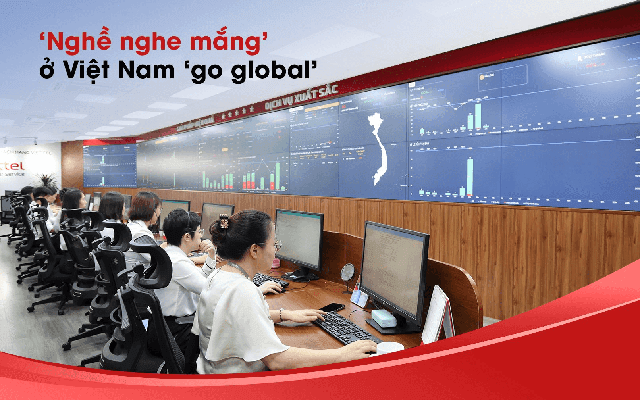
A few years ago, no one would have believed that Vietnam would have a Call Center able to compete with firms in India or the Philippines. But today, when Viettel Customer Service is born, it redefines the Call Center with new competitive capabilities in the AI era, and the journey to go global has begun with bright prospects.
"If we were not in Viettel, we would have died or shrunk to a tiny operation," says Ms. Pham Thanh Van, reflecting on luck not as chance but as being nurtured within a technology ecosystem. Viettel Customer Service has grown inside Viettel’s technology ecosystem, especially Viettel Telecom. As OTTs rose and networks’ voice and messaging declined, Call Center volumes plunged by more than 80%. The traditional "listening to complaints" role diminished, and many players faced choices to pivot, shrink, or disappear—especially with AI changing the landscape.
Call Center Viettel did not face this alone. Viettel Telecom became a giant lab, testing AI across millions of real customer interactions daily to build a new capability for a future-ready company (VCX).
Training chatbots, data classification, journey design, experience governance on an AI platform, and running large-scale digital processes—these efforts trimmed headcount from over 7,000 to about 1,000, while increasing impact on customer experience.
Step by step, the unit that preceded VCX stopped simply doing "listening to complaints" and developed core capabilities in operations, data, and seamless customer experience management. This foundation was recognized early by Viettel’s leadership as pivotal for VCX to evolve.
From Viettel Telecom’s Call Center origins, VCX initially served only Viettel as a client. For more than two decades, nearly every capability—millions of daily interactions, managing thousands of agents, designing hundreds of millions of customer journeys—existed to serve a single ecosystem. The workload was enormous, the pressure high, but there was a degree of safety in not needing external customers.
When VCX officially formed, the first change was mindset: "From cost center to profit center," as Ms. Van succinctly notes.
Previously, tasks were to serve internal Viettel units well; now VCX had to go to market, build products, bid for contracts, and compete. People who were used to B2C but inside the group had to learn B2B and B2G, proving value with two decades of accumulated capability.
But stepping into the market revealed that what VCX carried wasn’t just a call center—it was the capacity to solve customer-experience management problems across many sectors.
Interestingly, VCX’s first external clients weren’t primarily telecoms. Its customer-experience governance capabilities gradually extended to logistics (Viettel Post, Express247, FedEx), banking, electricity, e-commerce, and many service sectors.
The common thread among these clients is the scale: serving massive user bases and handling enormous interaction volumes while ensuring every request is tracked and resolved according to a process. This is the playing field VCX has honed over more than twenty years.
Public-sector digital governance is a growing area, with iHanoi as a notable project where VCX applied core capabilities—from content interaction to journey design and service operation governance.
iHanoi serves hundreds of thousands of daily interactions and is among Hanoi’s largest digital interactions channels between government and citizens, with millions of users and monthly activity.
This marks the first time VCX’s user-experience governance capabilities have been demonstrated beyond telecoms to manage an entire city’s platform.
After one year of independent operation, Viettel Group set new goals for VCX. If in 2025 revenue from external customers outside Viettel’s ecosystem was around 2%, in 2026 it rose to 20%, and by 2030 VCX targets a 50-50 revenue split between internal and external customers.
This is not only a
business metric—it signals that VCX is no longer an internal service unit, but a technology-led customer-experience company competing on the global stage. The target markets extend beyond Vietnam, as AI, data, and digital platforms become central to the customer experience.
VCX does not plan to export thousands of call-center agents abroad; instead, it aims to export its knowledge, AI platform, and experience-management capabilities to serve multiple industries worldwide. Under this plan, Viettel’s existing markets will be the first to scale, followed by financial services, e-commerce, and real estate, with an early external order from a bank in Myanmar. The lead for the go-global effort is VCX’s captain, Mr. Nguyen Tien Dung (former CEO of Mytel – Viettel Myanmar).
Today, VCX continues to pursue opportunities in Viettel’s footprint—Cambodia, Laos, and Myanmar—while expanding collaborations with local BPO providers and AI-based customer-service solutions. Two decades ago VCX was known as Vietnam’s largest and most powerful Call Center. Today, it aims to be recognized as a technology company focused on customer-experience governance.
If the opening chapter of this journey was written with millions of daily calls, the next chapter will be written with a broader ambition: to export the learned capabilities and AI-driven experience-management platform so that they can compete in the global market.