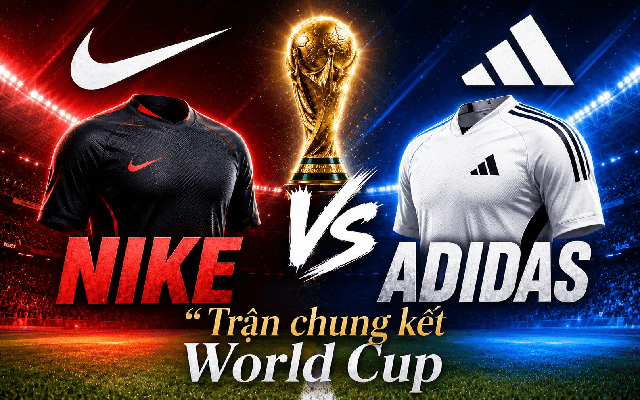
Nike and Adidas are spending millions of dollars on the World Cup in a bid to secure the future of soccer in the United States.
As the World Cup unfolds across the United States, Nike and Adidas are not only selling shoes, jerseys, or match balls. The event is seen as the biggest opportunity in more than three decades to elevate soccer in a country long dominated by American football, basketball, and baseball. With 11 host cities, World Cup 2026 is positioned to accelerate growth in a market that Nielsen says has more than 62 million soccer followers in the United States, making it the fourth-largest soccer fan community globally. The figure was recorded before screens in bars, restaurants, and households across the United States lit up for World Cup matches.
For Nike and Adidas, this is a market that cannot be missed. During the 39 days of the tournament, at least a dozen sportswear brands—from Puma and Umbro to Reebok—are vying for attention from fans. But no one has invested more aggressively than Nike and Adidas, which are staging events across the United States, Mexico, and Canada, launching expensive advertising campaigns featuring a global lineup of stars, and releasing jerseys, footwear, and limited-edition collections. Both understand that this World Cup is not just a month of selling but a branding battle for years to come.
Adidas has the advantage of its long-standing position as the official FIFA partner. The German brand has been associated with the World Cup since 1970 and is the official match ball supplier. In World Cup 2026, Adidas continues to benefit from rights of official presence in the tournament ecosystem, including brand identity, official products, and FIFA-linked activities.
Nike does not hold that privilege. But Nike has another advantage: its brand strength in the United States. The Beaverton, Oregon-based company has built a narrative around turning a sports event into a public story where stars, products, street fashion, and social media merge. With the World Cup hosted in the United States, Nike can pursue visibility through teams, players, video campaigns, retail experiences, and fan communities even without formal FIFA rights.
Nike has faced pressure to reclaim a high-performance image after a period of strategic missteps. Nike has emphasized federation kit lineup for 2026, described as a fusion of team heritage, cultural identity, and Aero-FIT cooling technology—an attempt to reaffirm its core focus on technical innovation, performance, and elite athletic language.
Adidas has pursued a storytelling approach through its You Got This campaign, featuring Timothée Chalamet, Lionel Messi, Bad Bunny, Lamine Yamal, Jude Bellingham, Trinity Rodman, and icons Zinedine Zidane, David Beckham, and Alessandro Del Piero. The emphasis is to bring the World Cup narrative back to the backyard and street corners, highlighting memories of football beyond the official tournament.
The comparison highlights different strengths: Adidas holds official rights, deep-rooted relationships, and a strong product lineup for national teams, while Nike benefits from a broad cultural footprint and a strong base in American sports culture. Short-term, Nike may lead on U.S. shelf space and pricing, but Adidas appears to have an advantage in brand affinity, consumer trust, and longer-term financial expectations across the World Cup cycle.
This rivalry mirrors the broader evolution of soccer in the United States. The sport has moved beyond a niche interest to become part of the fabric of American entertainment, aided by Major League Soccer growth, high-profile player moves, immigrant communities, and a younger, globally connected audience. Brands do not control the narrative entirely; they bet on players, teams, moments, and the unpredictable emotions of the tournament.
Adidas arrives with official rights and strong emotional momentum, aided by a crop of young stars such as Lamine Yamal and Jude Bellingham. Nike enters with the challenge of proving it remains the top sports brand in the minds of Americans while leveraging product innovation and performance storytelling to convert moments into sales.
Camilo Andrade, Nike’s global vice president and general manager of football, says the World Cup is a growth catalyst for the brand.
Chris Murphy, Adidas senior vice president for brand marketing, describes the tournament’s scale as huge and central to the brand’s strategy.
Ultimately, the greatest prize may not be a single month of higher sales but the right to define what football looks like to the next generation of American fans. If Adidas leverages its official position, emotional storytelling, and a strong lineup of up-and-coming stars, it could reinforce its global rebound. If Nike turns the World Cup into a sustained sales catalyst through product innovation and a performance image, it could demonstrate that a downturn was temporary.