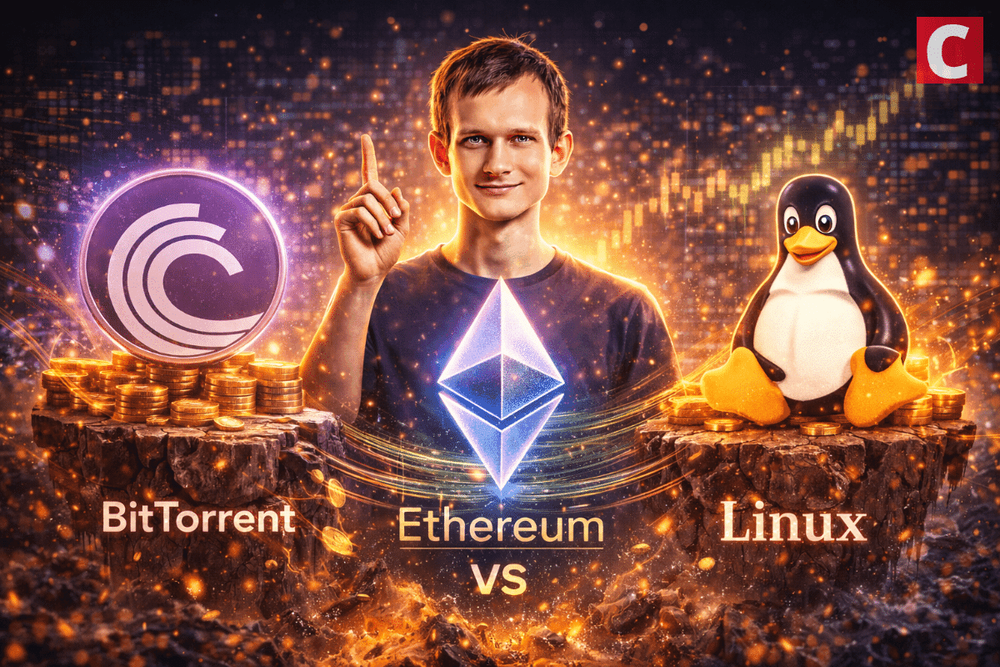
Vitalik Buterin described
Ethereum as shared infrastructure, not a speculative asset. On Jan. 8, he compared Ethereum to BitTorrent and Linux, two systems that scaled globally without giving up decentralization.\n\nVitalik discussed Ethereum’s core goal, which is to achieve maximum autonomy without intermediaries, while still supporting mass use and institutional trust.\n\n> One metaphor for Ethereum is BitTorrent, and how that p2p network combines decentralization and mass scale. Ethereum's goal is to do the same thing but with consensus.\n> \n> Another metaphor for Ethereum is Linux.\n> \n* Linux is free and open source software, and does not compromise on…\n\n— vitalik.eth (January 8, 2026)\n\nBitTorrent: Scale without Control\n---------------------------------\n\nButerin compared Ethereum to BitTorrent’s peer-to-peer model. BitTorrent achieved massive scale by distributing bandwidth across users, not by central coordination.\n\nEthereum aims to do the same with consensus. Instead of distributing files, it distributes verification and settlement. The objective is a network that grows in usage without relying on trusted middlemen.\n\nRelated article: Ethereum L2 Starknet Faces Downtime, Here Is What We Know\n\nButerin noted that BitTorrent is not just a consumer tool. Enterprises and governments already use it to distribute large files. Decentralization did not prevent adoption.\n\nLinux: Power Over Comfort\n-------------------------\n\nThe second comparison was Linux. Linux is open-source, free, and uncompromising. It is also embedded across global infrastructure, cloud systems, and government operations.\n\nButerin pointed out that Linux supports both mass-market systems and highly minimal, user-controlled distributions. Ethereum L1 is meant to serve a similar role.\n\nEthereum should be the financial and infrastructure layer for users who want full control, while remaining stable and trustworthy enough for enterprises to build on.\n\nA World Computer, Not a Meta\n----------------------------\n\nRecently, Buterin warned against pushing Ethereum toward short-term trends such as meme coins or artificial usage incentives. He argued that Ethereum’s role is to act as a neutral world computer.\n\n> Welcome to 2026! Milady is back.\n> \n> Ethereum did a lot in 2025: gas limits increased, blob count increased, node software quality improved, zkEVMs blasted through their performance milestones, and with zkEVMs and PeerDAS ethereum made its largest step toward being a fundamentally…\n\n— vitalik.eth (January 1, 2026)\n\nThe network’s benchmark, according to Buterin, is the “walkaway test.” Applications should keep running even if their original developers disappear.\n\nThat standard applies to the base protocol and the apps built on top of it. Dependence on centralized services weakens the model. He described Ethereum as a response to an internet dominated by subscription platforms and centralized control.\n\nEthereum’s goal is to provide financial, identity, governance, and social infrastructure that users can rely on without permission.