•
•
•
•
•
•
•
•
•
•
•
•
•
•
•
•
•
•
•
•
•
•
•
•
•
•
•
•
•
•
•
•
•

The VN-Index rose sharply to its highest level in four months and closed near the all-time high, after an early session pullback was followed by renewed buying strength. The index had been expected by many analyst groups to ease, arguing the rally was driven mainly by Vingroup-related stocks and that liquidity had not improved. That view held only in the morning, when broad selling pressure weighed on the index by more than 6 points. After the lunch break, buying in the stock market helped the VN-Index quickly return to green and extend gains.
The VN-Index closed at 1,891 points, its highest level since late January. It was within about 10 points of the 1,902 all-time high (based on the close).
ACB Securities said the 1,900-point level is likely to act as a key resistance, with the risk of short-term profit-taking pressure rising as the index approaches the historic peak.
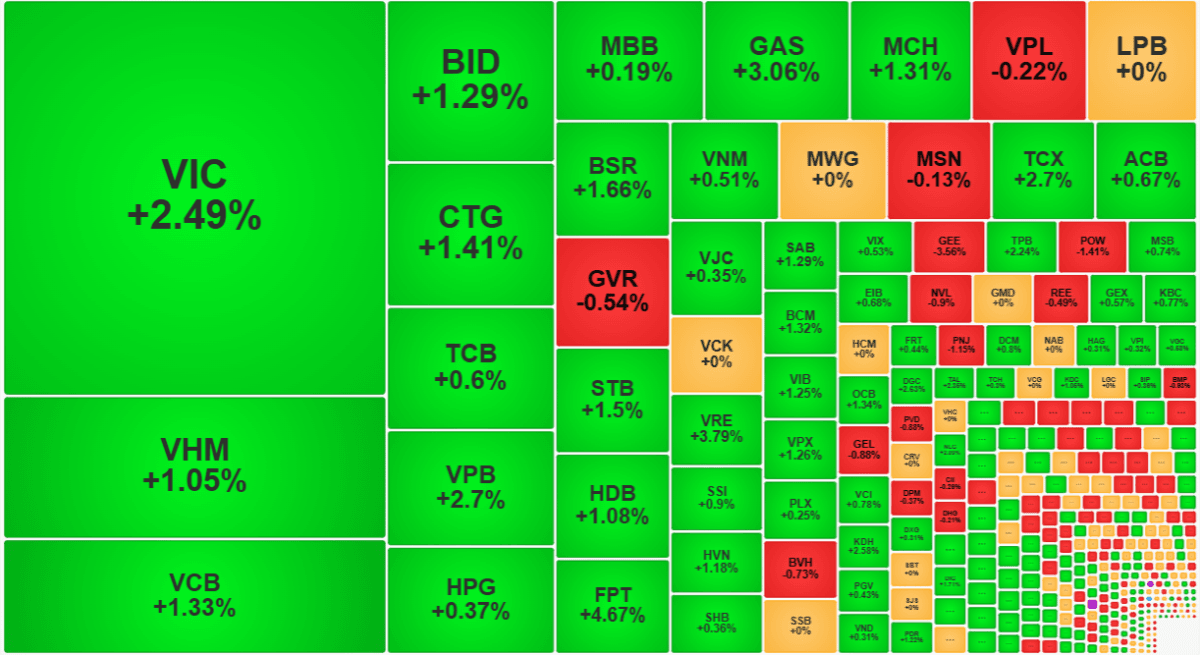
Trading on the Ho Chi Minh City exchange showed a bullish tilt: 202 stocks advanced, nearly double the number of decliners. Large-cap performance was more mixed, with 24 gainers versus eight decliners.
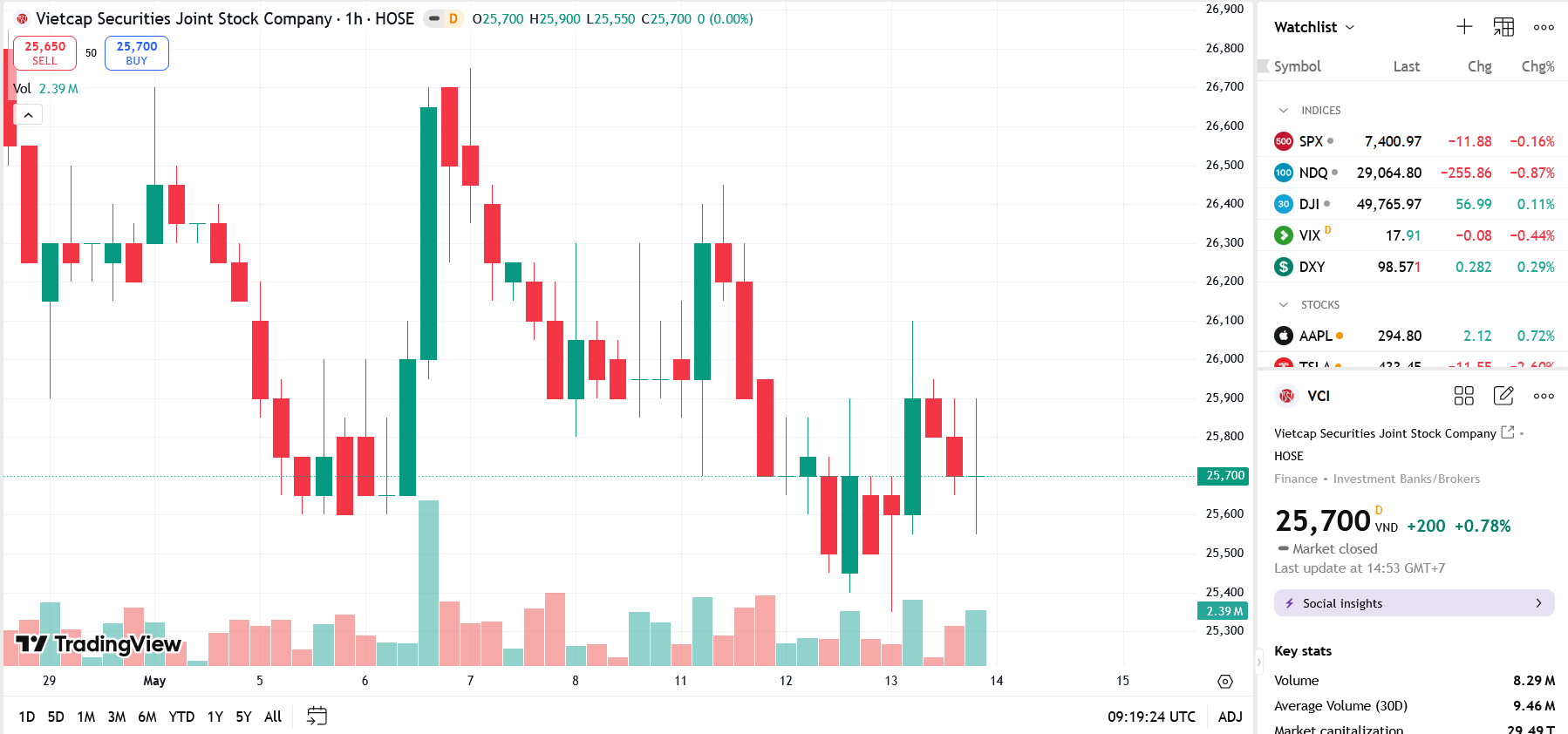
Stocks drove the positive tone as all constituent stocks ended at their reference prices. The VIX and HCM Index reached their ceiling, while several leading names—including SSI, VCI, TCX, VPX, and VCK—rose 2-4%.
The session’s sentiment was also supported by FTSE Russell updating the list of 29 stocks meeting the criteria for inclusion in the FTSE Global All Index. Separately, forecasts by several organizations indicated Vietnam could be added to MSCI’s watchlist in the upcoming review.
Bank stocks improved, though gains were more modest than the broader market. STB, LPB, ACB, and EIB rose above 2%, while larger-cap banks VCB and BID gained about 1%.
In real estate, shares linked to Vingroup remained the main drivers. VRE rose 4% and VPL gained 2.3%. VIC reversed from a decline to close flat at 219,500 dong.
Several developers also advanced, including Dat Xanh, TTC Land, Phat Dat, and Quoc Cuong Gia Lai, each rising more than 1%. In contrast, Novaland faced continued heavy selling pressure after two consecutive floor trades, falling about 4%.
The oil and gas sector was less favorable following global crude price movements. POW and GAS were the exceptions, staying in positive territory, while most other stocks closed lower, down 0.5-1.5%.
Liquidity on the Ho Chi Minh City exchange reached nearly 24 trillion dong, up slightly from the first two sessions of the week. Novaland led trading value at nearly 1.3 trillion dong, far ahead of the next two names, VIX and VHM.
Foreign investors maintained negative sentiment for the tenth straight session, selling more than 3.9 trillion dong while adding about 2.8 trillion dong in purchases. The outflow pressure was concentrated on HPG and ACB, with net selling of over 7 million and 10 million shares, respectively.

Bitcoin (BTC) investors who use steady dollar-cost averaging (DCA) may be underperforming versus strategies that adjust exposure to the market’s cycle, according to new research arguing that Bitcoin’s behavior differs from traditional long-duration assets.
In a report cited by Markus Thielen of 10x Research, Bitcoin’s market…