•
•
•
•
•
•
•
•
•
•
•
•
•
•
•
•
•
•
•
•
•
•
•
•
•
•
•
•
•
•
•
•
•


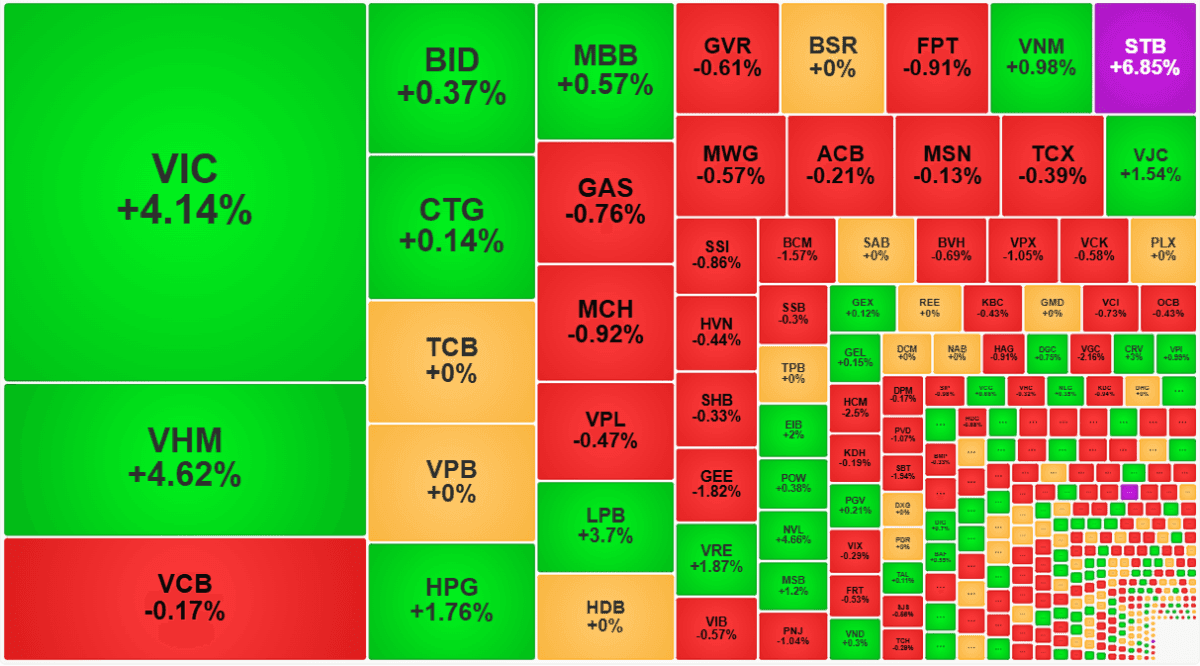
Strength of Vin group stocks continued to lead the index into the around 1,900-point zone. At the morning close, VN-Index rose 20.90 points. VIC and VHM were the main contributors, adding more than 19 points, while market breadth showed decliners outnumbering advancers.
VN-Index increased by 1.14% to 1,858 points, near the late-February peak. During the session, the index reached an intraday high of 1,866.1 points (+1.58%). However, breadth at the top of the session was uneven, with 126 gainers versus 147 losers, and at the close there were 116 gainers versus 173 losers.
The rally-led effect was not new, but after yesterday’s profit-taking on VIC and VHM, the rebound with high liquidity was notable. Both stocks posted new historic highs and entered the Top 5 most actively traded names. VIC rose 4.14% from the reference price after having been pressured down about 1.49% from its high. VHM fell to 2.06% but then rose 4.62%. Despite selling pressure, buyers were strong enough to keep both stocks supporting the index.
Beyond VIC and VHM, STB delivered a notable move among VN30 constituents, hitting the daily ceiling and temporarily closing near its historical high. Despite the strength, STB’s market capitalization is relatively small, contributing less than 2 points to VN-Index, though it supported the VN30-Index by nearly 6 points. LPB also gained 3.7%, but it only recovered today after six prior sessions of correction.
Overall VN30 breadth was balanced with 12 gainers and 12 losers, while the index still rose strongly by 1.35%. In addition to VIC and VHM, other gainers included STB, LPB and VRE (+1.87%), HPG (+1.76%) and VJC (+1.54%). On the downside, declines were mild, with SSI (-0.86%), FPT (-0.91%) and GAS (-0.76%) among the weakest.
VN30 liquidity rose 23% versus yesterday morning, reaching 7,007 billion VND. The increase was mainly driven by HPG, which recorded 2,121 billion VND—about 6.3 times yesterday’s liquidity. For VN30 overall, the group added about 1,321 billion VND, while HPG alone contributed 1,782 billion VND.
On the broader HoSE market, liquidity increased by nearly 16% this morning, while outside VN30, the rest of the market barely rose. This reflected generally weak price momentum across breadth. The positive was that selling pressure was light: among 173 decliners, only 13 fell more than 1% with liquidity of at least 10 billion VND.
Notable decliners included HCM (-2.5%) with 172.9 billion VND, GEE (-1.82%) with 109.9 billion VND, PVD (-1.07%) with 38.7 billion VND, PNJ (-1.04%) with 30.4 billion VND, HAH (-1.29%) with 29.6 billion VND and VGC (-1.95%) with 24.4 billion VND.
On the upside, conditions were not much better. Funds appeared weak and concentrated, leaving fewer stocks with convincing strength. Among 44 stocks rising by 1% or more, only 14 had strong liquidity. HPG, STB, VHM and VIC accounted for nearly all trading in this group. Other names included NVL (+4.66%) with 533.5 billion VND, EIB (+2%) with 297.7 billion VND, VRE (+1.87%) with 194.2 billion VND, VJC (+1.54%) with 172.9 billion VND and PVT (+1.39%) with 73.6 billion VND.
As a result, many stocks posted only small moves and liquidity remained weak despite a strong VN-Index rise. The “green outside, red inside” pattern was described as not favorable for investors, repeating a similar situation seen earlier in 2026 when the index reached a new peak while most stocks declined.
Foreign investors traded fairly balanced on the morning session, with net buying of about 63.5 billion VND on HOSE. However, flows were concentrated in a few stocks. On the net buying side, FUEVFVND (+294 billion VND), HPG (+266.2 billion VND) and MSN (+50.8 billion VND) were notable. On the net selling side, VCB (-117.3 billion VND), MSB (-102.4 billion VND) and FPT (-50.2 billion VND) were the main sellers.







Premium gym chains are entering a “golden era” that is ending or already in decline, as rising operating costs collide with shifting consumer preferences toward more flexible, community-based ways to exercise. Long-term memberships are shrinking, margins are pressured by higher rents and facility expenses, and competition from smaller, more personalized…