•
•
•
•
•
•
•
•
•
•
•
•
•
•
•
•
•
•
•
•
•
•
•
•
•
•
•
•
•
•
•
•
•


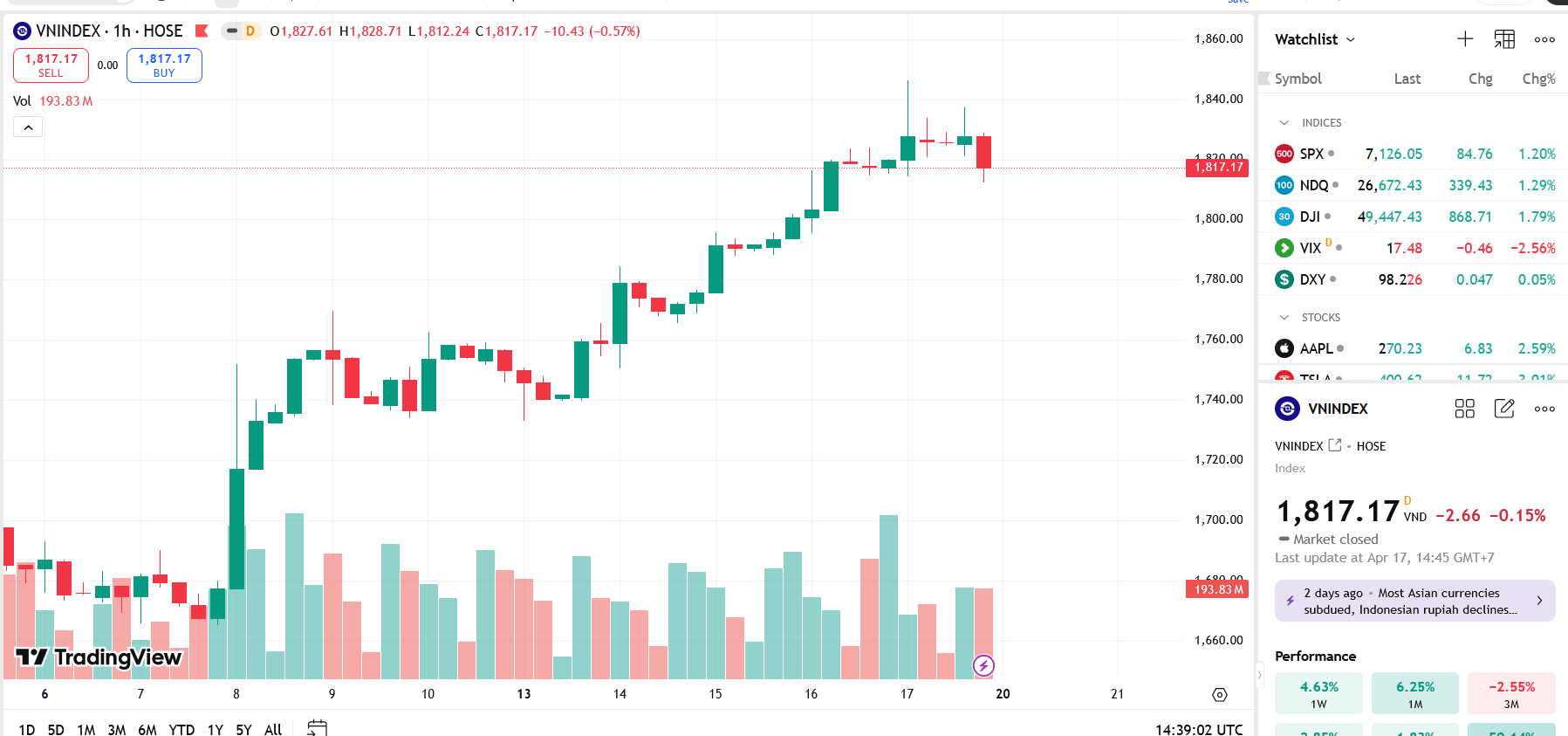
Vietnam’s VN-Index ended the week higher, with market outlooks from several securities firms pointing to continued upside potential but also highlighting nearby resistance levels and signs of short-term momentum cooling.
During the week, the VN-Index rose 67.17 points, or 3.84%, to 1,817.17 points. The HNX-Index increased 8.09 points, or 3.21%, to 260 points.
BVSC said the near-term outlook remains fairly positive. It noted that the large-cap group could not sustain its rally to support the index, but downside pressure is not large because gains in other stock groups helped offset the weakness.
BVSC added that the VN-Index could continue to rise next week and aim to test the strong psychological resistance zone at 1,865–1,880 points. The firm advised investors to maintain holdings and raise stop-loss to around cost for short-term positions, while new trading positions should focus on stocks that have not risen much or have retreated to support zones.
BSC said that after choppiness in the 1,812–1,847 range, the VN-Index closed at 1,817.17 points, down nearly 3 points from the previous day. It reported market breadth as fairly balanced, with 11/18 sectors higher, led by Retail, followed by Oil & Gas, Chemicals, and Information Technology. The Travel & Leisure sector declined the most. BSC also said foreign investors were net buyers on HSX and net sellers on the other two exchanges, and that short-term momentum has slowed, with the index needing time to find a new balance.
SHS stated that the short-term trend remains upward, moving toward around 1,850 points. It described this as a resistance zone linked to high price levels in January and February 2026, adding that the VN-Index may not yet break through this resistance. SHS also cited resistance for the VN30 index near 2,000 points and said the market’s gains are being driven by leading stocks, particularly VinGroup approaching early-2026 historical highs, while other sectors remain less positive.
VCSC said the VN-Index still maintains an uptrend as it trades above MA20 and MA50, which keeps the possibility of retesting the old peak at 1,900–1,920 points. It also pointed to support near 1,795 (+/−10) points, while noting that selling pressure from the Vingroup group may keep the index in a higher-volatility uptrend in the near term.
SSI said the overall state of the VN-Index has not been materially affected, with resistance around 1,840–1,880 and near-term support around 1,780–1,800.
TVS said the market resembles strong correction periods seen in Q4 2025. It noted the VN-Index fell slightly by 2.7 points (-0.2%), closing at 1,817.2. TVS said the index rose earlier on strength in Retail (MWG, FPT) and Banking (VPB, TCB), but selling pressure in Vingroup stocks weighed on the index in the afternoon. The firm advised investors to remain cautious, monitor Vingroup as a key driver, maintain a safe portfolio weight, and avoid aggressive purchases until clearer trends emerge.
VCBS said the VN-Index ended the week with a gravestone doji after a string of gains. It reported that daily momentum indicators remain positive, with RSI rising toward overbought levels and MACD widening between its signal lines, suggesting buyers still dominate. However, on intraday charts, VCBS said short-term profit-taking pressure is increasing, with RSI cooling after overbought conditions and MACD signaling a potential pullback. VCBS concluded that the market may face continued volatility and consolidation early next week as demand tests support, highlighting a nearby key level around 1,801 (MA20). It advised investors to avoid chasing stocks that have run up and to consider selective deployment in bank and consumer stocks with solid fundamentals while waiting for sector-wide liquidity improvements.
Across the outlooks, the main themes are: the VN-Index’s ability to extend gains toward resistance zones (including 1,865–1,880 and potentially 1,900–1,920), the need for consolidation as momentum cools, and the role of Vingroup in driving near-term volatility.







Premium gym chains are entering a “golden era” that is ending or already in decline, as rising operating costs collide with shifting consumer preferences toward more flexible, community-based ways to exercise. Long-term memberships are shrinking, margins are pressured by higher rents and facility expenses, and competition from smaller, more personalized…




