•
•
•
•
•
•
•
•
•
•
•
•
•
•
•
•
•
•
•
•
•
•
•
•
•
•
•
•
•
•
•
•
•


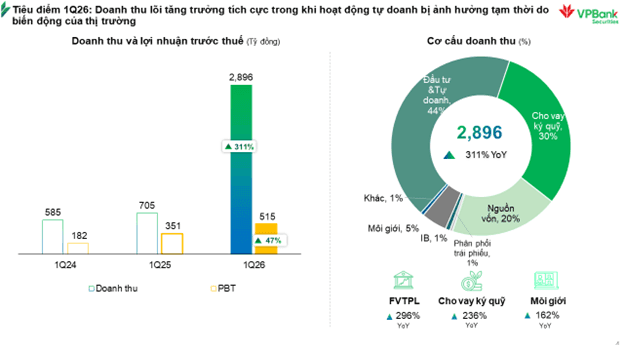
VPBankS said it aims to accelerate growth to achieve a 2026 profit target of more than VND 6.45 trillion. While Q1 2026 results were affected by market volatility and some business lines had not yet recorded revenue as expected, the company maintained its full-year target and expects key growth drivers to become more visible from Q2 onward.
In Q1 2026, the Vietnamese stock market saw sharp volatility amid geopolitical instability and a high interest-rate environment, with the VN-Index declining significantly in March. Management said this pressured investment activity and profit margins for securities firms, including VPBankS.
At the investor meeting and Q1 2026 results release, VPBankS CEO Nhâm Hà Hải stated that Q1 performance was within expectations. The company reiterated that it still targets profit of more than VND 6.45 trillion for 2026 and expects growth drivers to accelerate more clearly from Q2.
VPBankS said margin lending remains its most important growth pillar this year. In Q1 2026, margin loan outstanding reached around VND 38,000 billion, up about VND 4,000 billion from the start of the year. Based on its current trajectory, the company targets margin loan balances of around VND 50,000 billion by the end of 2026.
The bank attributed the outlook to improving market liquidity and the return of retail funds as interest rates stabilize and are expected to ease further by year-end, which it said would create room for margin lending—particularly for securities firms with strong capital and funding capabilities such as VPBankS.
VPBankS also highlighted access to low-cost funding from within the VPBank ecosystem. It previously mobilized large international syndicated loans, which management said provided a financial foundation for expanding margin activities and improving investment efficiency in 2026.
Alongside loan growth, VPBankS is expanding its brokerage presence. After entering the HOSE brokerage top-10 market share in Q4 2025 and maintaining that position in Q1 2026, the company aims to capture about 5% of HOSE’s market share in 2026. Management said expanding its personal client base and increasing trading volume should support margin revenue in the remaining quarters.
In addition to margin lending, VPBankS expects its investment banking (IB) segment to contribute to growth in 2026. Management said revenue from bond issuance advisory is expected to become clearer from Q2 rather than earlier in the year.
VPBankS pointed to a gradual recovery in the corporate-bond market as a factor supporting advisory activity. After restructuring and clarifying the regulatory framework, liquidity conditions improved and demand for corporate fundraising increased. With the corporate client ecosystem from VPBank and strategic partner SMBC, together with its distribution and advisory capabilities, VPBankS said it sees opportunities to expand its share in this segment.
The company targets advisory and distribution on bond issuances of around VND 35 trillion in 2026. However, the CEO indicated that in Q2 there are already expected bond issuances to be advised totaling around VND 60 trillion from large corporations.
“Chúng tôi đang lên kế hoạch triển khai tư vấn, bảo lãnh và phân phối. Doanh thu quý II dự kiến sẽ ghi nhận một lượng lớn phí tư vấn và phân phối từ con số 60.000 tỷ này,” the VPBankS CEO said.
VPBankS also aims to optimize capital-investment efficiency. In Q1, funds mobilized from international syndicated loans totaling USD 200 million and led by SMBC were not fully disbursed because the market did not offer many suitable investment opportunities.
Management said that as new bond supply increases from Q2 and IB activity improves, VPBankS will be able to allocate capital to higher-yield assets. This is expected to support investment income in later quarters and provide additional momentum toward its profit target.
With the convergence of three main engines—margin lending, IB, and capital deployment—VPBankS’ management reiterated that the 2026 profit target of more than VND 6.45 trillion is feasible. In a more favorable market scenario than expected, the company said actual results could exceed the target presented to shareholders.
Premium gym chains are entering a “golden era” that is ending or already in decline, as rising operating costs collide with shifting consumer preferences toward more flexible, community-based ways to exercise. Long-term memberships are shrinking, margins are pressured by higher rents and facility expenses, and competition from smaller, more personalized…