•
•
•
•
•
•
•
•
•
•
•
•
•
•
•
•
•
•
•
•
•
•
•
•
•
•
•
•
•
•
•
•
•


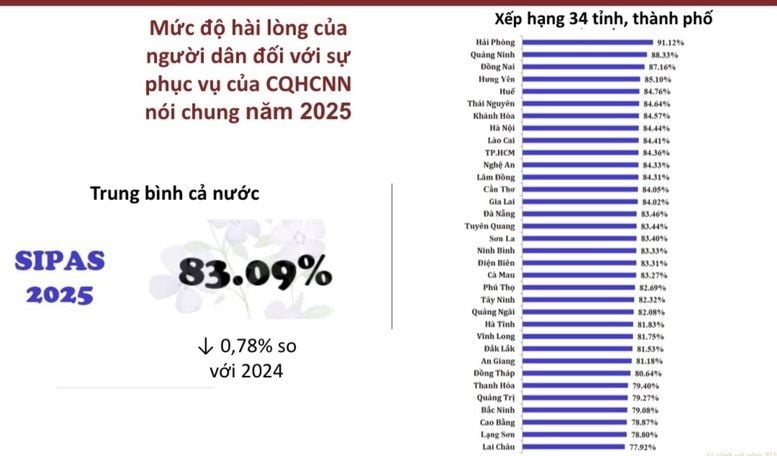
Which localities lead SIPAS 2025 public service satisfaction index? The Ministry of Home Affairs has just published the SIPAS 2025 results evaluating citizens’ satisfaction with the service of state administrative agencies in 2025. SIPAS 2025 achieved 83.09%, a slight decrease from the previous year. In the ranking of 34 provinces and municipalities, Hai Phong, Quang Ninh, and Dong Nai were the top three localities. According to the Ministry of Home Affairs, the SIPAS 2025 measurement was conducted nationwide with 36,000 survey responses from 720 communes/wards across 34 provinces and municipalities; 35,649 valid responses were collected, yielding a validity rate of 99.03%. The SIPAS index is a composite framework comprising 37 indicators reflecting perceptions and evaluations, 51 indicators reflecting the level of satisfaction, and 10 indicators reflecting citizens’ needs and expectations, forming a comprehensive picture of the quality of service provided by state administrative agencies. Overall, citizen satisfaction in 2025 reached 83.09%, down 0.78 percentage points from 2024, though still higher than 2023 by about 0.43%. Specifically, in the policy formulation and implementation area, satisfaction stood at 83.08%, down 0.68%. All sub-components declined modestly, including government accountability at 83.31%; opportunities to participate in policy development and implementation at 82.83%; the quality of policy implementation at 83.11%; and policy outcomes and impact at 83.05%. In the public service delivery domain, satisfaction was 83.11%, down 0.91% from the previous year. The indicators on service access, administrative procedures, civil service, service outcomes, and handling of feedback all declined. For the results across 34 provinces and municipalities, satisfaction levels ranged from 77.92% to 91.12%, with the gap between the highest and lowest localities reaching 13.2%. The three leading localities nationwide are Hai Phong, Quang Ninh, and Dong Nai. Conversely, the three lowest were Lai Chau, Lang Son, and Cao Bang. According to the Ministry, the leading provinces tend to rank high across most evaluation criteria, while the bottom group shows relatively uniform lower satisfaction across many aspects, reflecting systemic limitations in implementation. SIPAS 2025 also identifies several notable bottlenecks in administrative reform. In particular, opportunities for citizen participation and feedback mechanisms remain limited. Satisfaction with opportunities to participate in policy development and implementation stands at 82.83%, down 0.30% from 2024; satisfaction with the Public Administrative Service Center/One-Stop Shop receiving and processing feedback is 82.49%, down 0.92% from 2024. This remains the lowest-satisfaction area and has not shown clear improvement over the years. In addition, although citizen interest in nine policy groups remains high (77.27% to 82.16%), the share of citizens actively contributing policy feedback remains below 50%. In-person feedback at community meetings is the highest at 46.83%, while online feedback is around 10%. Notably, traditional channels still dominate for information access, policy input, and delivery of administrative services. Internet use to access policy information is 39.11%; online policy feedback is 21.18%; online delivery of public services is 29.87%. The survey also recorded that 11.05% of respondents reported some civil servants causing delays in resolving matters; 8.88% reported that people had to pay unofficial fees. While these rates are not large, they occur across all regions and have risen slightly vs. the prior year. Meanwhile, the public’s demand and expectations for service quality improvements remain high, ranging from 86.22% to 88.65%. People particularly want stronger capacities of civil servants; improved handling of feedback; and better facilities and equipment. Remarkably, the level of expectation is relatively uniform across provinces (ranging from 79.38% to 92.91%), signaling a widespread demand for service quality improvements nationwide. According to the Ministry of Home Affairs, SIPAS 2025 results indicate that administrative reform in the next phase should focus on improving implementation capacity at the local level, tightening administrative discipline, narrowing the quality gap of service across regions, and advancing digital transformation with a people-centered approach. At the same time, there is a need to build a more effective two-way feedback mechanism between administrative bodies and citizens to raise service quality and strengthen genuine citizen participation in governance. Source: Nhật Quang. See also Fili. 10:50 12/05/2026
Premium gym chains are entering a “golden era” that is ending or already in decline, as rising operating costs collide with shifting consumer preferences toward more flexible, community-based ways to exercise. Long-term memberships are shrinking, margins are pressured by higher rents and facility expenses, and competition from smaller, more personalized…