•
•
•
•
•
•
•
•
•
•
•
•
•
•
•
•
•
•
•
•
•
•
•
•
•
•
•
•
•
•
•
•
•


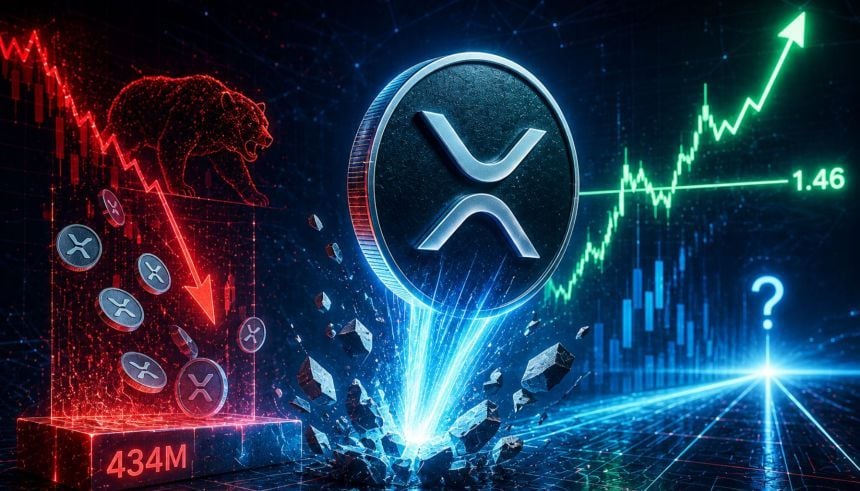
XRP is showing strength as the market recovers from February’s lows, with the price pushing above $1.46 and derivatives activity rebuilding across major exchanges. While the move appears constructive at first glance, a CryptoQuant report highlights a structural divergence in the flow data that complicates a straightforward bullish interpretation.
The open interest picture indicates leverage is increasing. On Binance, XRP open interest rose from approximately 207 million on April 30 to nearly 232 million today, reflecting a notable increase in derivatives positioning over a short period as the price recovers. In general, rising open interest during a price advance can signal strengthening market participation.
However, CryptoQuant’s analysis focuses on what is driving that change. The report points to a divergence between price action, spot demand, and perpetual futures flow—suggesting the market is not telling a single, consistent bullish story.
On Binance, Perpetual CVD has dropped to approximately -$434 million, its lowest current reading, even as open interest continues to climb. With two key metrics moving in opposite directions on the same exchange, the report’s interpretation is that perpetual futures traders are not simply supporting the recovery; they appear to be selling into it or positioning defensively.
CryptoQuant also flags spot activity as weaker than the price action suggests. All CEX Estimated Spot CVD declined to approximately $575 million despite XRP pushing above $1.46. If the rally were driven by broad-based spot accumulation, that figure would be expected to rise alongside the price, but it has not.
The leverage rebuild is not limited to Binance. On May 11, open interest increased by approximately $18 million on Binance, $10.4 million on OKX, and $8.5 million on Bybit—adding a combined $36.9 million across three major venues in a single session. This indicates derivatives participation is expanding across the ecosystem at the same time.
Taken together, the data points form a specific structure: price is rising, leverage is rebuilding, but spot demand is not keeping pace. CryptoQuant frames this combination as more consistent with a derivatives stress test—where the market is probing whether organic demand can validate a move that futures positioning is currently resisting.
Technically, XRP is trading around $1.44 after consolidating above a critical support zone formed following February’s capitulation event. The chart suggests an attempt to transition from stabilization into early recovery, but momentum remains constrained beneath a major resistance cluster.
From the February lows near $1.10, XRP has improved meaningfully. Buyers reclaimed the 50-day moving average and pushed the price back into the $1.40–$1.50 region, which is now described as the key short-term battleground. This area has repeatedly rejected upside attempts since March, indicating active supply when XRP approaches breakout territory.
At the same time, sellers have not produced a meaningful breakdown despite multiple pullbacks. XRP continues printing higher lows from the April bottom, and the short-term moving average is beginning to flatten beneath price, suggesting bearish momentum is weakening gradually rather than accelerating.
Volume also aligns with the consolidation narrative: trading activity remains far below the panic-driven spikes seen during February’s collapse, indicating the market has shifted away from forced liquidation conditions into a more balanced environment.
While the broader structure remains fragile while XRP trades below the 100-day and 200-day moving averages, the report notes that if buyers reclaim and hold above the $1.50 region, the next upside target would likely emerge near $1.65–$1.70.

Premium gym chains are entering a “golden era” that is ending or already in decline, as rising operating costs collide with shifting consumer preferences toward more flexible, community-based ways to exercise. Long-term memberships are shrinking, margins are pressured by higher rents and facility expenses, and competition from smaller, more personalized…