•
•
•
•
•
•
•
•
•
•
•
•
•
•
•
•
•
•
•
•
•
•
•
•
•
•
•
•
•
•
•
•
•


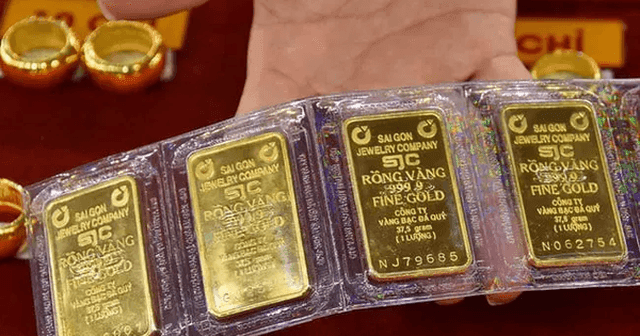
Gold prices in Vietnam reversed higher on March 27, with SJC gold bars and plain gold jewelry moving up by about 1 million VND per tael by 1:34 PM. Internationally, gold edged higher to around 4,465 USD/ounce.
At 1:34 PM on March 27, SJC adjusted the price of gold bars to 168.6–171.6 million VND per tael, up 1 million VND from the morning. The price of plain gold jewelry was also adjusted to 168.4–171.4 million VND per tael.
DOJI similarly increased its quotes by 1 million VND per tael to 168.6–171.6 million VND per tael.
Meanwhile, Bao Tin Minh Chau and Bao Tin Manh Hai kept their quotes unchanged at 167.6–170.6 million VND per tael for both gold bars and plain gold jewelry.
Earlier in the morning of March 27, SJC gold bars and plain jewelry were quoted at 168.5–171.5 million VND per tael at major brands including SJC and DOJI, as well as PNJ. Bao Tin Minh Chau and Bao Tin Manh Hai also quoted 168.5–171.5 million VND per tael for SJC gold bars, while plain gold jewelry was 168.0–171.0 million VND per tael.
On the international market, late trading on March 26 saw gold fall sharply to 4,350 USD/ounce, before recovering slightly. The current spot price was reported at 4,402 USD/ounce, equivalent to about 141 million VND per tael when converted at the bank USD rate, excluding taxes and fees.
Wells Fargo commodity analysts said the latest move in gold reflected a reversal of expectations amid a complex macro environment. The bank cited that higher interest rates, a stronger dollar, and rising real yields outweighed geopolitical risk.
Wells Fargo noted that sharp moves in the U.S. dollar and Treasury yields, along with narrowing expectations for rate cuts, were significant negative factors for gold. The bank added that gold has fallen nearly 22% from its record peak of 5,600 USD/ounce reached at the end of January.
At the time of reporting, spot gold traded around 4,391.50 USD/ounce, down about 2.7% on the day. Wells Fargo said demand for gold as a safe haven weakened after investors reassessed rate expectations and shifted funds to support the dollar.
Despite the near-term weakness, Wells Fargo said it remains distinctly positive on gold in the long term. The bank forecast gold could reach 6,100–6,300 USD/ounce by the end of 2026, supported by ongoing central bank demand and expectations that yields and the dollar will ease in the future.
Analysts also pointed to central bank purchases remaining well above long-term averages, which they said provides structural support for gold.
Looking ahead, Wells Fargo expected the Iran conflict to have limited economic impact, with inflation pressures cooling and U.S. Treasury yields falling by year-end. The bank argued the U.S. is better positioned to absorb energy shocks than in past crises due to structural factors such as a service-based economy, net energy-exporter status, and lower household energy expenditure. It also expected the conflict would not be prolonged, reducing the risk of sustained inflation.
Overall, Wells Fargo said macro conditions remain favorable and that stagflation is not the base case. In this context, the bank viewed recent gold weakness as a tactical opportunity, recommending investors gradually increase positions as the pullback develops.







Premium gym chains are entering a “golden era” that is ending or already in decline, as rising operating costs collide with shifting consumer preferences toward more flexible, community-based ways to exercise. Long-term memberships are shrinking, margins are pressured by higher rents and facility expenses, and competition from smaller, more personalized…




