•
•
•
•
•
•
•
•
•
•
•
•
•
•
•
•
•
•
•
•
•
•
•
•
•
•
•
•
•
•
•
•
•


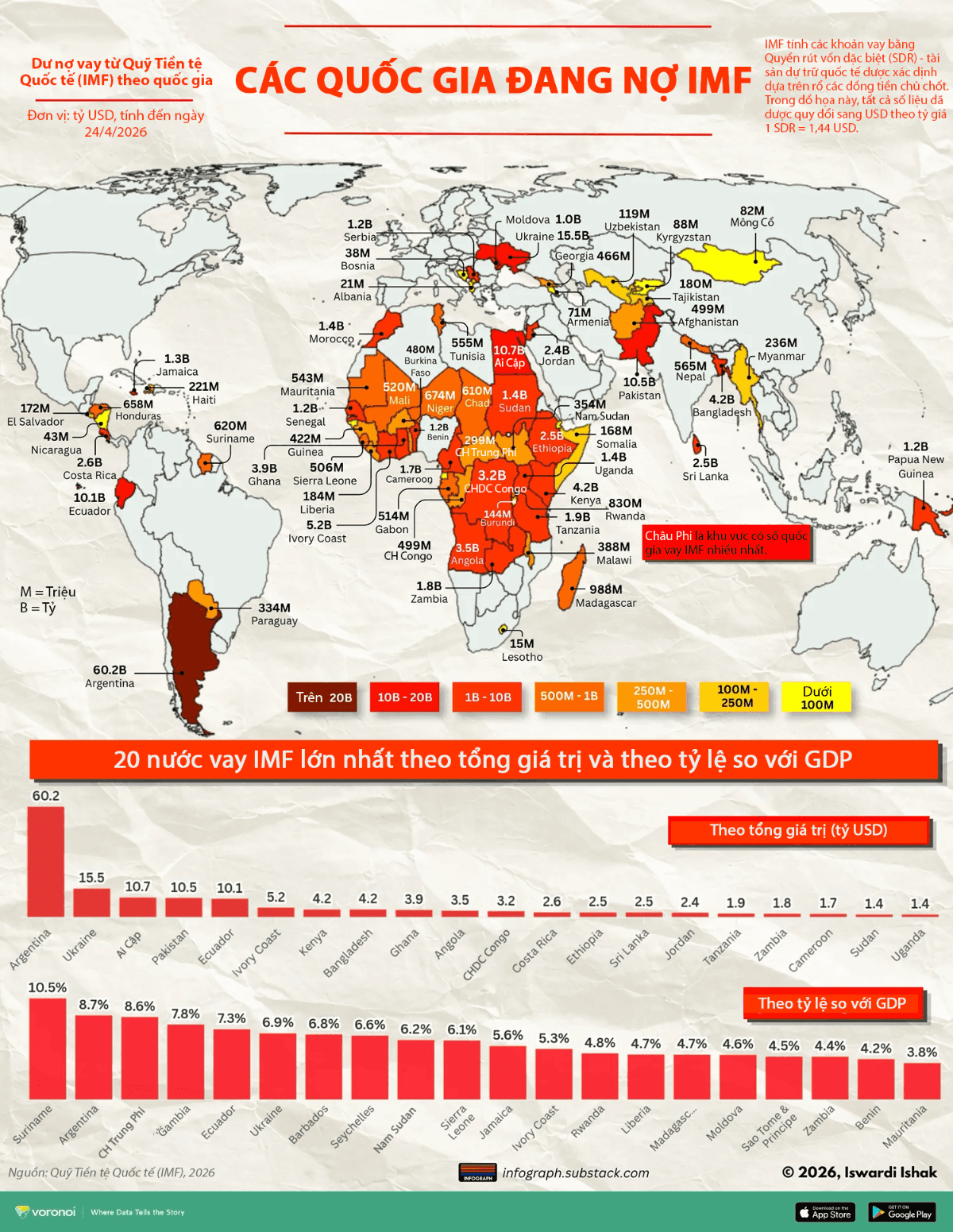
Dozens of countries facing economic pressures and strained public finances continue to rely on support from the International Monetary Fund (IMF). IMF data, as reflected in an infographic covering IMF lending debt across countries as of April 2026, show that borrowing is concentrated in a small number of large cases while many others carry smaller IMF debt positions.
Argentina stands out as the largest IMF borrower by a wide margin. Its IMF debt outstanding is more than $60 billion, nearly four times the amount of the second-largest country, Ukraine. The scale of Argentina’s borrowing reflects decades of repeated crises marked by high inflation, monetary instability, and frequent reliance on IMF-supported programs.
Beyond the top case, the next-largest IMF borrower group includes Ukraine, Egypt, and Pakistan. Many other countries have IMF debt under $1 billion, with these smaller positions concentrated mainly in Africa.
When IMF debt is measured as a share of GDP, Suriname is highlighted as the most notable example. IMF debt in this South American country represents the highest ratio relative to the size of its economy, linked to a severe crisis in the early 2020s.
Suriname defaulted in 2020 after years of weak fiscal management, declining oil revenues, and rising external debt. The default triggered an IMF-supported debt restructuring program intended to stabilize public finances and contain inflation.
The restructuring was accompanied by stringent austerity measures, which also coincided with depreciation of the domestic currency.
Countries commonly seek IMF assistance during economic difficulties, particularly when facing balance of payments crises—situations where governments cannot pay for imports or service foreign debt. Borrowers may also experience currency volatility, such as sharp depreciation of local currencies or dwindling foreign exchange reserves, while others face fiscal imbalances, including large budget deficits and rising public debt.
Argentina is cited as an example of repeated reliance on IMF support during inflation and currency crises.
Unlike conventional loans, IMF lending is denominated in Special Drawing Rights (SDR), an international reserve asset created by the IMF. The SDR value is determined by a basket of major currencies, including the USD, euro, yuan, yen, and pound sterling.
Countries can receive SDR allocations or borrow from the IMF in SDRs, then convert into stronger currencies to meet payment needs. In the infographic, IMF data have been converted to USD using an approximate rate of 1 SDR = 1.44 USD.
Geographically, Africa stands out less for the size of individual IMF loans and more for the number of countries that rely on the institution. The region has the most IMF borrowers, reflecting ongoing external-financing needs tied to long-standing structural issues.
These issues include heavy reliance on basic commodity exports, limited fiscal space, and weak resilience to external shocks. As a result, even when individual IMF borrowing amounts are relatively small, dependence on IMF support is common across the region.
While the IMF can act as a financial safety net during crises, it is also criticized for the policy conditions attached to its lending. Such conditions typically include calls for economic reforms, including austerity measures, which critics say can create significant political and social pressure.
Critics argue that IMF requirements may slow growth or increase inequality in borrower countries. Supporters counter that the adjustments are necessary to restore macroeconomic stability and provide a foundation for long-term growth.





Premium gym chains are entering a “golden era” that is ending or already in decline, as rising operating costs collide with shifting consumer preferences toward more flexible, community-based ways to exercise. Long-term memberships are shrinking, margins are pressured by higher rents and facility expenses, and competition from smaller, more personalized…