•
•
•
•
•
•
•
•
•
•
•
•
•
•
•
•
•
•
•
•
•
•
•
•
•
•
•
•
•
•
•
•
•


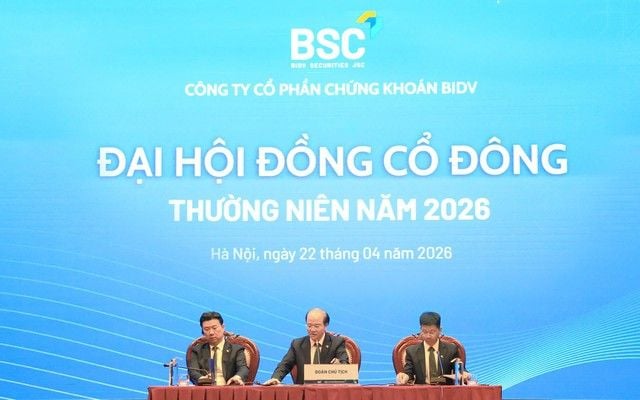
On the morning of April 22, 2026, BIDV Securities Joint Stock Company (BSC) (stock code: BSI) held its 2026 annual general meeting of shareholders (AGM), approving a 2026 pretax profit target of 700 billion dong and a development strategy through 2030 centered on comprehensive digitization and strengthening financial capacity.
Shareholders focused on BSC’s development orientation for 2026–2030, under which the company aims to become a securities firm providing an integrated ecosystem of financial products and services on a single digitized platform. The plan is designed to maximize the value of BSC’s customer ecosystem and strategic shareholders.
The strategy is built on three pillars: Finance, Technology, and Products. BSC said it will prioritize an integrated trading platform embedded in BIDV’s digital ecosystem, while expanding the use of artificial intelligence to personalize the customer experience.
On financial capacity, BSC expects to raise its charter capital to over 11,000 billion dong in the 2026–2027 period to expand operations and strengthen competitiveness.
For the 2026 business plan, the AGM approved a pretax profit target of 700 billion dong and a minimum capital-adequacy ratio (CAR) of 260%. BSC said the growth direction is set on a cautious basis to suit a market environment that may be volatile, with the aim of maintaining operational efficiency and financial safety.
BSC reported that in 2025 it recorded pretax profit of more than 616 billion dong, total assets of over 16,600 billion dong, and equity of 5,500 billion dong.
Regarding shareholder returns, the AGM approved a plan to pay 2025 dividends of 10% in shares. For 2026, BSC plans to maintain a 10% dividend, with the form of payment flexible between cash and stock dividends depending on actual conditions.
The AGM also approved issuing shares to pay dividends at a ratio of 10:1, which is expected to lift charter capital to nearly 2,700 billion dong, supporting the strengthening of financial capacity and providing a base for scaling up in the coming period.
From a governance perspective, the AGM completed the election of the Board of Directors and the Supervisory Board for the 2026–2031 term and approved amendments to the Charter and internal governance regulations.
Shareholders: How does the company view the potential of the stock market when Vietnam officially upgrades to FTSE Secondary Emerging Market in September 2026 and extends to 2027?
Chairman Ngô Văn Dũng: He cited three impacts. First, the FTSE upgrade is a historic event for Vietnam’s stock market, but outcomes depend on market absorption; international experience suggests indices may rise in the run-up period and correct in the short term after the decision takes effect, while sustainable opportunities are expected in the longer-term cycle. Second, foreign capital is expected to enter through both active and passive funds, with passive funds (ETF funds) estimated at 1.3–1.5 billion USD initially and active funds potentially reaching 3–5 billion USD over the long run. Third, the market will gradually “standardize” as international institutional investors participate, which may change market structure such as the retail-to-institutional balance, foreign room, and IPO activity.
Shareholders: Please outline concrete plans to implement the strategy to increase equity.
Vice Chairman Chung Jae Hoon: He said that, under the 2026–2030 strategic development paper, Hana Securities (HSC) and BIDV agreed on the need to increase capital to strengthen BSC’s comprehensive competitive capacity. The Board is coordinating to develop a detailed capital-increase plan, targeting implementation in 2026–2027.
CEO Nguyen Duy Viễn: He said increasing BSC’s capital is “no turning back” because the current scale is modest relative to the market. He noted that the smaller scale limits competitiveness, particularly in entering new business fields such as digital assets, and makes it harder to attract large investors as the market moves toward upgrading. He stated the plan is to double charter capital by 2027, from about 5,500 billion dong to at least 11,000 billion.
Shareholders: Please clarify the digital transformation roadmap and AI deployment in line with the 2026–2030 strategy.
CEO Nguyen Duy Viễn: He said BSC has an advantage through BIDV, a pioneer in digital transformation, supported by Hana Securities’ technology platform. BSC plans to digitalize all products, integrate them on the digital platform, and connect to BIDV’s banking app to leverage customer resources. He added that BSC will intensify AI deployment to improve productivity by combining its existing workforce of about 300 staff with an “AI workforce.” The company formed an AI task force in March and plans to implement it in 2026.
Shareholders: Regarding participation in international financial centers in Ho Chi Minh City and Da Nang, has BSC established a dedicated unit or representation office, and does it plan to have a presence there?
CEO: He said the company is studying and evaluating opportunities and is prepared to implement related plans, including forming a dedicated department or presence at these centers, if and when the business area is determined to be viable.

Premium gym chains are entering a “golden era” that is ending or already in decline, as rising operating costs collide with shifting consumer preferences toward more flexible, community-based ways to exercise. Long-term memberships are shrinking, margins are pressured by higher rents and facility expenses, and competition from smaller, more personalized…