•
•
•
•
•
•
•
•
•
•
•
•
•
•
•
•
•
•
•
•
•
•
•
•
•
•
•
•
•
•
•
•
•


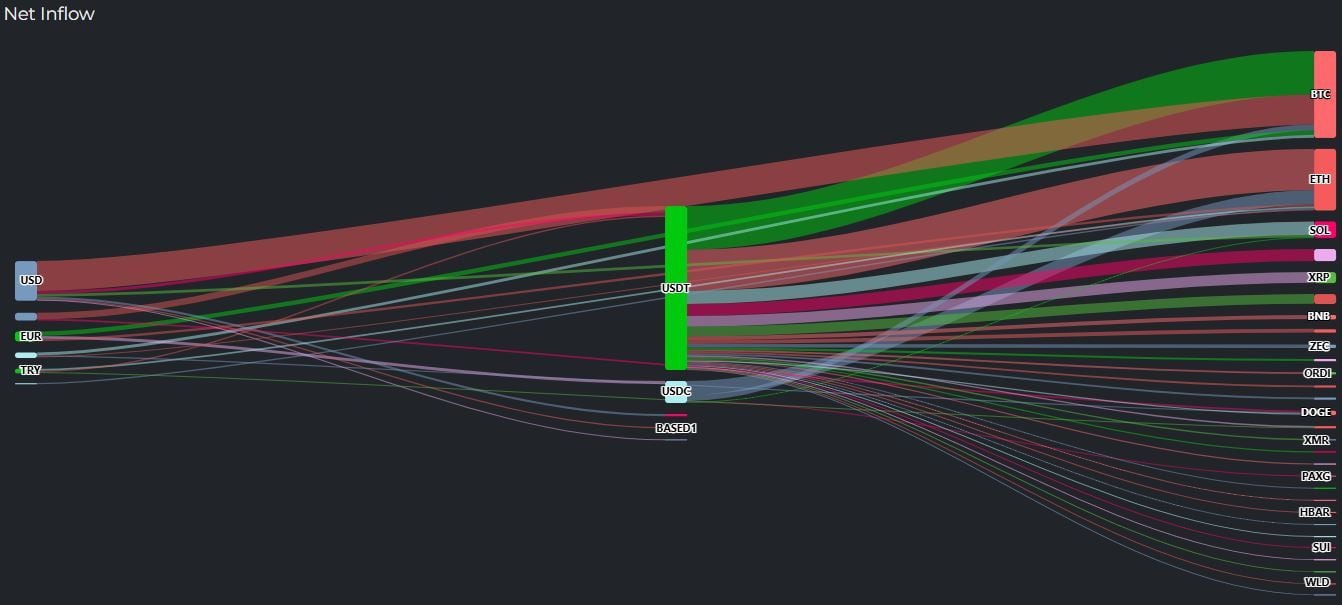
Bitcoin (BTC) led fresh capital inflows into the crypto market on Sunday, even as several smaller tokens faced notable sell pressure—an uneven flow pattern that suggests renewed preference for large-cap liquidity over higher-risk altcoins.
Cryptometer data compiled as of 2:35 p.m. ET on April 20 showed net funds entering the digital asset market over the prior five hours through major fiat channels. The inflows included $13.74 million in U.S. dollars (USD), $3.34 million in euros (EUR), and $1.43 million in Turkish lira (TRY).
A significant portion of that capital—about $56.39 million—shifted into Tether (USDT), underscoring continued reliance on dollar-pegged stablecoins as the primary staging point for crypto allocation.
From there, USDT and USD Coin (USDC) were redistributed across leading cryptocurrencies. Cryptometer’s flow breakdown showed BTC attracting the largest single inflow at $29.81 million, followed by Ethereum (ETH) with $21.24 million.
Solana (SOL) added $5.78 million in net inflows, while XRP drew $3.69 million. The distribution indicates buying interest concentrated in highly liquid assets that can absorb directional positioning during periods of macro or market uncertainty.
On the outflow side, the same five-hour window showed heavy selling pressure in several tokens. OFC recorded the largest outflow at $28.35 million, while BETH saw $5.94 million exit.
PIEVERSE and Aave (AAVE) also posted outflows of $4.25 million and $2.43 million, respectively. The divergence—major-cap inflows alongside sharp outflows in select altcoins—often points to rotation rather than a broad, uniform risk-on move.
Stablecoins also acted as a defensive parking place during the period, with $35.33 million flowing into USDT and $9.92 million into USDC.
Ethereum showed a mixed pattern: around $8.44 million moved into ETH before much of it appeared to rotate back into cash, suggesting short-duration positioning rather than sustained accumulation.
Cryptometer’s data also indicated active conversion back to fiat, with roughly $20.14 million moving into USD and $11.89 million into South Korean won (KRW). This cash-out activity, alongside stablecoin accumulation, suggests traders are keeping short-term optionality high—deploying capital into BTC and other large caps while reducing exposure to more volatile alt assets.
Overall, the latest flow snapshot reinforces a recurring dynamic: when capital returns to the market, it often enters through stablecoins and concentrates in benchmark assets first, leaving parts of the altcoin market vulnerable to abrupt liquidity-driven selloffs.




Premium gym chains are entering a “golden era” that is ending or already in decline, as rising operating costs collide with shifting consumer preferences toward more flexible, community-based ways to exercise. Long-term memberships are shrinking, margins are pressured by higher rents and facility expenses, and competition from smaller, more personalized…