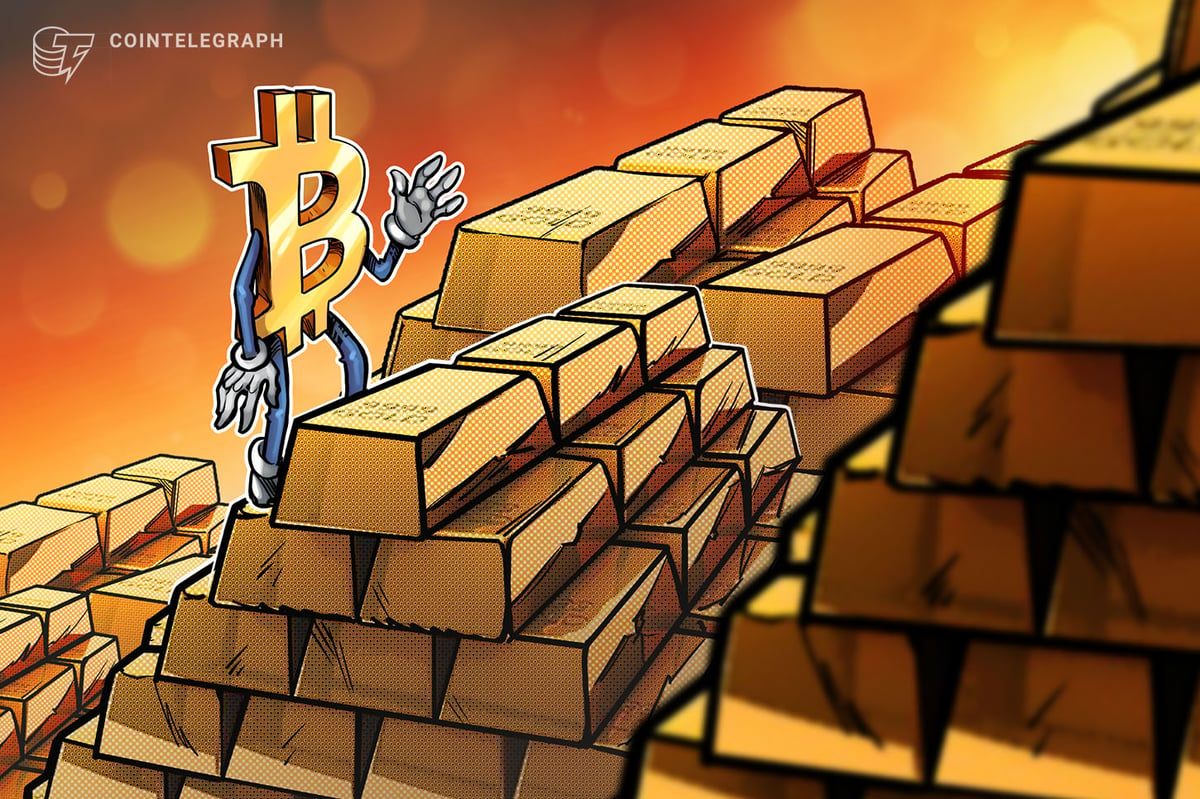
Before the Iran war broke out, Bitcoin spent months trading sideways while gold rallied to record levels. At the time, gold was widely viewed as the go-to safe haven as inflation concerns persisted and geopolitical tensions built, while Bitcoin failed to demonstrate similar defensive characteristics.
Nearly a month after the US and Israel launched the first strikes on Iran on Feb. 28, that narrative is being challenged. Bitcoin initially fell to $63,176 on the news of the attacks, but has since risen about 12% to $71,012 as of Wednesday.
Gold, meanwhile, has been pressured by rising oil prices and renewed inflation fears. It fell 11% last week, marking its largest weekly loss since 1983.
Jonatan Randin, a senior market analyst at PrimeXBT, said Bitcoin continues to behave like a risk asset rather than a safe haven. In his view, it sells off alongside equities during geopolitical shocks.
“It’s range-bound and showing weakness within a broader downtrend. That’s not safe haven behavior,” Randin said.
Matthew Pinnock, co-founder of decentralized finance project Altura, said global liquidity remains the dominant driver of Bitcoin’s price, with macro conditions outweighing headline-driven volatility.
Pinnock described Bitcoin as trading like a “high-beta liquidity asset,” where tighter financial conditions—such as higher real yields, a strong dollar, and weaker exchange-traded fund inflows—reduce marginal capital and pressure prices.
A September 2024 analysis compiled by Sam Callahan of OranjeBTC found Bitcoin’s price had a 0.94 correlation with global liquidity between May 2013 and July 2024. The same analysis also showed Bitcoin moved in the same direction as global M2 in 83% of 12-month periods, compared with gold’s 68.1%. The closest directional alignment after Bitcoin was the S&P 500 index, a benchmark for US large-cap equities and a commonly cited risk-asset proxy.
Randin said more recent data reflected a similar pattern, pointing to global liquidity rising in the third quarter of 2025, around the time Bitcoin reached a new all-time high.
Near-term inflation concerns have shaped market expectations since the conflict began, driven by rising oil prices and supply disruptions after the closure of the Strait of Hormuz, a key shipping route.
Randin said inflation concerns tied to geopolitical shocks tend to work against Bitcoin in the short term. Higher oil prices can feed into inflation expectations, reduce the likelihood of rate cuts, and keep real yields elevated—tightening financial conditions and suppressing risk appetite, which limits demand for assets like Bitcoin.
“In that sense, Bitcoin is not reacting to inflation itself, but to the policy response that follows,” Randin said.
He pointed to the Iran conflict pushing oil prices above $110, alongside the Federal Reserve raising its 2026 personal consumption expenditures inflation forecast to 2.7% and signaling a more cautious easing path. He also noted that a Tuesday announcement by Trump to pause Iran strikes pulled Brent crude oil prices down.
Randin said Bitcoin may be better understood as a long-term monetary debasement hedge rather than a short-term inflation hedge. “It responds to the expansion of money supply over multi-year cycles, not to CPI prints. On the timescale of a war-driven oil shock, it still behaves like the risk asset it is.”
Bitcoin’s behavior during the Iran conflict still aligns with a risk asset profile. Each escalation has triggered selloffs, liquidation cascades, and tighter correlation with equities, even though Bitcoin has held up better than traditional assets over certain periods.
Randin said Bitcoin entered the conflict already in a technical bear market, down more than 40% from its October highs and ahead of equities in pricing deteriorating conditions. “So while it has held up relatively well since the strikes began, outperforming the S&P 500, gold and silver over certain windows, it hasn’t given us any meaningful directional move.”
He added that a structural shift would require a clear break from that pattern, and that such signals have yet to appear.
Onchain indicators, however, suggest a different undercurrent. Continued accumulation, declining exchange reserves, and growing holdings among large wallets point to positioning building, even if price action has not reflected it.
Pinnock said the positioning is still constrained by macro conditions. “Right now, inflation driven by a hike in oil prices due to geopolitical factors is pushing yields higher and keeping central banks hawkish, which tightens liquidity. That creates a ‘bad inflation’ regime where BTC falls alongside other risk assets,” he said.
He added that the inflation hedge thesis breaks because Bitcoin responds more to monetary expansion than to inflation itself, and that current conditions are restrictive rather than stimulative.
Until liquidity conditions ease and Bitcoin decouples from equities during stress events, its role as a safe haven remains unproven.