•
•
•
•
•
•
•
•
•
•
•
•
•
•
•
•
•
•
•
•
•
•
•
•
•
•
•
•
•
•
•
•
•
The cryptocurrency market traded in a mixed range on Sunday, with major assets posting modest gains even as broader activity indicators—particularly in stablecoins, DeFi and derivatives—showed a sharp cooling in 24-hour volumes.
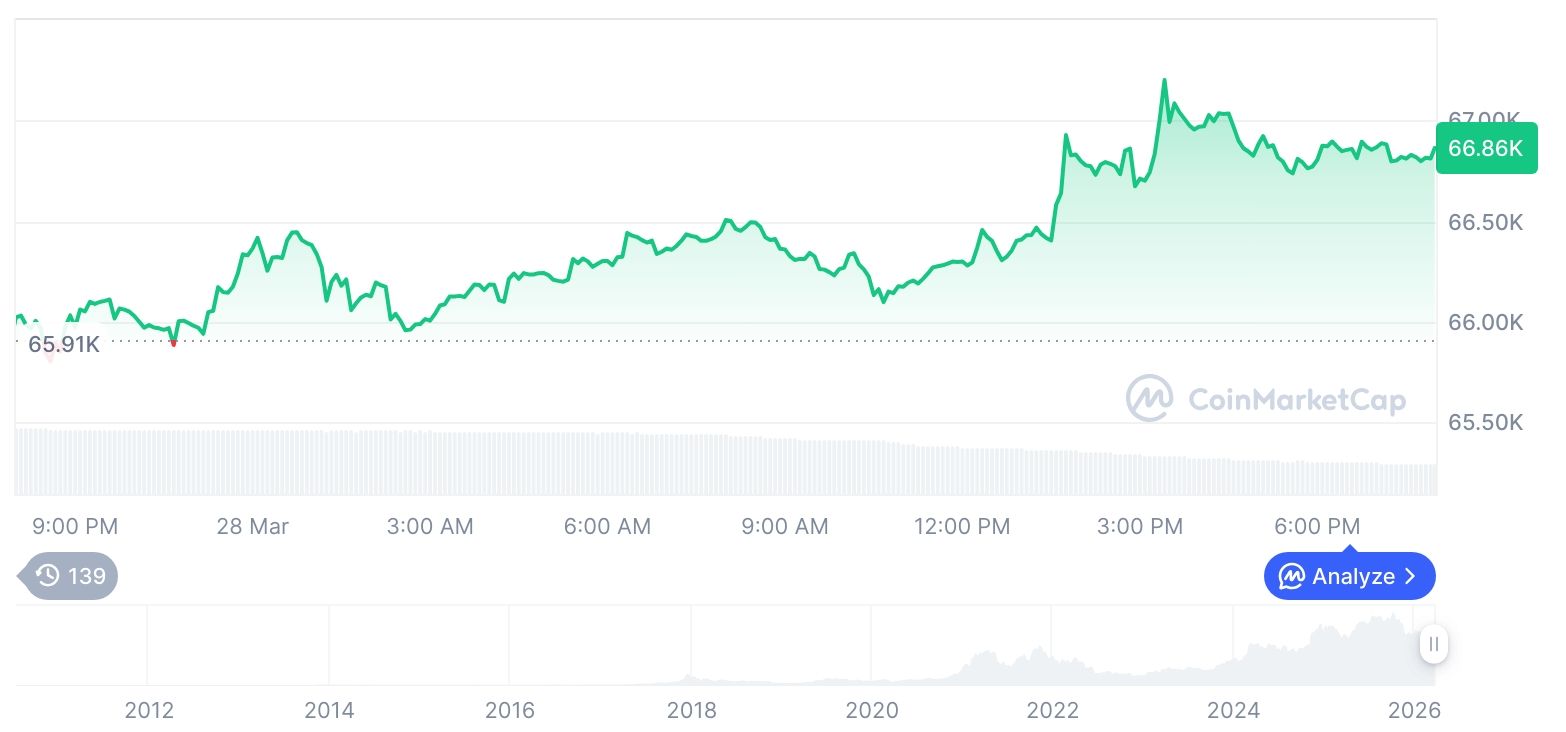
Bitcoin (BTC) was changing hands at $66,831, up 1.26% over the previous day as of Sunday UTC. Ethereum (ETH) rose 1.35% to $2,018. While spot prices edged higher, participation metrics suggested reduced turnover across key trading venues.
Large-cap altcoins also leaned positive. XRP gained 1.41%, BNB added 1.02%, and Solana (SOL) climbed 0.56%, pointing to incremental bid support across the upper tier rather than a broad-based rotation into higher-beta tokens.
Total crypto market capitalization stood at approximately $2.31 trillion, while aggregate 24-hour trading volume was about $55.1 billion. Bitcoin’s market dominance ticked up to 57.87% (a 0.01 percentage-point increase), and Ethereum’s share rose to 10.54% (also up 0.01 percentage point). The small dominance changes suggest the day’s advance was broadly in line with the overall market rather than driven by a major shift into or away from the largest assets.
Sector-level flows were less energetic. The DeFi market’s total capitalization was estimated at roughly $58.1 billion, while 24-hour DeFi trading volume fell 34.40% to about $6.11 billion.
Stablecoins held a combined market capitalization near $288.5 billion, but their 24-hour volume dropped 48.44% to approximately $53.9 billion. The decline in stablecoin turnover was notable given stablecoins are often used as a proxy for on-exchange liquidity and risk transfer.
Derivatives activity also retreated. Total 24-hour crypto derivatives volume was reported at around $448.5 billion, down 46.32% from the previous day. This pointed to easing leveraged positioning and short-term hedging demand even as spot prices pushed higher.
Overall, the session reflected modest upside in benchmark tokens alongside slowing transaction intensity. The pattern can indicate tentative conviction, with traders watching whether rising prices can be supported by renewed liquidity inflow and broader participation.