•
•
•
•
•
•
•
•
•
•
•
•
•
•
•
•
•
•
•
•
•
•
•
•
•
•
•
•
•
•
•
•
•


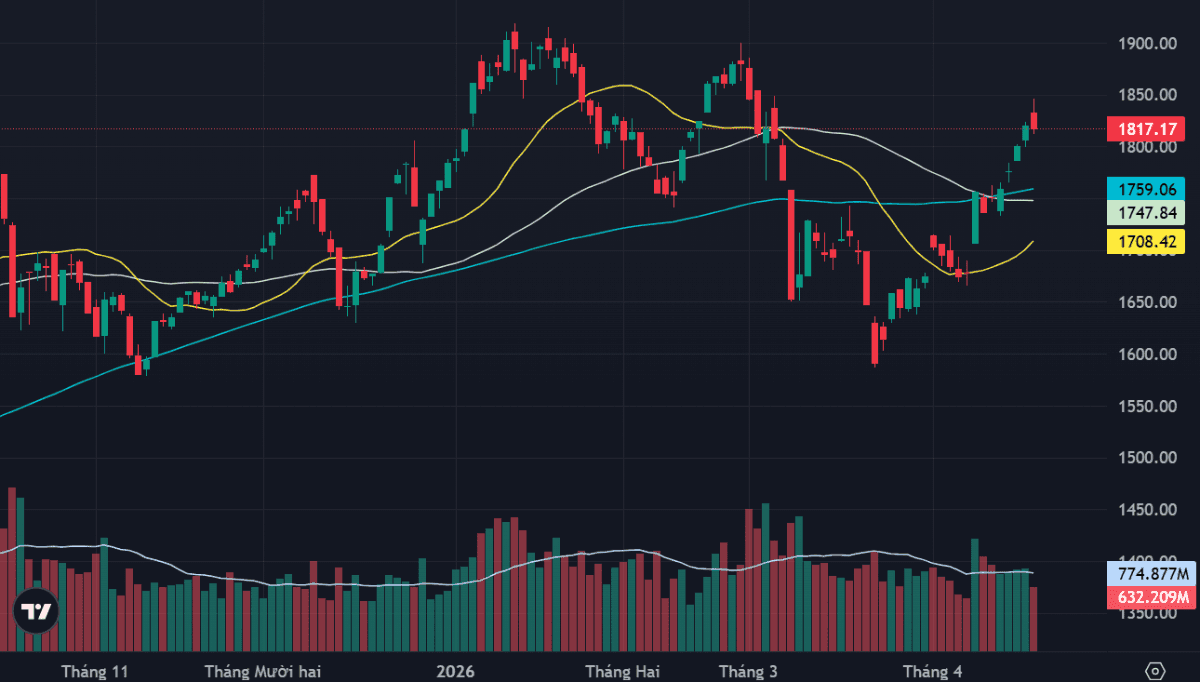
The Vin group stocks weighed on sentiment this afternoon, immediately dampening the VN-Index’s upside momentum. While several other blue chips were in positive territory, they were not enough to offset the Vin-related weakness. Market dispersion pointed to selective liquidity rather than broad-based panic.
The VN-Index closed Friday down 0.15%, equivalent to 2.66 points. As of 1:30 p.m., the index was still up more than 17 points, but the late slide was heavily influenced by VIC and VHM.
VIC surged earlier in the session to a new all-time high, up as much as 5.65%. After a rally of more than 57% from the March bottom and especially following two consecutive limit-up days, profit-taking emerged. In the first hour, VIC fell 0.95% from the reference before rebounding. At 1:32 p.m., it rebounded to a peak of about 3.01% above the reference, but then slid for the remainder of the session. VIC closed down 0.74%, with an intraday movement reaching as much as -6.05%.
VHM underperformed VIC in recent days, but its rebound from the March bottom was as high as 62%. VHM retraced toward its historical high early on, then moved similarly to VIC, declining continuously. However, VHM did not recover as VIC did; at 1:32 p.m., when VIC reached its peak, VHM was still down 2.2%. VHM closed down 5.17%, becoming the day’s biggest drag on points.
All Vin group stocks fell today except VIC and VHM. VPL fell 3.83% and VRE fell 3.38%. Despite the Vin weakness, the rest of the VN30 basket performed relatively well, with breadth at 19 gainers to 10 decliners. The best performers included MWG up 6.89%, GVR up 4.04%, FPT up 2.56%, VPB up 2.36%, GAS up 2.17%, PLX up 2.17%, and MSN up 1.92%. Among these, only GAS and VPB are in the top 10 by market capitalization.
The VN30-Index closed higher by 0.45%, modestly below its intraday high of +1.51%. Even so, the index reflected “pillar support” around the VN-Index.
A key positive sign was that market breadth did not weaken much as VIC and VHM fell. At 1:32 p.m., when the two pillars recovered the most, HOSE recorded 168 gainers and 120 decliners. By the close, breadth was fairly balanced with 178 gainers and 146 decliners. This suggests the market maintained dispersion despite pressure from large-cap stocks.
Liquidity showed pronounced differentiation. Even with the late weakness, 70 stocks closed up at least 1% versus the reference, better than the previous day (46 stocks rose when the VN-Index gained more than 19 points). The VN30 basket accounted for 10 of these names, with MWG and MSN showing exceptionally high liquidity in the trillions of dong per stock. FPT, VPB, and TCB were also among the top-liquidity names.
Large trades in these stocks helped VN30 liquidity rise about 1.4% versus yesterday, while total HOSE matched-value trading fell 9%. The liquidity share of the VN30 group increased to 60.9%, the highest in six weeks.
In the Midcap group, the overall basket remained mixed, with the representative index down 0.11% on 32 gainers and 29 decliners. Notable gainers included VPI up 3.56% on 302.3 billion dong traded, BSR up 3.49% on 274.7 billion, DCM up 2.02% on 176.9 billion, DGW up 1.66% on 174 billion, PNJ up 1.93% on 156.7 billion, GMD up 1.36% on 114.5 billion, and VCG up 1.14% on 105.7 billion.
On the decline side, pressure was meaningful, with 15 stocks down more than 1% alongside liquidity above 100 billion. VHM led the declines as profit-taking pushed liquidity toward nearly 1.296 trillion dong, the highest in 11 sessions when counting only matched trades. Other notable decliners included SHB down 1.61% on 1,007 billion, SSI down 1.04% on 536 billion, VRE down 3.38% on 209.3 billion.
Overall, the market showed high dispersion in both the gainers/decliners ratio and volatility intensity, which is viewed as a positive signal in the context of VN-Index instability driven by large-cap impact. Liquidity fell about 9% across the two listed exchanges on a matched-trade basis, with larger declines among mid- and small-cap stocks. This partly indicates that speculative activity has cooled.






Premium gym chains are entering a “golden era” that is ending or already in decline, as rising operating costs collide with shifting consumer preferences toward more flexible, community-based ways to exercise. Long-term memberships are shrinking, margins are pressured by higher rents and facility expenses, and competition from smaller, more personalized…