•
•
•
•
•
•
•
•
•
•
•
•
•
•
•
•
•
•
•
•
•
•
•
•
•
•
•
•
•
•
•
•
•


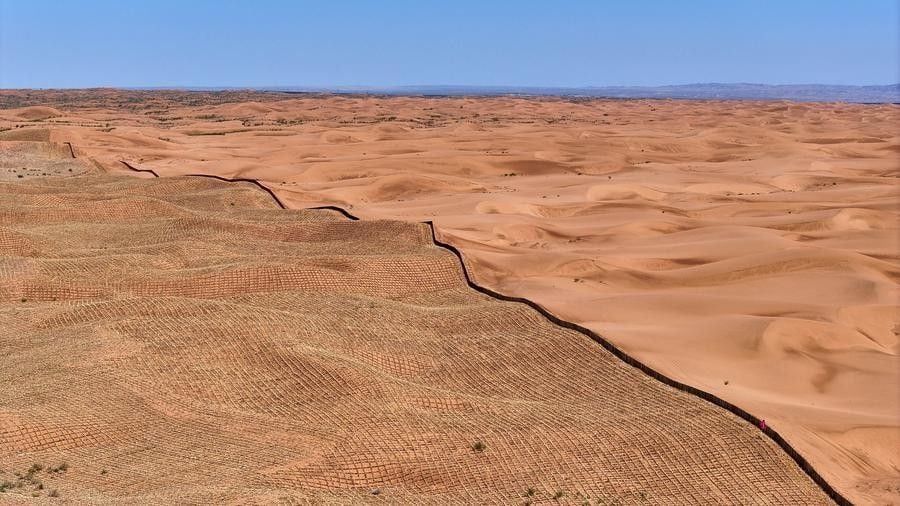
Along the southeastern edge of the Tengger Desert, workers are deploying a sand-control method that uses straw bound into lattice grids. Straw bundles are tied into cords and pressed into the surface to create a large checkered grid, which reduces near-surface wind speeds, preserves moisture, and stabilizes sand particles—helping prevent dune movement.
According to Tang Ximing, a forestry engineer in Zhongwei, Ningxia Hui Autonomous Region, the technology has been significantly improved. “We are using a newer grass-netting variety, which requires less labor, is installed faster, and can maintain effectiveness for 5–6 years, longer than traditional methods,” he said. Tang added that the upgrade helps reduce costs and supports wider replication.
Ningxia, located deep in China’s northwest and surrounded by desert on three sides, has Zhongwei as a key protective zone where the Tengger Desert has repeatedly threatened to push southeast, affecting residents and economic infrastructure.
As early as the 1950s, China applied the “straw lattice” technique in the region to protect the Baotou–Lanzhou railway—the first rail line to cross the desert—from sand burial. The method helped keep transportation operations running and later supported broader desert-control programs. After decades of efforts, Ningxia became the first provincial-region in China to reverse desertification.
The straw-lattice work is part of China’s wider response to desertification, concentrated in the western, northern, and eastern regions known as the Three-North. In 1978, China launched the Three-North Shelterbelt Program, described as the world’s largest afforestation project, aiming to build a “green wall” to curb desert spread, protect cropland, and improve ecological conditions.
After decades of implementation, China reports that about 53% of degraded land is under effective management. The country also accounts for roughly 25% of the world’s new green coverage in recent years.
China’s anti-desertification efforts are also tied to economic development through “sand economy” models that add value. In Inner Mongolia, by-products from pruning windbreaks are used to produce biomass fuel. After processing, grinding, and pelleting, the fuel achieves calorific value comparable to coal but at lower cost and with substantially lower emissions. A plant representative said the facility processes more than 36 tons of input daily and produces over 30 tons of biomass pellets, supporting local employment, particularly for farmers and herders.
In Ningxia, desert tourism and solar-energy development are turning arid lands into stable income sources. In Gansu, desert-adjacent farmers are growing drought-tolerant crops, forming more than 100 related enterprises and production bases and creating a new value chain based on local natural conditions.
China is also sharing its desertification-control experience internationally. As a signatory to the United Nations Convention to Combat Desertification (UNCCD), China exports technological solutions, management models, and practical know-how to other regions.
In Almaty, quinoa varieties developed by Ningxia agribusiness firms are planned for cultivation on saline-alkali soils. Wu Xiarui, chairperson of an agro-tech company in Ningxia, said trials that began in 2018 have produced positive results.
Wu added that the project increases soil fertility, improves land-use efficiency, and reduces irrigation water by more than 30% and fertilizer use by 15–30%. The company is expanding cooperation with Belt and Road Initiative countries including Uzbekistan and Egypt to build an integrated model combining technology transfer, ecological restoration, and local industrial development.
Earlier this month, a one-week international training program on desertification prevention organized by the UNCCD Secretariat was held in Ningxia. It included 34 trainees from 18 countries, including Mongolia, Korea, and India. The article also notes that China trains nearly 100 desertification specialists each year from developing countries in Asia, Africa, and Latin America.
China’s experience is being applied in multiple regions. In Mongolia, Chinese experts have supported a billion-tree initiative planned for 2030. In Saudi Arabia, a model combining solar power with stabilizing sand has been applied. In the southern Sahara, lessons from the Three-North program are being used through the Great Green Wall initiative.
Feng Zhanwen, head of the China–Central Asia Desertification Cooperation Center, said the technologies have value beyond national borders. “There is only one Earth. Desertification technologies do not belong to China alone but are a global asset,” he emphasized. The center plans three field projects in Central Asian countries this year and will conduct two technical training courses to further expand international cooperation.
In the context of climate change and worsening land degradation globally, the article concludes that China’s approach—combining ecological solutions, technology, and economic development—offers a more sustainable path for desertification control.




Premium gym chains are entering a “golden era” that is ending or already in decline, as rising operating costs collide with shifting consumer preferences toward more flexible, community-based ways to exercise. Long-term memberships are shrinking, margins are pressured by higher rents and facility expenses, and competition from smaller, more personalized…