•
•
•
•
•
•
•
•
•
•
•
•
•
•
•
•
•
•
•
•
•
•
•
•
•
•
•
•
•
•
•
•
•


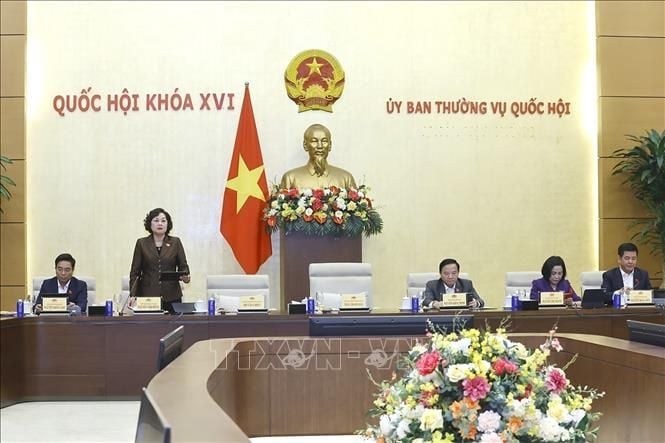
On the morning of April 20, at the National Assembly House, the Standing Committee of the National Assembly discussed draft amendments to several provisions of the Personal Income Tax Law, the Value-Added Tax Law, the Corporate Income Tax Law and the Special Consumption Tax Law. Finance Minister Ngo Van Tuan presented the Government’s report.
For personal income tax and value-added tax for households and individuals engaged in business, the minister said that, based on impact assessment, the draft amendments aim not to specify a concrete threshold for personal income tax. Instead, they would assign the Government the authority to define the threshold for VAT exemption for households and individuals engaged in business in the law.
For the Corporate Income Tax Law, the draft amendments would add an exemption threshold for corporate income tax and assign the Government to specify this threshold, as well as provide details on exemptions in accordance with the authority conferred by Clause 15, Article 4 of Law No. 67/2025/QH15.
According to Minister Ngo Van Tuan, the provisions are intended to support households, individuals engaged in business, and small enterprises to develop production and business activities. They also aim to ensure equity in income tax policy between households/individuals engaged in business and small-scale enterprises, while encouraging households and individuals to transition to corporate forms.
The minister also said devolving authority to the Government would create a legal basis for flexible management of fiscal policy, including tax policy, and would institutionalize content set out in Conclusion No. 18-KL/TW and Resolution No. 66-NQ/TW, as well as provisions in the National Assembly’s Organization Law and similar regulations that assign taxation powers to the Government.
Regarding special consumption tax on electric vehicles powered by battery with under-24 seats, the draft amendments would extend the current policy through the end of 2030.
The Economic and Financial Committees’ appraisal notes that most opinions within the Standing Committee support the direction to add an exemption for small-scale enterprises. The aim is to ensure fairness in applying tax policy between small businesses and households/individual traders, and to facilitate households’ transition to corporate forms, contributing to the goals set out in Resolution 68-NQ/TW.
To ensure the quality of the bill and consistency when presenting to the National Assembly, Deputy Speaker Nguyen Thi Hong suggested that the Government provide clarifications and substantiate the dynamic elements to be decided by the Government based on economic and social conditions. These include the threshold for personal income tax, the VAT exemption threshold for households/individuals, and the corporate income tax exemption threshold.
The Standing Committee called for careful review of the extension timing and the application of special consumption tax on electric vehicles, ensuring policy objectives and balanced interests. It also requested review of effective dates and the implementation timeline for personal income tax, value-added tax, and corporate income tax to ensure consistency, prevent disputes, and improve feasibility in implementation.

Premium gym chains are entering a “golden era” that is ending or already in decline, as rising operating costs collide with shifting consumer preferences toward more flexible, community-based ways to exercise. Long-term memberships are shrinking, margins are pressured by higher rents and facility expenses, and competition from smaller, more personalized…